We know 80% of prospects prefer email, but getting a good cold email response rate is harder than ever. You can’t just throw a few paragraphs together and hit send. So, how do you stand out? It’s not about a massive strategy change. It’s about small, smart adjustments to your cold email outreach sequence that lead to much better email reply rates. This guide is full of those simple, effective tweaks you can use right away to get more replies and build your pipeline.
Consider that most people receive over 140 emails every day. Your cold emails (especially!) need to cut through the clutter and engage the recipients right away. After all, if you can’t get prospects to open, read, and respond to your emails, you can’t progress them down the sales funnel! Here are some proven strategies to increase your cold email response rates:
Understanding Cold Email Response Rates
Before you can improve your cold email performance, you need a baseline. Setting realistic goals is key to building a sustainable outreach strategy and keeping your team motivated. While every campaign is different, industry data gives us a solid starting point for what to expect. It’s important to remember that these numbers are benchmarks, not unbreakable rules. Your specific industry, the quality of your prospect list, and the relevance of your offer will all play a significant role in your results. Think of these metrics as a compass to guide your efforts and help you identify areas where you can refine your approach for better engagement.
What is a Good Cold Email Response Rate?
So, what number should you be aiming for? Generally, a good cold email response rate falls somewhere between 1% and 5%. While that might sound low, it’s a realistic starting point for outreach to a completely cold audience. Of course, top-performing campaigns can see much higher numbers. Highly targeted B2B outreach can achieve response rates between 5% and 15%, and some elite campaigns even break the 10% barrier. According to an analysis of over 20 million emails by Woodpecker, the average response rate hovers in this range, confirming that getting a reply from a cold prospect is a tough but achievable goal. The key takeaway is that success hinges on precision targeting and compelling messaging.
Industry Benchmarks for Success
One of the most significant factors influencing your reply rate is personalization. Generic, one-size-fits-all emails simply don’t cut it anymore. Data shows that emails with advanced personalization can earn a 17% reply rate, while those with little to no personalization see that number drop to just 7%. This demonstrates that taking the time to research your prospect and tailor your message to their specific needs or pain points pays off. Manually personalizing every single email isn’t always feasible, which is where AI-powered workflows can help you scale your efforts effectively without sacrificing that crucial human touch.
Context Matters: Warm vs. Cold Leads
It’s also essential to distinguish between warm and cold leads when evaluating your success. A warm lead—someone who has already engaged with your brand in some way—will naturally have a much higher response rate. For truly cold emails sent to prospects who have never heard of you, expectations should be adjusted accordingly. As one user on Wall Street Oasis noted, getting just one or two replies for every 20-30 emails sent (around a 5% response rate) is considered normal in this context. Setting this realistic expectation helps prevent discouragement and allows you to focus on the long-term process of building relationships from a cold start.
Key Metrics Beyond Response Rate
While the reply rate often gets all the attention, it’s only one piece of the puzzle. To get a complete picture of your campaign’s health, you need to track a few other key metrics. These indicators can help you diagnose problems early on. For instance, if your open rates are low, your subject lines might need work. If open rates are high but reply rates are low, the issue likely lies within your email body. Looking at these metrics together allows you to make targeted adjustments instead of guessing what’s wrong with your overall strategy.
Average Open Rates
Your open rate is the first hurdle you need to clear. If no one opens your email, nothing else matters. The average open rate for cold email campaigns is around 53%, but highly effective campaigns can see that number climb as high as 90%. This metric is heavily influenced by your subject line, the preview text, and your sender’s reputation. A compelling, curiosity-inducing subject line can make all the difference in convincing a busy professional to click. Consistently high open rates are a sign that you’re successfully capturing your audience’s initial attention.
Effort vs. Reward: Setting Realistic Expectations
You might see some sources claim an average cold email reply rate of 8.5%, but many sales experts find that to be an optimistic figure. As sales leader Chris Orlob points out, the reality for most campaigns is closer to 1% or 2%. Achieving a reply rate above 3% is often considered a solid performance. This isn’t meant to be discouraging; rather, it highlights the persistence required in cold outreach. Success isn’t about one perfect email but about a consistent, optimized process of testing, learning, and refining your approach over time.
Keeping Your Unsubscribe Rate Low
Finally, keep a close eye on your unsubscribe rate. This metric tells you how many people are actively opting out of your communications. Ideally, you want to keep this number below 2%. A high unsubscribe rate can be a red flag that your targeting is off, your messaging isn’t resonating, or you’re emailing too frequently. More importantly, it can damage your sender’s reputation and increase the likelihood of your emails landing in the spam folder. Maintaining a healthy, engaged list is just as important as getting replies.
1: Write Subject Lines That Get Opened
Did you know that over 40% of recipients decide whether to open an email based on the subject line alone?
The most effective email subject lines are creative, compelling, and informative. They’re relevant and pique the recipients’ interest without giving away too much. Also, mentioning the recipients’ names or specific information can increase open and response rates.
Here are some proven cold email subject line formulas:
- Question About [ Goal/Challenges]
- [ Mutual Connection] Recommended To Connect
- Hi [ Name], [ a Relevant Question]?
- Can I Help With [ Problem Your Products Solve]
- # Tips For [ Pain Point]
- [ Benefits] for [ Prospect’s Company]
The Ideal Subject Line Length
When it comes to subject lines, length absolutely matters. You want to be concise enough to be read easily on a mobile device but descriptive enough to spark curiosity. So, what’s the sweet spot? Research shows that subject lines with 6 to 10 words tend to have the highest open rate. This length gives you enough room to be specific and compelling without getting cut off in the recipient’s inbox preview. It’s about respecting their time and showing that you can get straight to the point. A subject line that’s too long can feel overwhelming, while one that’s too short might be vague and get overlooked as spam.
Start with an Action Verb
Think of your subject line as a tiny call to action. Its job is to get the reader to perform one simple action: open the email. A great way to do this is to start the subject line with a verb. Using an action word immediately frames the email’s purpose and creates a sense of momentum. For example, instead of “Question about your sales process,” try “Improving your sales process.” This small change shifts the focus from a passive query to an active benefit for the prospect. It helps your email stand out by communicating value and intent right from the start, making it much more likely to be opened.
2: Personalize Your Pitch (The Right Way)
If you want to cut through the inbox clutter, your email can’t be generic. At the very least, make sure you’re addressing recipients by their names, i.e., “Hi [ Name],” instead of “Hi.”
You can also integrate LinkedIn Sales Navigator or your CRM system with your email interface so you can reference each prospect’s information and personalize your content to speak to their unique challenges and priorities.
In addition, you could use LinkedIn scraping solutions to export valid email addresses directly from LinkedIn for your cold email outreach.
The good news is that personalization doesn’t mean you have to spend hours crafting each individual email. You can use email templates to leverage content that works so you can personalize outbound emails at scale. What if you don’t know whom to contact in an organization? Instead of sending a generic email, inquire about the right person to contact so you can look up his/her information before reaching out.
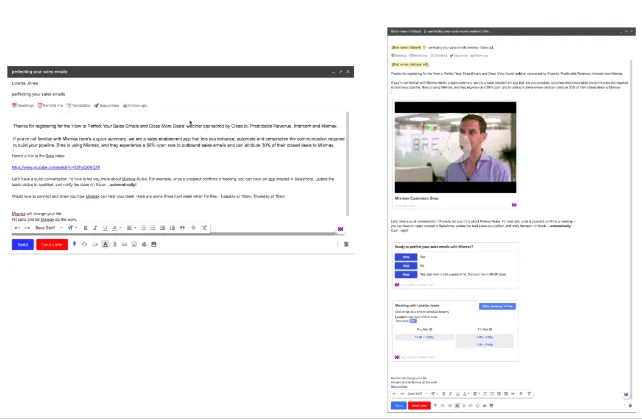
Make sure your emails look interesting. At a high level, email hasn’t changed for at least 20 years – it’s still black text on a white background with a link or two. Look at the two emails below – which is more interesting and which is more likely to get a response?
The Quantified Impact of Personalization
Let’s talk numbers, because the data on personalization is too compelling to ignore. According to a study that analyzed 20 million sales emails, messages with advanced personalization see a 17% reply rate. Those without it? A mere 7%. This means taking the time to tailor your message can literally double your chances of getting a response. This goes way beyond just using a mail merge to insert a first name. True personalization involves referencing a recent company achievement you saw on their newsfeed, mentioning a shared connection, or speaking directly to a challenge you’ve identified from their job description. It shows you’ve done your homework and see them as an individual, not just another name on a list.
Target Smaller Lists for Better Results
The “spray and pray” approach to cold emailing is officially over. While it feels productive to send a thousand emails at once, the results often speak for themselves—and not in a good way. The same study found that campaigns targeting smaller, more focused lists of 1-200 prospects had a 10% higher reply rate than massive campaigns sent to over 1,000 people. Why? Because it’s nearly impossible to meaningfully personalize a message for a thousand different people. By focusing on a smaller, highly-curated list, you can invest the time needed to craft a genuinely relevant message for each person, which, as we just saw, is the key to getting replies and starting valuable conversations.
A Note on Using AI for Personalization
There’s a lot of talk about whether prospects can “sniff out” an AI-written email. While many people believe they can spot AI-generated text, studies show they’re often wrong. The real secret isn’t to avoid AI, but to use it as a smart assistant. Think of it as a partner that can help you scale your personalization efforts without sacrificing quality. For example, you can use AI-powered workflows to generate a first draft of an email that pulls in key details from your CRM. From there, you can add your own human touch, refining the tone and adding a specific insight. This hybrid approach allows you to work efficiently while ensuring your outreach remains authentic and impactful.
3: Structure Your Email for an Easy ‘Yes’
Your emails should be succinct, to-the-point, and follow a logical sequence that makes prospects want to keep on reading:
An opening sequence personalized to address the recipient’s circumstances and show that you’re not just throwing spaghetti on the wall. It should also be fact-packed, concise, and specific to pique the reader’s interest.
Buyer-specific content that speaks to the unique challenges of the recipient’s role or company. It should be consistent with the subject line and show how your products and services can provide value.
A close that includes a clear call-to-action, such as scheduling a brief phone call with you. You can use one-click scheduling and make it easy for prospects to take action.
Related Post: 9 Sales Email Sequence Software Tools for Sales Engagement and Automation
Keep Your Message Succinct
Your prospects are busy, and their inboxes are crowded. To stand out, you have to get straight to the point. Research consistently shows that short, concise emails that focus on value rather than a hard sell perform best. Think of each email as a quick, impactful conversation starter, not a full-blown presentation. A great practice is to write your draft and then challenge yourself to cut it by 25%. Remove any fluff, jargon, or sentences that don’t directly support your main point. While a successful campaign might involve a sequence of 4-7 emails to get a response, each message in that sequence needs to be sharp and respectful of the reader’s time to keep them engaged.
4: Nail Your Introduction in Two Sentences
Many salespeople make the mistake of talking about their products right away in their cold emails without first building rapport with the recipients. However, people like to buy from those they can relate so make sure to introduce yourself in the opening sequence and establish trust.
Keep the introduction succinct, conversational, friendly, and relevant. Tell the recipients who you are, what you do, and why you’re contacting them. Don’t forget to customize the introduction to highlight mutual connections or common interests (which you can research using LinkedIn Sales Navigator.) You can also include a photo in your email signature so the recipients can associate a face with the name to accelerate the trust factor.
Articulate Their Problem Better Than They Can
As sales expert Chris Orlob puts it, if you can articulate a prospect’s problem better than they can, they’ll automatically assume you have the solution. This goes beyond listing generic pain points. It’s about showing you understand the specific challenges of their role and industry so well that your opening lines build immediate trust. This deep personalization is what separates your message from the noise. In fact, one study found that emails with advanced personalization achieve a 17% reply rate, more than double the 7% rate for non-personalized messages. When you demonstrate a genuine understanding of their world, you’re not just selling; you’re starting a valuable conversation.
5: Show, Don’t Tell: Sell Benefits with Proof
The “meat” of your email content should focus on how the recipients can benefit from your products or services. If you talk about specific features, position them so they’re relevant to the recipients.
For example, communicate how your products can save money, help increase profits, save time, make them look good, or make their lives easier. In addition, people are highly influenced by social proof when making purchasing decisions. You can include a short paragraph on how your products have helped customers (e.g., a well-recognized company in the recipient’s industry) achieve specific results.
6: Make Your Call to Action Impossible to Ignore
Having to highlight different aspects of your products or services for different audiences doesn’t mean you have to start from scratch and reinvent the wheel every time you write an email.
>You can create emails based on proven copyrighting formulas to apply effective persuasion tactics at scale:
- Pain > Problem Solved > Bridge (i.e. how to get there) > Call to Action
- Pain > Agitate (i.e. highlight the cost or implementation time) > Solution (i.e. how your product is relevant) > Call to Action
- Star (i.e. the big idea) > Chain (i.e. facts, sources, reasons, and benefits) > Hook (i.e. call-to-action)> Call to Action
- Attention (i.e. pique curiosity) > Interest (i.e. make it personal) > Desire (i.e. use social proof) > Call to Action (i.e. ask for a response)
- Personal Star (i.e. the prospect) > Tell the Story (i.e. the star’s transformation) > Solution (i.e. relate the star’s victory to your product) > Call to Action
- Awareness (i.e. recognize the pain) > Understanding (i.e. how the pain affects the recipient) > Solution (i.e. how your product delivers the solution) > Call to Action
Use a Low-Commitment CTA
The goal of your first cold email isn’t to book a full demo or secure a major deal; it’s simply to start a conversation. Asking for a significant time commitment right away can feel overwhelming and often leads to your email being ignored. Instead, focus on a low-commitment call to action that makes it incredibly easy for your prospect to respond. Think of it as lowering the barrier to entry. Instead of asking for a 30-minute meeting, try a simple, interest-gauging question like, “Is this something you’re interested in learning more about?” or a qualifying question such as, “Are you the right person to discuss this with?” These types of CTAs only require a quick “yes” or “no,” which dramatically reduces the effort needed to reply. A strong, singular, and easy-to-reply-to CTA is proven to drive better results because it respects the prospect’s time. Once you get that initial positive response, you’ve successfully opened the door for a more substantial conversation.
7: Design a Cold Email Outreach Sequence That Works
Your prospects have a lot in their inbox and they may not see or have the time to respond to your first email. Think about your own behavior. When you receive a cold email how often do you respond on the first touch?
Setting up a follow-up email sequence (also called a drip campaign) can help you nurture relationships, build trust, and increase response rates by as much as 300%. You can use an email productivity tool to personalize these emails at scale and improve cost-efficiency. You can also set behavioral triggers to send out the right message at the right time and embed videos, calendar invites or surveys to increase response rates.
You may be wondering how many emails you should include in your sequence. There’s no one size fits all answer because it depends on many different factors – your prospect, what you are selling, how compelling your email is, and many more. A 10 touch sequence works well for us, but it may not work well for your sales team. We do find that sequences that include touches from a variety of mediums – emails, tasks, LinkedIn touches and even texts – work better than sequences that just have email touches.
The Power of Persistent Follow-Ups
It’s easy to feel like you’re being a pest when you send multiple follow-up emails. But the truth is, persistence pays off. Your prospects are busy, and your first email can easily get lost in the shuffle. A thoughtful follow-up sequence keeps you on their radar and shows that you’re serious about providing value. The key is to make each touchpoint meaningful, offering a new piece of information or a different angle on the problem you solve. This approach transforms follow-ups from nagging reminders into helpful nudges that guide your prospect toward a solution.
How Many Follow-Up Emails Are Enough?
The data tells a clear story: more is often better. While you don’t want to spam anyone, stopping after one or two emails means you’re likely leaving conversations on the table. Research from Woodpecker found that sales campaigns with 4-7 emails in a sequence achieve a 27% reply rate—a rate that is three times higher than sequences with only 1-3 emails. Similarly, HubSpot notes that a well-designed drip campaign can increase response rates by as much as 300%. The sweet spot seems to be around 4 to 7 emails, giving you enough opportunities to connect without overwhelming your prospect’s inbox.
Automating Follow-Ups with AI-Powered Workflows
Managing a 7-touch sequence for every single prospect sounds exhausting, right? That’s where automation becomes your best friend. Using a sales execution platform allows you to build out these sequences once and enroll prospects as needed, freeing you up to focus on conversations with engaged leads. With AI-powered workflows, you can schedule your follow-ups to send automatically until you get a reply. The best strategies go beyond just email, incorporating multiple channels like LinkedIn connection requests or tasks to make a phone call. This creates a more dynamic and effective outreach that feels personal, even when it’s automated.
8: Test and Tweak for Higher Email Reply Rates
Remember it’s unlikely that you’re going to get it right the first time. So track your email open and response rates to see what works what doesn’t for your specific audience so you can fine-tune your outbound email strategies.
9: Don’t Let Your Emails Land in Spam
Why Email Deliverability is Crucial
You can write the most compelling, personalized, and value-packed email in the world, but it won’t matter if it never reaches your prospect’s inbox. Many cold emails fail for one simple reason: they get flagged by spam filters before a human ever sees them. Getting your emails successfully delivered is the absolute first hurdle you have to clear. With average cold email response rates hovering between a slim 1% and 5%, you can’t afford to lose perfectly good emails to the spam folder. Every message that successfully lands in a primary inbox is a valuable opportunity, so making sure your deliverability is in top shape is a non-negotiable part of any successful outreach strategy.
How to Avoid Common Spam Triggers
Spam filters are smart, and they’re specifically looking for generic, mass-blasted content. The best way to avoid them is to not act like a spammer. Personalization is your best defense. We already know that emails with personalized subject lines are 26% more likely to be opened, and that same principle helps with deliverability. Another major red flag for spam filters is sending the exact same email to hundreds of people at once. To get around this, you should slightly alter the wording in each email. This doesn’t mean you have to write every message from scratch; platforms with AI-powered workflows can help you create and send unique variations at scale, ensuring your outreach feels personal and stays out of the spam trap.
Sending Cold Emails from Gmail? Read This First
Do yourself a favor and give Mixmax a try – you can literally be up and running in a day with our all-in-one productivity suite. Try us for 14 days – free.
Frequently Asked Questions
My cold email response rate is only around 2%. Is that normal, or am I doing something wrong? First, take a breath—you’re likely doing better than you think. For truly cold outreach, a response rate between 1% and 5% is standard. It’s easy to see flashy numbers online and feel discouraged, but the reality is that getting a reply from someone who has never heard of you is tough. A 2% rate means you’re in the game. Instead of viewing it as a failure, see it as a solid baseline you can improve with small, consistent tweaks to your subject lines, personalization, and call to action.
I’m worried about being annoying. How many follow-up emails are actually effective? This is a concern I hear all the time, but the data shows that persistence is key. Most replies don’t happen after the first email. A sequence of 4 to 7 emails often gets the best results, sometimes tripling the response rate of a shorter sequence. The trick is to make each follow-up valuable, not just a “bumping this up” message. Offer a new insight, share a relevant resource, or reference a different pain point. When you consistently provide value, you’re not being annoying; you’re being helpful.
Personalizing every email sounds like a ton of work. How can I do it without spending my entire day on it? You’re right, manually personalizing hundreds of emails isn’t a good use of your time. The key isn’t to do everything by hand but to work smarter. Focus on smaller, more targeted lists where you can find common ground. Then, use tools to help you scale. For instance, AI-powered workflows can generate a solid first draft that pulls in key details from your CRM or a prospect’s LinkedIn profile. You can then spend just a minute or two adding a genuine, human touch to that foundation. It’s about blending smart automation with authentic insight.
My open rates are pretty good, but I’m just not getting replies. What’s the most likely problem? A good open rate is a great start—it means your subject lines are working! If the replies aren’t coming, the issue is almost always inside the email itself. The most common culprits are a message that’s too long, a pitch that focuses on your product instead of the prospect’s problem, or a confusing call to action. Try cutting your email body down to just a few concise sentences that clearly articulate a problem you’ve identified and hint at a solution. Make it all about them, not about you.
What’s the best call to action to use in a first email? The goal of a first cold email is simply to start a conversation, not to book a 30-minute demo. A high-commitment ask is a quick way to get ignored. Instead, use a low-commitment CTA that makes it incredibly easy for them to say yes. Try asking a simple, interest-based question like, “Is solving [problem] a priority for you right now?” This requires just a simple “yes” or “no” and removes the pressure of scheduling a meeting, making a prospect far more likely to engage.
Key Takeaways
- Focus on Quality Over Quantity: Instead of blasting a huge list, target smaller, well-researched groups. Deep personalization—referencing a prospect’s specific challenges or recent company news—is proven to more than double your reply rate.
- Make Replying Effortless: From a short, action-oriented subject line to a simple, low-commitment question, design your email to be easy to answer. Keep the body concise and get straight to the point to respect your prospect’s time.
- Automate Your Persistence: Don’t stop after one email, as a sequence of 4-7 follow-ups can triple your response rate. Use AI-powered workflows to manage this process, ensuring you stay top-of-mind without spending all your time on manual outreach.