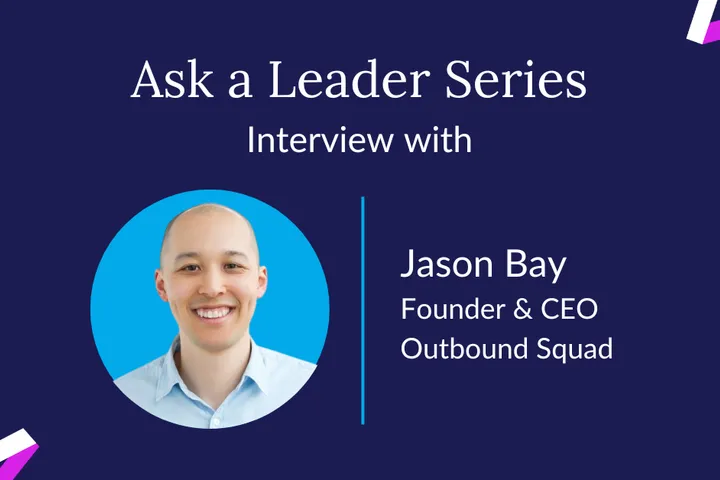
Most outbound emails are pitchy, generic, and immediately deleted. According to Jason Bay, this isn't just bad writing; it's a sign of a deeper misunderstanding of what outbound is for. It’s not about finding people to sell to; it’s about finding people whose priorities align with the problems you solve. As the founder of Outbound Squad, Jason helps teams make this critical mindset shift. In our interview, he explains how to find that alignment, what it means to have a compelling point of view, and how to structure a cold call that actually starts a conversation.
Interview with Jason Bay, Founder and CEO at Outbound Squad
In this interview, Founder & CEO Jason Bay from Outbound Squad talks about coaching tips for SDRs and AEs, the importance of marketing and sales alignment, advice he’d give to aspiring sales leaders, two sales books he’d highly recommend, and an outbound sales mistake that makes him cringe.
Who is Jason Bay and What is Outbound Squad?
Before we jump into the interview, let's get to know our guest. Jason Bay is the founder and CEO of Outbound Squad. His company is dedicated to helping sales teams master the art of outbound sales. As Outbound Squad puts it, they provide "special training and coaching to help sales teams get better at finding new customers and creating more sales opportunities." Their focus is on proactive outreach, a crucial skill for any team that wants to consistently crush its quota instead of just waiting for leads to fall into their lap. Jason's approach is all about building a repeatable process for generating pipeline.
Training Sales Teams to Build Stronger Pipelines
Many sales teams hit a wall, not because their reps can't close, but because their pipeline is empty. They become too dependent on inbound leads, and when that well runs dry, they miss their targets. Outbound Squad tackles this exact problem. They note that "many sales teams struggle because they don't have enough good sales leads, even if their sales reps are good at closing deals." By teaching teams how to build a strong outbound motion, they help create a more predictable and robust pipeline. This shift from reactive to proactive selling is what separates good teams from great ones, ensuring there are always new opportunities to work.
The "Outbound Squad" Podcast
If you want to dive deeper into Jason's methods, his podcast is the perfect place to start. The Outbound Squad podcast is a goldmine of practical advice for B2B sales reps and leaders. Each episode is designed to help you get better at prospecting and selling to new customers. Jason shares actionable tips, interviews other sales experts, and breaks down the tactics that are working right now. It’s like having a sales coach in your pocket, offering weekly insights to sharpen your skills and keep you motivated. It’s a must-listen for anyone serious about their outbound sales game.
Free Resources and Paid Programs
One of the best things about Jason's approach is its accessibility. He doesn't hide all the good stuff behind a paywall. The podcast frequently points listeners to a wealth of free resources, including an "Outbound Masterclass" course, workbooks, and even AI prompts to help with writing outreach. These materials give you a real taste of the Outbound Squad methodology and provide immediate value you can apply to your own process. Of course, for teams looking for more intensive training, they also offer paid coaching programs designed to transform a team's outbound performance from the ground up.
Defining Outbound Sales and Calling
Jason's work is all about "outbound," but what does that really mean? The term gets thrown around a lot, and it’s often used interchangeably with "cold calling," but there’s more to it. To get the most out of the interview, it helps to have a clear understanding of the key concepts. Outbound is a strategy, a mindset, and a set of actions all rolled into one. It’s about taking control of your pipeline by initiating contact with potential customers. Let's break down some of the fundamental terms you'll hear in the world of outbound sales.
Outbound vs. Inbound Calls
The simplest way to think about the difference is who makes the first move. With inbound, the customer comes to you. They might fill out a form on your website or call your support line. With outbound, you go to them. As one source explains, "outbound calls are a big part of a company's sales and marketing plan. They help businesses to find new potential customers (leads) and turn interested people into paying customers." It's a proactive approach. Instead of waiting for the phone to ring, you're the one dialing, sending the email, or connecting on LinkedIn to start a conversation and create an opportunity.
Cold Calling vs. Warm Calling
Not all outbound calls are created equal. The most well-known type is the cold call, where you contact someone who has shown no prior interest in your product. The goal is to spark that interest from scratch. A warm call, on the other hand, is when you reach out to someone who has already engaged in some way. Maybe they opened your last three emails, downloaded a resource, or visited your pricing page. These engagement signals turn a cold introduction into a timely, relevant conversation. Having AI-powered workflows that surface these signals means you know exactly who to call and when, making your outreach far more effective.
Common Goals of Outbound Calls
While the primary goal for most sales teams is booking meetings and closing deals, outbound calls can be used for much more. As one contact center resource notes, companies make outbound calls for a wide range of reasons, including "selling products, collecting payments, doing surveys, research, asking for donations, or telling customers important news." For sales reps, this highlights the versatility of picking up the phone. An outbound call could be for prospecting a new account, following up on a proposal with a current opportunity, or even checking in with a closed customer to ask for referrals. It's a fundamental tool for driving business forward at every stage of the customer lifecycle.
1. What is THE top trend you're seeing in sales right now?
The number one coaching tip for SDRs and AEs is to create a culture of self-accountability. So as a sales leader, what's better than holding your reps accountable is having a culture where they hold themselves accountable.
What I recommend is having a good give-to-get policy when it comes to coaching. So in order to get coaching from you, a rep must attempt to coach themselves. If they want feedback on a cold call, they have to give themselves feedback on a cold call first and bring that to you. So create scorecards and self-accountability, and allow your reps to self-coach.
The Role of Technology in Modern Outbound
Technology is essential for any modern outbound sales team. The right software helps reps work more efficiently and have more meaningful conversations. Automation takes care of the repetitive tasks that used to eat up most of a seller's day, like dialing numbers or logging activities. This frees up reps to focus on what they do best: connecting with people and solving problems. When you equip your team with the right tools, you’re not just helping them make more calls or send more emails; you’re giving them the information and time they need to build a stronger pipeline.
Automatic Dialers and Call Analytics
Automatic dialers have completely changed the calling game for sales teams. Instead of manually punching in numbers and waiting through endless rings, these systems automatically call contacts from a list. They are smart enough to connect the sales rep only when a real person answers the phone. This simple function saves an incredible amount of time, allowing reps to move from one conversation to the next without the dead space in between. It turns a task that was once about brute force into a more focused and productive activity, letting reps spend their energy on the actual conversation, not the manual labor leading up to it.
The Importance of CRM Integration
A dialer is useful, but its true power is unlocked when it’s connected to your CRM. When your sales tools and your CRM talk to each other, reps get instant access to a prospect’s entire history right before a call. This context is everything. It allows for a personal, relevant conversation instead of a generic pitch. Furthermore, the integration automates the tedious work of logging every call, email, and meeting. With AI-powered workflows, all sales activities are automatically synced to Salesforce or HubSpot. This not only saves reps hours of manual data entry every day but also gives managers a consistently accurate picture of what’s happening across the team.
2. Why is it important for sales & marketing to collaborate?
On one side of the equation, as a marketer, you're creating content. And the type of content that you create for the prospect is really important based on where they're at in the buyer’s journey.
If you don't work together closely with sales, and then vice versa, the content that you're going to give a prospect who knows nothing about the problems that you solve, or that your solution even exists, that's a very different piece of content than someone who’s deciding between vendors, and deciding between your approach.
So the reason why it's super important is that from a content standpoint, if you want sales reps to use the content that you create, you need to collaborate with them and really understand what those one-to-one conversations are like.
3. What advice would you give to aspiring sales leaders?
The advice I would give to aspiring sales leaders is the same advice I was given as a first-time manager at 19: your biggest strengths will be your team's biggest weaknesses.
So what does that mean?
It means the stuff that comes naturally to you as a rep are going to be things that you don't think about teaching other people. So if you're really good at building rapport, or getting to pain, or multithreading and getting executives in, or whatever it might be. The things that are very obvious to you, I would really double down on focusing on teaching those to your team, because it's not going to be the first thing that you think of.
Key Metrics to Track for Outbound Success
You can't improve what you don't measure. For outbound sales, tracking the right numbers tells you exactly what’s working and what’s not. Focusing on a few key performance indicators (KPIs) helps you pinpoint issues in your process, whether it’s a bad contact list, an ineffective script, or a need for better coaching. When your team has clear visibility into these metrics, they can stop guessing and start making data-driven decisions to book more meetings and close more deals. Consistently tracking these numbers is the first step toward building a predictable revenue engine.
Answer Success Rate (ASR)
Your Answer Success Rate, or ASR, is a straightforward but critical metric. It measures how many of your outbound calls are actually answered by a person. To calculate it, you simply divide the number of connected calls by the total number of calls you dialed. A low ASR is a major red flag, often pointing to a poor-quality contact list with outdated numbers or a flawed dialing strategy. If your reps are spending their days listening to ringing phones and voicemail prompts, they aren’t selling. Tracking ASR helps you quickly identify and fix the top-of-funnel issues that drain your team's time and energy before a real conversation can even begin.
Sales Conversion Rate
While ASR measures connection, the Sales Conversion Rate measures the outcome of that connection. This is the percentage of conversations that result in a desired action, like booking a meeting, scheduling a demo, or closing a sale. This metric is the ultimate test of your script, your value proposition, and your rep’s ability to guide the conversation effectively. A high call volume with a low conversion rate suggests a problem with what’s being said on the call. By analyzing this KPI, you can identify which reps need coaching and which parts of your pitch aren't landing, allowing you to refine your approach for better results.
Cost Per Call
Every minute a sales rep spends on the phone has a cost. The Cost Per Call metric helps you understand the efficiency of your outbound efforts by dividing the total cost of your sales operation (salaries, software, etc.) by the number of calls made. The goal is to lower this cost by making every call more impactful. Tools that automate administrative work, like logging calls in your CRM or scheduling follow-ups, are key. When reps save hours on manual tasks, they can make more calls or have higher-quality conversations, directly improving the ROI of your outbound program and making your entire sales motion more profitable.
Understanding the Legal Rules of Outbound Calling
Outbound calling isn't a free-for-all. A web of federal and local regulations governs how and when you can contact prospects. Ignoring these rules isn't just bad practice; it can lead to hefty fines and damage your brand's reputation. Staying compliant is non-negotiable. It means respecting consumer privacy and ensuring your outreach is both ethical and legal. Before launching any outbound campaign, it's essential to understand the basic legal landscape, particularly the rules surrounding the National Do Not Call Registry and the Telephone Consumer Protection Act (TCPA). This protects your business and builds trust with the people you’re trying to reach.
The DNC Registry and TCPA Compliance
Two pillars of outbound compliance are the National Do Not Call (DNC) Registry and the Telephone Consumer Protection Act (TCPA). The DNC Registry is a list of phone numbers that sales teams are legally prohibited from calling for telemarketing purposes. Always scrub your call lists against this registry before dialing. The TCPA sets broader rules for outreach, dictating permissible call times (generally between 8 a.m. and 9 p.m. in the recipient's time zone), restricting the use of autodialers and pre-recorded messages, and requiring you to maintain an internal DNC list. Using AI-powered workflows can help manage compliance, but it's always best to consult with legal counsel to ensure your practices are fully compliant.
4. Are there books you'd highly recommend?
One that I recently read is called MEDDICC by Andy Whyte. And MEDDICC’s really great if you're doing any kind of sales, where you're closing deals that are over $10,000. And one of the hardest things to do when you're approaching sales calls is figuring out what you need to take away from the call in order to advance the deal forward. And a really great way to do that is through a qualification framework.
I'm not a huge fan of BANT, because it's so seller-centric. MEDDIC is something that aligns a little bit more with how a company might buy something. So I definitely recommend you check that out.
And the other one is Challenger Sale. So I think having a compelling point of view is really important these days. There are so many vendors out there selling the same product for the most part. And the differentiator is "commercial teaching," as they call it in that book. What can you teach this prospect about their competitors in the way that people are doing business right now, that would be a surprise to them and create an emotional reaction that's going to help you with prospecting or selling? So I'd recommend checking out those two books.
Alternative Ways to Build Sales Skills
Essential Reading for Sales Reps
Beyond formal training, some of the best skill-building happens on your own time. As Jason mentioned, creating a culture of self-accountability is key, and that starts with you. Diving into books that challenge your perspective is a great way to self-coach. Jason recommends MEDDICC by Andy Whyte as a powerful qualification framework for deals over $10k. Unlike older, seller-centric models, MEDDICC aligns with how a company actually buys, helping you identify what you need from each call to move a deal forward. He also suggests The Challenger Sale, which focuses on "commercial teaching"—bringing a compelling point of view that teaches a prospect something new about their own business. In a crowded market, being the one who brings insight is how you stand out.
Getting Hands-On with Sales Tools
Reading gives you the framework, but applying it with the right tools is where you see real growth. To know if your outreach is working, you need to track key metrics like Answer Success Rate and Sales Conversion Rate. This isn't just for managers; this data tells you what's working so you can do more of it. Modern sales execution platforms give you this insight without forcing you to live in another dashboard. For example, when your tools work inside your inbox, you can see real-time engagement signals—who opened your email, who clicked a link—and use that information to follow up at the perfect moment. With AI-powered workflows, you can turn your best-performing tactics into automated sequences, ensuring you consistently apply what you've learned to every deal.
5. What is one outbound sales mistake that makes you cringe?
The biggest mistake ends up manifesting itself as really pitchy cold emails, for example. But I think at the core of that there's a lack of understanding of what we're actually trying to accomplish when we do outbound.
Outbound is not about looking for people to sell your solution to and to get sales calls with. Outbound is really looking for people whose priorities align with the priorities that you can help with. So if I sell sales training, for example, to a VP of sales, I'm not looking for good people to sell sales training to. I'm looking for VPs of sales whose priorities are getting their account executives to do more prospecting and increasing the business acumen of their SDR team so that they can land meetings with executives. Those are high-level priorities that these people have, that I can align with.
So that word “align” both from a selling and a prospecting standpoint, if you can think about ‘who can I find that aligns with the types of things that our clients care about, and have conversations with those people, those will naturally lead to conversations. So don't look for people to sell your stuff to; look for where there is alignment in priorities and problems that your solution can ultimately help with.
Check out our interview with Head of Sales Content Will Aitken to learn how to sell ice to a Canadian in winter.

A Step-by-Step Guide to a Better Cold Call
Jason’s point about aligning with priorities is key. A great cold call isn’t a monologue; it’s the start of a conversation. It’s about finding out if that alignment exists. But getting a busy professional to open up in 60 seconds requires a solid plan. You can’t just wing it and hope for the best. Following a simple, proven structure helps you stay in control of the call, demonstrate your professionalism, and show the prospect you respect their time. Here’s a five-step framework to make your cold calls more effective and less intimidating for everyone involved.
Step 1: Do Your Research
Never call completely cold. Before you dial, take five minutes to understand who you’re calling. Check out their LinkedIn profile and their company’s recent news. According to research from Cognism, this initial homework helps you find common ground and a relevant reason to connect right now. You’re not just another random salesperson; you’re a professional who has taken the time to learn about their world. This small step shows respect and immediately sets you apart from the dozens of other reps calling them that day. It transforms your opening from a generic interruption into a relevant conversation starter.
Step 2: Craft a Strong Opening
You have about seven seconds to earn the next thirty. Don’t waste it with a weak, "Is now a good time?" Instead, start with a confident opening that states who you are and why you’re calling, then asks for permission. For example, "Hi [Name], this is [Your Name] from [Your Company]. I noticed [Relevant Observation from Research]. I have an idea on how you can [Achieve Outcome], and I was hoping to share it with you. Do you have 30 seconds?" This approach respects their time while creating enough curiosity to keep them on the line. It shows you're prepared and have something specific of value to offer.
Step 3: Keep the Pitch Concise
Once you have their attention, get straight to the point. Your initial pitch should be no longer than 30 seconds. This isn’t the time to list every feature your product has. Instead, focus on a single, compelling problem you believe they have and how you can solve it. Frame it as a hypothesis. For example, "Many sales leaders I speak with are struggling to get their reps to use their CRM. We help them automate that data entry right inside Gmail. Does that sound like a challenge your team ever faces?" This is short, relevant, and transitions smoothly into a question, inviting them into the conversation.
Step 4: Ask Diagnostic Questions
The goal of a cold call isn’t to sell; it’s to see if there’s a reason to have a longer conversation. After your concise pitch, shift into asking smart questions. Talk about the common problems you solve and ask if they resonate. If they say yes, you’ve found a potential pain point. You can then dig deeper by asking follow-up questions like, "How are you handling that today?" or "What happens when that process breaks?" This turns the call from a pitch into a collaborative discussion where you are diagnosing their situation, not just pushing a product. This is how you find the priority alignment Jason Bay mentioned.
Step 5: Define the Next Step
If you’ve identified a real pain point that you can solve, the final step is to secure a follow-up meeting. Make your call-to-action clear and easy. Instead of a vague "let's connect again sometime," suggest a specific next step, like a 15-minute demo to show them exactly what you mean. Then, make it incredibly simple for them to book it. Using a tool with one-click scheduling lets you drop your availability directly into the follow-up email. This eliminates the frustrating back-and-forth and makes it effortless for them to get on your calendar while the problem is still top of mind.
Common Pitfalls for Sales Agents
Knowing what to do is only half the battle; you also need to know what to avoid. Even with a great script and solid research, a few common mistakes can derail your cold calls and tank your results. These unforced errors can make you sound unprofessional and waste the valuable time of both you and your prospect. They're the small things that separate average reps from top performers. Steering clear of these pitfalls will help you connect with more prospects and book more meetings. Here are two of the most frequent mistakes reps make and how to fix them.
Failing to Record and Review Calls
Most reps hang up the phone and immediately move on to the next call without a second thought. This is a huge missed opportunity for growth. Recording and listening to your calls is like watching game tape for an athlete—it’s the fastest way to identify what’s working and what isn’t. You’ll hear where you stumbled, where you missed a buying signal, or where your tone was off. Using a tool like Mixmax’s Meeting Copilot automates this process, so you get transcripts and summaries without any extra work. This makes self-coaching a simple, daily habit instead of another chore on your to-do list.
Not Using a Mobile Phone
Are you still dialing prospects from a generic office number? You might be hurting your chances before they even pick up. People are conditioned to ignore calls from unknown or blocked landlines. Data shows that prospects are significantly more likely to answer a call coming from a mobile number. It feels more personal and less like a corporate sales pitch from an anonymous call center. Using a dialer that allows you to call from a mobile number can dramatically increase your answer rates and give you more chances to start a conversation. It's a small change that can have a big impact on your connect rate.
Frequently Asked Questions
What is the main difference between outbound and inbound sales? The key difference is who starts the conversation. Inbound sales happen when a potential customer reaches out to you first, maybe by filling out a form on your website. Outbound sales are proactive; your sales team initiates contact with potential customers through cold calls, emails, or social media to generate new opportunities.
Why is it a mistake to focus only on selling a product during a cold call? Focusing only on your product turns the call into a pitch that most people will ignore. The real goal of a cold call is to discover if there's an alignment between the prospect's business priorities and the problems your product solves. The call should be a conversation to diagnose their needs, not a monologue about your features.
What is one simple thing I can do to make my cold calls more effective? Do five minutes of research before you dial. Look at the person's LinkedIn profile and their company's website. This allows you to open the call with a relevant observation instead of a generic script. It shows you respect their time and immediately separates you from the dozens of other salespeople calling them.
How can I improve my sales skills on my own? A great way to self-coach is to record and review your own sales calls. Listening to your conversations helps you hear where you did well and where you missed opportunities. You can also read books that challenge your perspective, like The Challenger Sale or MEDDICC, to learn new frameworks for selling and qualifying deals.
Why is it so important for sales and marketing teams to work together? When sales and marketing collaborate, the content created for prospects is much more effective. Marketers gain insight into the real conversations reps are having, which helps them create materials that address actual customer pain points. This ensures that when a sales rep shares a piece of content, it's relevant to where the buyer is in their decision-making process.
Key Takeaways
- Stop Selling, Start Aligning: Successful outbound is not about finding people to sell your product to. It's about finding people whose priorities align with the problems you solve. Focus your conversations on discovering if a prospect's challenges match the solutions you provide.
- Make Reps Accountable for Their Own Growth: The best sales cultures are built on self-accountability, not just manager feedback. Encourage reps to record and review their own calls. This practice of self-coaching is the fastest way to identify what works and turn weaknesses into strengths.
- Structure Your Calls to Start a Conversation: A good cold call follows a simple plan: research, open with a relevant hook, deliver a concise pitch, ask diagnostic questions to find pain, and define a clear next step. This framework turns a monologue into a dialogue and respects everyone's time.
Related Articles
- Interview With Outbound Squad Founder & CEO Jason Bay | Mixmax
- 10 Sales Prospecting Techniques For Supercharged Conversions
- 16 Proven Cold Email Best Practices to Increase Reply Rates | Mixmax
- Is Cold Calling Dead? 7 Sales Call Tips for Success in 2025
- How to Do Sales the Right Way with John Barrows | Mixmax