The biggest lie in sales tech is that another tool will solve all your problems. The reality? Most tools fail for one simple reason: reps don’t use them. A great sales engagement strategy is only as good as your team’s ability to execute it. This guide focuses on practical sales engagement tips and best practices that your team will actually adopt. We’ll explore different sales engagement strategies built to make their day easier, not harder. This helps them focus on what they do best: selling.
And by that, we mean stepping up your sales engagement strategy and making sure you’re doing everything you can to connect with your potential customers in meaningful and impactful ways.
Think of it like a dance–you want to lead, but also be able to follow. You want to be confident, but not overbearing. And most importantly, you want both parties to enjoy the process (we hope).
But where do you start?
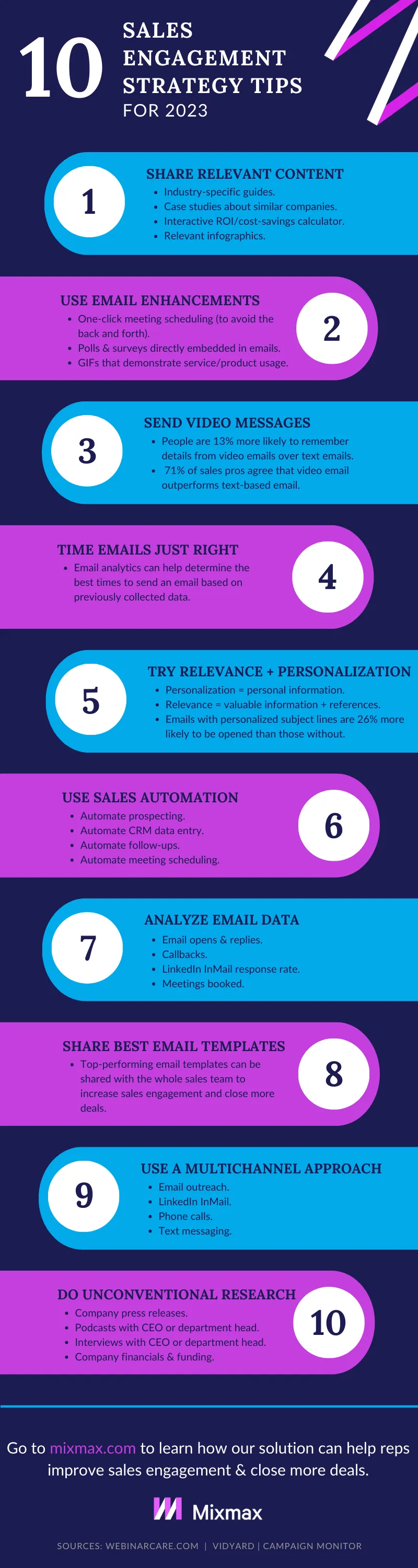
With so many different tactics and techniques out there, it can be overwhelming to figure out which ones will work best for your business. That’s why we’ve created this infographic packed with 10 top sales engagement strategies for 2024.
Whether you’re a sales leader, a seasoned sales pro, or just starting out, these tips will help you connect with your customers, build trust, and close more deals.
Dive into this infographic to learn the secrets of a winning sales engagement strategy. You’ll find everything from email enhancements to relevance & personalization to cost-savings calculators to…
Well, we don’t want to spoil it.
See for yourself below.
10 sales engagement strategy tips for 2024
What is Sales Engagement?
At its core, sales engagement is the series of interactions between a seller and a potential buyer. But it’s not just random contact; it’s a deliberate, structured plan for how your sales team communicates. This means using the right message, at the right time, on the right channel—whether that’s email, phone, or social media. The goal is to move beyond simply making contact and instead build a real, two-way conversation that helps guide the buyer through their journey. It’s the playbook that turns individual sales actions into a clear, measurable process.
A strong sales engagement strategy transforms selling from an art into a science. By creating a structured approach, you can measure what works, refine your process, and repeat your successes across the entire team. This isn’t about forcing reps to be robotic; it’s about being intentional with every touchpoint. When every interaction has a clear purpose, you build trust more effectively and keep deals moving forward. It’s the fundamental difference between shouting into the void and having a productive conversation that leads to a closed deal.
The Difference Between Sales Engagement and Sales Enablement
It’s easy to get these two terms mixed up, but they play distinct and complementary roles. Think of it this way: sales enablement gives your team the car, the map, and the driving lessons. It’s all the training, content, and tools they need to be ready to sell effectively. Sales engagement, on the other hand, is the actual driving. It’s the series of turns, accelerations, and stops—the direct interactions with buyers—that get you to your destination. In short, enablement prepares the seller for the journey, while engagement is the seller in action, navigating the road. You need both to win the race.
The 3 Core Principles of Engagement: Clarity, Consistency, and Connection
To make your engagement strategy truly effective, it helps to ground it in three core principles: clarity, consistency, and connection. Clarity means everyone on your team understands the mission, the goals, and what’s expected in every interaction. Your messaging is direct and easy for buyers to understand. Consistency means your actions and communications are reliable and predictable, which is crucial for building trust. Finally, connection is about building genuine relationships. It’s the art of moving past a purely transactional mindset to understand the person on the other side. When you nail these three Cs, you create an experience that feels authentic and keeps buyers engaged.
How to Build a Sales Engagement Strategy
Building a sales engagement strategy from scratch might sound like a massive undertaking, but it’s really about being thoughtful and methodical. You’re creating a repeatable process that guides your team’s interactions with prospects, turning the habits of your top performers into the standard for everyone. This isn’t about writing rigid scripts that stifle personality. Instead, it’s about providing a flexible framework that ensures key messages are delivered and critical steps aren’t missed, while still leaving room for reps to be themselves and personalize their approach.
The ultimate goal is to create a roadmap that takes a potential customer from their very first point of contact all the way to a closed deal and beyond. This process involves deeply understanding who you’re talking to, what their buying journey looks like, and what you want to achieve at each stage. By breaking this down into manageable steps, you can build a powerful and predictable engine for growth. Let’s walk through the four key steps to building a sales engagement strategy that actually works and gets your team results.
Step 1: Understand Your Customer with Buyer Personas
You can’t have a meaningful conversation if you don’t know who you’re talking to. This is where buyer personas come in. A buyer persona is a semi-fictional, detailed profile of your ideal customer, built from real data and some educated insights. Go beyond just their job title and company size. What are their goals and motivations? What challenges keep them up at night? Where do they go for information? Creating these personas helps you tailor your messaging and outreach so it resonates on a personal level, making your engagement feel less like a sales pitch and more like a helpful conversation.
Step 2: Map the Entire Sales Process
Once you know who you’re talking to, you need to map out their journey with your company. Document every single stage of your sales process, from the initial awareness phase all the way through to purchase and customer advocacy. What are the key touchpoints along this path? What information does a buyer need at each specific stage to feel confident moving forward? By visualizing the entire process, you can spot potential friction points and identify new opportunities to engage more effectively. This map becomes the foundation for your outreach sequences and acts as a safety net to ensure no lead falls through the cracks.
Step 3: Set Clear, Measurable Goals
A strategy without goals is just a list of good intentions. To know if your engagement efforts are actually paying off, you need to define what success looks like in clear, numerical terms. Set specific, measurable goals for your strategy, such as “increase reply rates on cold outreach by 15%” or “book 20% more qualified meetings per rep.” These goals should focus on the outcomes that drive revenue, not just activity metrics like “make 100 calls a day.” Having specific targets gives your team a clear finish line to run towards and allows you to accurately track your progress over time.
Step 4: Develop a Lead Nurturing Program
The reality of sales is that not every lead is ready to buy the moment you first speak to them. A lead nurturing program is your plan for staying top-of-mind with prospects who are interested but not yet ready for a full sales conversation. This involves using a mix of automated and personalized outreach—like helpful emails, timely calls, and relevant social touches—to provide value and build a relationship over time. The key is to deliver the right content at the right time to gently guide them through their own buying journey. When they are finally ready to make a decision, you’ll be the first person they think of.
The Role of Technology and AI in Your Strategy
A great strategy is essential, but the right technology is what allows you to execute it effectively and at scale. Sales engagement platforms are designed to take the manual, repetitive work out of outreach, follow-up, and reporting. They help your team stay organized and ensure consistent communication across multiple channels without letting important tasks slip through the cracks. This isn’t about replacing the human element of selling; it’s about freeing up your reps from administrative busywork so they can spend more of their time actually selling and building relationships with customers.
More recently, Artificial Intelligence (AI) has become a critical part of the modern sales tech stack. AI can analyze vast amounts of data to surface insights that a human simply couldn’t find on their own. It can tell you the best time to send an email, which leads are most likely to convert, and even suggest the next-best action to take on a key account. By integrating AI into your engagement strategy, you’re not just helping your team work harder; you’re helping them work smarter by making data-driven decisions that lead to better outcomes and more closed deals.
What is a Sales Engagement Platform (SEP)?
A Sales Engagement Platform, or SEP, is the command center for your team’s sales outreach. It’s a software tool that helps reps execute their engagement strategy by managing multichannel communication, from emails and phone calls to social media touches. A good SEP automates repetitive tasks, provides deep analytics on what’s working and what isn’t, and integrates with your CRM to keep all your customer data in one place. Essentially, it gives your sales team a structured way to engage with prospects and customers, ensuring a consistent and measurable approach to building pipeline.
How Mixmax Acts as Your SEP Inside Gmail
Most SEPs are separate applications that force reps to constantly switch between tabs and learn a whole new interface. This creates friction and is a major reason why adoption rates for sales tools are often so low. Mixmax is different. It’s a sales execution platform that works directly inside Gmail, the place where your reps already spend their entire day. You can build multi-step sequences, track email opens and clicks in real-time, and schedule meetings with one click, all without ever leaving your inbox. Because it’s so intuitive, teams see 90% adoption in the first week. It also syncs all activity to Salesforce automatically, saving reps over two hours a day on manual data entry.
Using Cadences for Consistent Outreach
Cadences, often called sequences, are the heart of a modern sales engagement strategy. A cadence is a pre-defined series of touchpoints—like a mix of emails, phone calls, and LinkedIn messages—designed to connect with a prospect over a set period. This isn’t about spamming people. It’s about creating a thoughtful, multi-step plan for outreach that ensures persistence without being annoying. A good cadence mixes automated steps with manual, personalized ones, giving reps a clear path to follow for every prospect. This consistency is key to breaking through the noise and getting the high reply rates that top teams achieve.
How AI Improves Sales Engagement
AI is no longer a futuristic buzzword; it’s a practical tool that gives sales teams a serious competitive edge. In sales engagement, AI acts like a smart assistant for every single rep. It can analyze past interactions to predict which deals are at risk, suggest the most effective messaging for a specific buyer persona, and automate the administrative tasks that used to eat up hours of valuable selling time. Instead of forcing reps to rely on gut feelings, AI provides data-backed recommendations to guide their actions. This helps them prioritize their efforts on the activities most likely to result in a closed deal.
Analyzing Calls for Key Insights
Your team’s sales calls are a goldmine of information, but it’s impossible for managers to listen to every single one. AI-powered meeting tools can automatically join, record, and transcribe calls. More importantly, they analyze the conversation to identify key topics, customer objections, and competitor mentions. This gives managers a scalable way to understand what’s happening on the front lines and provide targeted coaching. For reps, it means getting automated summaries and action items, so they can focus on the conversation itself instead of frantically taking notes.
Suggesting the Next-Best Action
One of the biggest challenges for reps, especially those with large territories, is knowing where to focus their attention. “What should I do next?” is a constant, nagging question. AI can answer it. By analyzing engagement signals from across all your channels—email opens, website visits, past call data—AI can synthesize this information and surface the next-best action for each account. For example, Mixmax’s Cortex™ AI can tell a rep that a key stakeholder just re-opened a proposal from three weeks ago, prompting an immediate and timely follow-up. It turns a reactive process into a proactive one.
Providing Personalized Coaching
AI can also act as a personal coach for every rep on your team, scaling a manager’s impact. By analyzing performance data, it can identify individual strengths and weaknesses. For example, it might notice that one rep has a great meeting-booked rate but struggles with a specific objection, while another writes great emails but doesn’t follow up consistently. AI can then provide personalized tips and suggest relevant training content to help each rep improve. This allows sales managers to move beyond generic advice and provide targeted coaching that actually moves the needle on performance.
Sales Engagement Best Practices
Having a solid strategy and the right technology is a great start, but how you execute that strategy day-to-day is what separates good teams from great ones. Best practices are the habits and techniques that top performers use consistently to build stronger relationships and close more deals. These aren’t complicated tricks or secret hacks; they’re simple, repeatable actions that, when done consistently, have a huge impact on your results. They are the foundation of a healthy sales culture and a predictable revenue engine.
The key to all of these best practices is to relentlessly focus on the buyer’s experience. Every interaction should feel helpful, relevant, and respectful of their time. This means listening more than you talk, personalizing your message beyond just their first name, and making it as easy as possible for them to engage with you. By adopting these best practices, you can ensure your sales engagement efforts are not only effective but also build a positive reputation for you and your company. Let’s look at a few of the most important ones.
Follow the 70-30 Rule in Conversations
This is a classic for a reason: it works. In any sales conversation, whether it’s an initial discovery call or a final demo, aim to let the buyer do about 70% of the talking. Your job isn’t to deliver a monologue about how great your product is. It’s to ask smart, open-ended questions and then actively listen to the answers. This approach does two critical things: first, it gives you all the information you need to truly understand their pain points and tailor your solution. Second, it makes the buyer feel heard and understood, which is the foundation of any strong, trusting business relationship.
Tailor Your Message to the Buyer’s Role
A one-size-fits-all message rarely works in B2B sales. The pain points and priorities of a front-line manager are very different from those of a C-level executive. A successful engagement strategy requires you to tailor your messaging to the specific role and responsibilities of the person you’re talking to. A manager might care about features that save their team time, while a VP is focused on ROI and strategic impact. Do your homework, understand what matters to them, and speak their language. This small bit of personalization shows you’ve done your research and makes your outreach far more credible and impactful.
Use Asynchronous Selling to Maintain Momentum
The sales process often stalls while waiting for the next live meeting to get on the calendar. Asynchronous selling is about keeping the deal moving forward between those scheduled calls. This can involve sending short, pre-recorded video messages to answer a quick question, sharing interactive product demos they can explore on their own time, or using collaborative documents to work on a proposal together. These tactics keep the buyer engaged and give them the information they need to build consensus internally, without having to schedule yet another 30-minute call. It respects their time and helps you maintain crucial deal momentum.
Common Sales Engagement Mistakes to Avoid
Knowing what *not* to do is just as important as knowing what to do. Even with a solid strategy and the best intentions, it’s easy to fall into common traps that can sabotage your sales engagement efforts. These mistakes often stem from prioritizing speed and volume over quality and connection, which can damage your reputation and turn off potential buyers before you even have a real conversation. Being aware of these pitfalls is the first and most important step to avoiding them.
The good news is that most of these mistakes are easily correctable. They usually involve a simple but powerful shift in mindset—from a seller-centric view of the world to a buyer-centric one. By focusing on providing value, being relevant, and maintaining a clean and connected data environment, you can steer clear of the errors that plague many sales teams. Let’s break down three of the most common mistakes and how you can avoid them to keep your engagement strategy on track.
Focusing on Quantity Over Quality
It’s a tempting trap to think that more activity will automatically lead to more results. This mindset leads to reps blasting out hundreds of generic emails or making endless cold calls with no real strategy. But buyers can spot a low-effort, templated message from a mile away, and it’s an immediate turn-off. Instead of focusing on hitting an arbitrary activity metric, focus on the quality of each interaction. A single, well-researched, personalized email is worth more than a hundred generic ones. Measure the outcomes that matter, like reply rates and meetings booked, not just the volume of outreach.
Using Stale or Irrelevant Content
The content you share with a prospect is a direct reflection of your brand and your attention to detail. Sending a potential customer an outdated case study, a broken link, or information that’s completely irrelevant to their business is a quick way to lose all credibility. Your sales engagement strategy should include a plan for regularly reviewing and refreshing your sales content. Make sure your team has easy access to the latest and most relevant materials for each stage of the buyer’s journey. Using fresh, targeted content shows that you’re on top of your game and that you respect the buyer’s time.
Allowing Data to Become Siloed
Your sales engagement platform generates a ton of valuable data: who’s opening your emails, which links are being clicked, what messaging gets the best response. But if that data lives in a silo, completely separate from your CRM and other business systems, it loses much of its power. When data is siloed, managers have an incomplete picture of the pipeline, and reps can’t see the full context of a customer relationship. It’s crucial that your engagement platform syncs seamlessly with your CRM, creating a single source of truth that everyone on the team can rely on for accurate, real-time information.
How to Measure the Success of Your Strategy
You can’t improve what you don’t measure. Once your sales engagement strategy is up and running, you need a clear way to track its performance and identify areas for improvement. Measuring success isn’t just about looking at the final revenue number at the end of the quarter. It’s about tracking the key performance indicators (KPIs) that are leading indicators of that success. These metrics give you real-time feedback on what’s working and what’s not, allowing you to make intelligent adjustments to your strategy on the fly instead of waiting until it’s too late.
A data-driven approach to sales engagement takes the guesswork out of managing your team. Instead of relying on anecdotal evidence or gut feelings, you can point to hard numbers to understand which reps are excelling, which sequences are most effective, and where the bottlenecks are in your process. This allows for more effective coaching and more accurate forecasting. The key is to focus on a handful of metrics that are directly tied to your business goals, rather than getting lost in a sea of vanity metrics that don’t actually tell you anything useful.
Key Performance Indicators (KPIs) to Track
When it comes to tracking KPIs for sales engagement, less is often more. Instead of trying to monitor dozens of different metrics, focus on the few that give you the clearest and most actionable picture of your sales health. These KPIs should cover the entire sales funnel, from top-of-funnel outreach all the way to bottom-of-funnel conversions. By tracking a balanced set of leading and lagging indicators, you can get a holistic view of your performance and make smarter decisions about where to invest your team’s time and resources.
Win Rate and Pipeline Velocity
Win rate and pipeline velocity are two of the most important bottom-line metrics for any sales team. Your win rate tells you what percentage of your qualified opportunities you’re actually closing. A steady increase in your win rate is a strong signal that your engagement strategy is helping you connect with the right buyers and communicate your value effectively. Pipeline velocity measures how quickly deals are moving through your sales process from creation to close. A faster velocity means your engagement efforts are successfully creating urgency and removing friction from the buying process, which directly impacts revenue.
Reply Rate and Conversion Rate
While win rate is a lagging indicator of past success, reply rate is a crucial leading indicator of future success. It’s the first sign of life in your outreach efforts. A low reply rate is a clear signal that your initial messaging isn’t resonating, and you need to adjust your approach. For context, top-performing teams using Mixmax see reply rates of 52%, compared to the industry average of 2-3%. Similarly, you should track conversion rates at each stage of your funnel—for example, the percentage of initial replies that turn into meetings, and the percentage of meetings that become qualified opportunities. These metrics help you pinpoint exactly where in your process you need to improve.
The Future of Sales Engagement
The world of sales is constantly evolving, and sales engagement is no exception. The future is less about revolutionary new tactics and more about the refinement and intelligent application of the principles we’ve discussed. Technology will continue to play an even bigger role, but not in the way some people fear. The goal isn’t to replace sellers with robots, but to augment them, freeing them from mundane and administrative tasks so they can focus on what humans do best: building relationships, thinking strategically, and solving complex problems for their customers.
In the coming years, we’ll see a continued move towards hyper-personalization at scale, powered by AI that can understand a buyer’s context and suggest the perfect message at the perfect time. Collaboration will also become even more critical, with sales, marketing, and customer success teams working more closely together, sharing data and insights to create a seamless customer experience from start to finish. The teams that win in the future will be the ones who successfully blend the art of human connection with the science of data-driven engagement.
The Rise of AI as a Sales Assistant
The future of sales engagement will see AI evolve from a simple tool into a true sales assistant for every rep. Imagine an assistant that preps you for every meeting with a concise summary of the account’s history and recent engagement signals. Imagine an assistant that drafts follow-up emails for you, captures your action items from a call, and updates your CRM automatically without you lifting a finger. This isn’t science fiction; this is already becoming a reality. By handling the routine, administrative parts of the job, AI will give reps more time to focus on high-value activities like strategic planning and building deep customer relationships.
Improving Collaboration Between Teams
Silos between departments are a major barrier to effective customer engagement and a frustratingly common problem. The future belongs to companies that can break down these walls. Sales, marketing, and customer success teams will need to work from a shared set of data and a unified view of the customer. This means tighter integrations between their tech stacks and more collaborative AI-powered workflows. When marketing’s insights on content engagement flow directly to sales, and sales’ feedback on lead quality flows back to marketing, the entire customer experience improves. This level of alignment is no longer a nice-to-have; it’s a competitive necessity.
**
Conclusion**
A strong sales engagement strategy is essential in today’s competitive market, and 2023 is the perfect time to take your game to the next level. By incorporating these 10 tips into your approach, you’ll be able to build stronger connections with your customers, establish trust, and ultimately close more deals.
Remember, sales engagement is about having a genuine conversation and building a relationship. So don’t be afraid to have fun, be yourself, and let your personality shine through. With these strategies in your back pocket, you’ll be well on your way to sales success in 2023 and beyond.
Frequently Asked Questions
What’s the difference between sales engagement and sales enablement? Think of it this way: sales enablement gives your team the tools, training, and content they need to sell. It’s the preparation. Sales engagement is the actual act of using those resources to interact with prospects and customers through emails, calls, and social media. Enablement is the “what,” and engagement is the “how.”
Is a Sales Engagement Platform (SEP) just another tool my reps will have to learn? It depends on the platform. Many SEPs are separate applications that require reps to switch tabs and work outside of their normal routine, which hurts adoption. Mixmax is different because it works directly inside Gmail. Reps can build sequences, track engagement, and schedule meetings without ever leaving their inbox, which is why teams adopt it so quickly.
How can AI help my sales team without being too complicated? AI’s real value is in making reps’ lives easier, not more complex. It acts as a smart assistant by handling administrative work, like summarizing calls and updating your CRM. It can also analyze engagement signals to tell a rep which account to focus on next. The goal isn’t to replace the rep, but to free them from manual tasks so they can spend more time selling.
My team’s reply rates are low. What’s the first thing I should fix? Stop focusing on quantity and start focusing on quality. A single, well-researched, personalized email is more effective than 100 generic ones. Start by tailoring your message to the buyer’s specific role and pain points. Also, use a multi-step, multi-channel sequence instead of just sending one-off emails. Persistence is key, but it has to be thoughtful.
How do I know if my sales engagement strategy is actually working? Look at the metrics that predict revenue, not just activity. Track your reply rates on outreach; a low rate means your initial message is off. Also, measure your conversion rates between stages, like how many meetings turn into qualified opportunities. Finally, keep an eye on your overall win rate and pipeline velocity. These numbers will tell you if your strategy is helping you close more deals, faster.
Key Takeaways
- Build a structured strategy: A successful sales engagement plan is a deliberate process. Start by defining your buyer personas, mapping the sales journey, setting clear goals, and creating a lead nurturing program to guide prospects from first contact to a closed deal.
- Use technology to work smarter: Sales engagement platforms and AI are essential for executing your strategy at scale. Use them to automate repetitive tasks, analyze calls for insights, and get data-driven suggestions for the next best action, freeing up reps to focus on selling.
- Prioritize quality and connection: Avoid common mistakes like focusing on activity volume over meaningful interactions. The best practices center on the buyer: listen more than you talk, tailor your message to their specific role, and use asynchronous selling to maintain momentum between meetings.