
There’s a lot of noise about using AI in sales. Most of it is generic advice that doesn’t actually help modern sellers. This guide is different. We’ll show you exactly how to use AI for sales prospecting in a way that fits your current workflow, not disrupts it. You’ll get practical AI prompts for sales to find better leads and learn how to craft compelling AI sales emails that actually sound like you. This isn’t about adding another complex tool. It’s about making your outreach smarter and more effective, right from your inbox.
How many times have you read an article or a LinkedIn post and thought, “This sounds great, but how on earth do I actually use it?”

That’s where we come in.
We’re going to get into the nitty-gritty of using AI, especially generative AI, in a real-world sales context.
From prospecting and account research to creating first drafts of sales emails, we’re going to show you how it’s done, step-by-step.
To make it even more practical, we’ll share specific ChatGPT prompts for sales you can use.
Think of it as your cheat sheet for making AI work for you.
If you’re tired of the fluff and ready for some action, you’re in the right place.
Here’s what you’ll find in this blog post:
- How generative AI will change sales
- How to use AI in sales (with ChatGPT prompts)
- AI features and tools built for sales teams
- What to avoid when using AI for sales
- Key takeaways (+ a neat generative AI tool)
- FAQ
The Evolution of Sales Prospecting: From Cold Calls to AI
To really get how AI is changing the game, it helps to look at how we got here. Sales hasn’t always been about smart tech and data-driven insights. The journey from manual, high-effort work to today’s AI-assisted selling shows why this moment is so important for reps who want to perform at their best.
From the Rolodex to the CRM
Not too long ago, a salesperson’s most valuable tool was a physical Rolodex. Prospecting meant endless cold calls and manually tracking every interaction in a notebook. Then came the CRM, which was a massive leap forward. Suddenly, all that customer data had a home. But it created a new kind of work. Reps started spending hours each day just updating Salesforce, logging calls, and tracking emails instead of actually selling. This manual data entry is not only tedious but also means the CRM is often out of date, making it hard to know the true state of your pipeline. It solved the organization problem but created an administration problem that still plagues sales teams today.
The Rise of AI in Sales
This is where AI steps in. It’s not about robots replacing reps; it’s about giving reps their time back and making them smarter. AI tools can analyze huge amounts of data to identify which prospects are most likely to buy, so you stop wasting time on dead-end leads. According to Salesforce, AI automates the manual tasks reps hate, like logging activities and sending follow-up emails, freeing them up to focus on building relationships. More importantly, it helps you know what to do next. By monitoring engagement signals, AI can tell you the perfect moment to reach out, turning a cold follow-up into a well-timed conversation. It’s the difference between guessing and knowing.
Beyond just saving time, AI helps you personalize outreach at a scale that was never possible before. It can analyze a prospect’s industry, role, and online activity to help you craft messages that actually resonate. Instead of sending a generic blast, you can send hundreds of tailored emails that feel one-to-one. This is how teams see reply rates jump from the typical 2-3% to over 50%. AI-powered workflows can then handle the follow-up sequences, ensuring no lead falls through the cracks. It’s about using technology to be more human and effective in your communication, not less.
How Will Generative AI Change Sales?
Here’s a bold claim for you: Generative AI is set to revolutionize the world of sales.
But unlike the tons of generic, eye-rolling claims out there, we have some solid reasons to back this one up.
First off, generative AI isn’t just some shiny new toy; it’s a powerful tool that can help you do more with less.
Imagine this: You’re about to reach out to a prospect, but instead of the usual guesswork and hours of research, an AI tool hands you a detailed profile of your prospect.
Their needs, their pain points, and even their communication style - all in a matter of minutes. Suddenly, crafting that personalized message doesn’t seem so daunting, does it?
But it doesn’t stop at prospecting. Generative AI can help you draft emails that sound just like you. It can prep you for your discovery calls and even help you respond to objections.
It’s like having a super-smart assistant who knows your job as well as you do (as long as you give the assistant proper context and guidelines (aka the right prompts).
And the best part? It’s only going to get better.
As generative AI continues to learn and evolve, it’ll become an even more valuable asset for sales teams.
So, if you’ve been on the fence about the whole “how to use AI in sales” thing, it’s time to jump in and give it a shot. Generative AI isn’t just the future of sales; it’s the here and now.
ThE fUtuRe iS nOw.
Here’s an interview with the Co-founder of Fluint, Nate Nasralla, on generative AI:
Nate Nasralla on generative AI in sales
Ok, now here are some ChatGPT prompts for sales you can customize and use ASAP.
### Automating Repetitive Tasks to Save Time Let’s be honest, no one gets into sales for the admin work. Yet, reps often spend hours each day on tasks like logging activities in a CRM, researching leads, and sending manual follow-up emails. This is time that could be spent selling. AI helps by taking over these repetitive jobs. It can automatically update your Salesforce records, find key information on prospects, and manage follow-up sequences. This isn’t about replacing reps; it’s about freeing them up to focus on what they do best: building relationships and closing deals. By handing off the manual work to AI-powered workflows, you can get back 2+ hours every single day. ### Improving Sales Forecasting Accuracy Sales forecasting often feels like guesswork. Managers rely on reps’ gut feelings and outdated CRM data, leading to missed targets and last-minute scrambles. AI changes this by making predictions based on data, not intuition. By analyzing historical sales data, engagement levels, and market trends, AI can predict future sales with much greater accuracy. For this to work, you need clean, real-time data. If your CRM isn’t up to date, your forecast will be wrong. That’s why tools that automatically sync every email, meeting, and call to your CRM are so critical. They ensure the data AI uses for forecasting is always accurate, giving you a forecast you can actually trust. ### Providing Deeper Customer Insights Do you ever wish you could read your prospect’s mind? AI is the next best thing. It analyzes customer behavior to give you real-time insights into their buying intent. Instead of guessing who is interested, you know. AI can track how prospects interact with your emails, content, and website, then flag the accounts that are showing the strongest buying signals. This allows you to focus your energy on the deals most likely to close. For example, engagement signals can tell you exactly when a prospect opens your email or clicks a link, so you can follow up at the perfect moment. #### Voice and Sentiment Analysis During a sales call, it’s easy to miss subtle cues. AI can act as a second set of ears, analyzing call recordings for customer sentiment. It can identify the tone of voice to pick up on hesitation, excitement, or confusion. After the call, you get a summary that highlights key moments and customer feelings. This helps you understand what really resonated with the prospect and where you might need to adjust your pitch. Instead of relying on memory, you get objective feedback that helps you refine your approach for the next conversation, making your follow-up smarter and more effective. #### Real-Time Call Assistance Walking into a meeting unprepared is a recipe for failure. AI can serve as your pre-call assistant, making sure you have all the information you need to succeed. Before a call, an AI tool can pull together a briefing with the prospect’s history, previous call summaries, and key account intelligence. It’s like having a research assistant who preps you for every conversation. This means you can spend less time searching for information and more time focusing on the customer. You walk in confident, informed, and ready to have a meaningful discussion about their needs.
How AI Identifies High-Value Prospects
Prospecting can often feel like you’re just throwing darts in the dark, hoping something sticks. You spend hours digging through LinkedIn and company websites, but it’s hard to know if you’re focusing on the right accounts. AI changes this by acting like a powerful flashlight, illuminating the prospects who are most likely to buy. Instead of just finding more leads, it helps you find the right leads. It does this by analyzing massive amounts of data to spot patterns and signals that are impossible for a human to catch. This means you can stop guessing and start engaging with prospects who actually want to hear from you.
Refining Your Ideal Customer Profile (ICP)
Your Ideal Customer Profile is the foundation of good prospecting. It’s a detailed description of the company that gets the most value from your product. Traditionally, creating an ICP involved a lot of guesswork and manual analysis of your best customers. But AI can supercharge this process. By analyzing your CRM data, AI can identify the specific attributes your best customers share—things you might not even have considered, like their technology stack or recent hiring trends. This gives you a dynamic, data-backed ICP. As a result, you can find valuable potential customers and stop wasting cycles on accounts that are a poor fit from the start.
Finding Lookalike Prospects
Once you have a crystal-clear, AI-refined ICP, the next step is to find more companies that match it. This is where lookalike modeling comes in. AI tools can scan the market to find new prospects that share the key characteristics of your most successful customers. Think of it as a matchmaking service for B2B sales. Instead of starting from scratch with a broad search, you get a curated list of high-potential accounts that mirror the ones you’ve already won. This approach helps you expand your pipeline with relevant targets, ensuring your outreach efforts are focused on businesses that are genuinely a good fit for your solution.
Identifying Key Trigger Events
Timing is everything in sales. Reaching out to a prospect at the exact moment they have a problem you can solve is the holy grail. AI helps you do just that by identifying key trigger events. These are events that signal a potential buying opportunity, like a new funding round, a key executive hire, or a sudden spike in hiring for a specific department. AI can instantly aggregate data from news articles, press releases, and social media to flag these events in real time. This allows you to craft a timely, relevant message that speaks directly to their current situation, dramatically increasing your chances of getting a reply.
Predictive Lead Scoring and Prioritization
Not all leads are created equal. Some are ready to buy now, while others are just starting their research. Predictive lead scoring helps you tell the difference. AI analyzes a wide range of behavioral and firmographic data—like website visits, content downloads, and email engagement—to rank your leads by their likelihood to convert. This goes far beyond traditional scoring models. It tells you which prospects to focus on right now. When you combine this with a sales execution tool, it becomes even more powerful. For example, Mixmax uses AI to surface your highest-priority conversations and tasks right inside your Gmail inbox, so you always know what to do next to move deals forward.
How to Use AI for Sales Prospecting (With Prompts)useful prompts)
You’ve heard about generative AI in sales, but the “how” part is giving you a tough time.
This section will be your guide on how to use generative AI in sales - with some practical, easy-to-use ChatGPT prompts for sales.
AI Prompts for Sales Prospecting
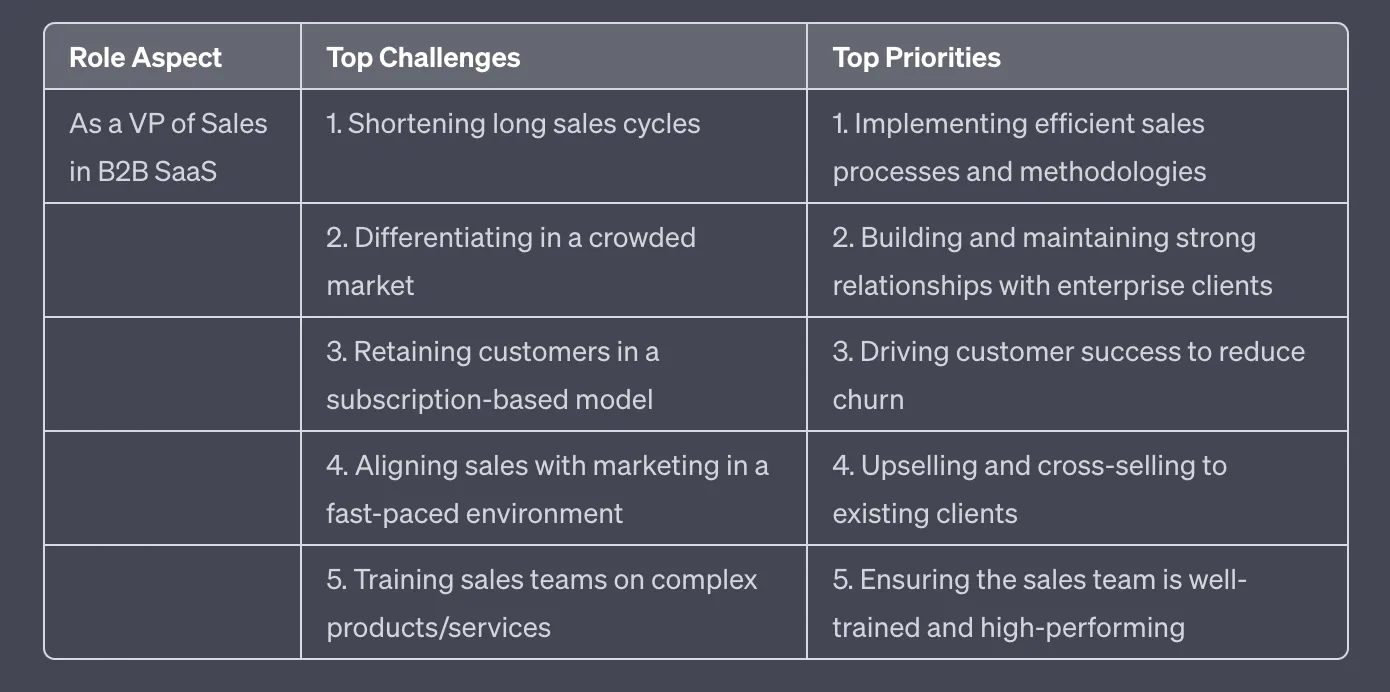
Imagine an assistant that could help you identify key challenges and priorities of your target personas and present them in a concise, organized table. AI can do that for you, automating the time-consuming task of prospecting and enabling sales reps to focus on what they do best - selling.
Prompt: “Act like a salesperson. Your target persona is a {target persona} in the {XX industry}. List the top 5 challenges and priorities that persona typically faces. Keep things simple. Put all of that info into an organized table.”
Result:
Here’s an interview we did with sales expert Thibaut Souyris on how to use AI for sales prospecting:
Thibaut Souyris on how to use AI for sales prospecting
Prompts for Better Account Research
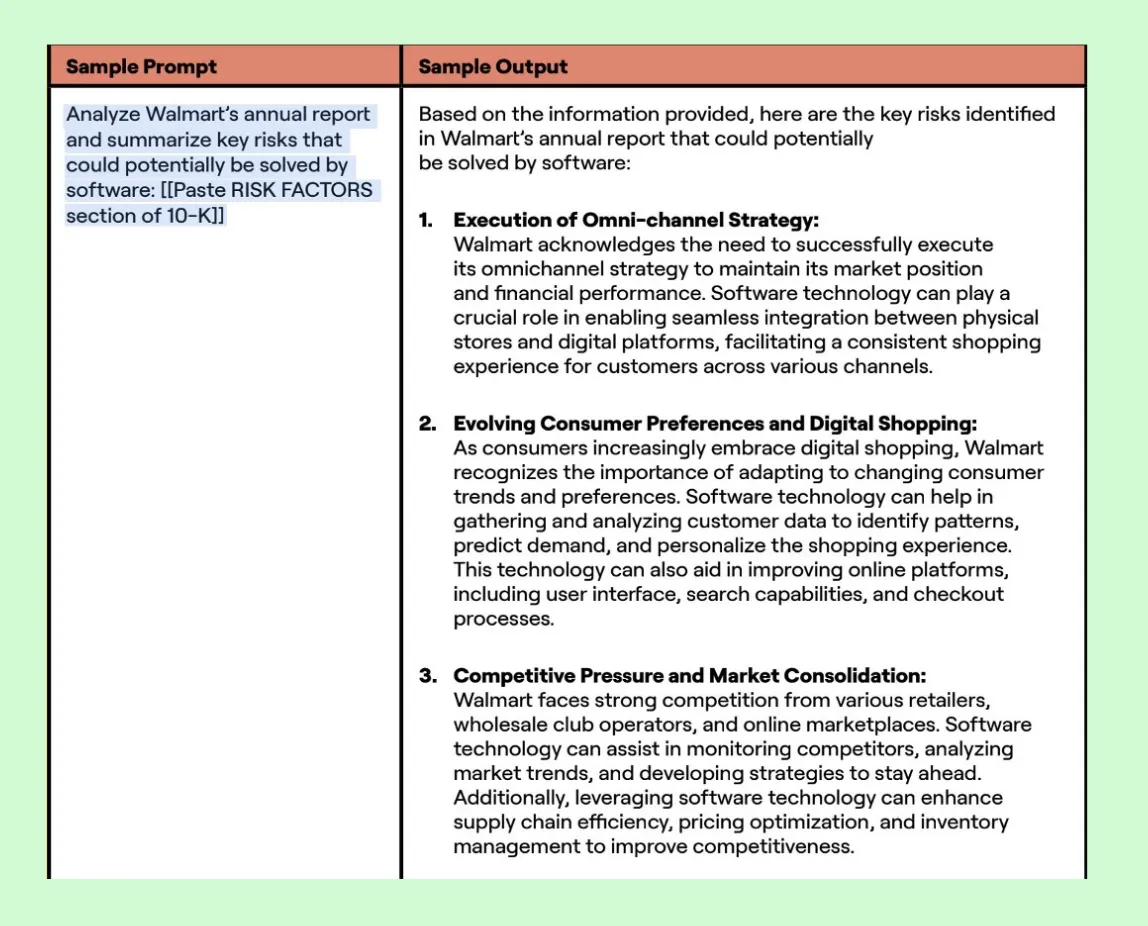
AI can revolutionize account research by analyzing complex financial documents like 10K reports IN A MATTER OF SECONDS.
By surfacing valuable insights about a company’s financial health, competitive positioning, and business strategy, AI helps you tailor your selling strategy to fit each account’s specific context.
Here’s an example of a prompt created by 30MPC & Sonny Round:
Draft Your First Sales Email with AI
Remember your best-performing sales email? What if you could replicate its success repeatedly? You can ask AI to use your high-performing emails as a base, generating first drafts that maintain your communication style (tone) and effectiveness. This amplifies your productivity while ensuring consistency in your messaging.
Check out Florin Tatulea’s LinkedIn post below to see how you can use AI to create first drafts of sales emails (including a wicked prompt) ⬇️
Note: Sales engagement platforms like Mixmax have built-in generative AI functionality that can help you compose emails directly in your email sequences. Worth a look (we’re not biased at all).
Use AI to Proofread Your Sales Emails
In sales, every email counts. Mistakes in spelling, grammar, or tone can impact the recipient’s impression of you. AI can act as a second pair of eyes, checking your emails for errors and ensuring they are always professional and impactful.
Prompt: “Proofread the following email for any spelling, grammar, or style errors, and suggest improvements where necessary. [Paste your email here]“
Prep for Discovery Calls with These Prompts
Prepping for a sales discovery call can be stressful, with a ton of variables to consider. AI can ease this process, generating insightful questions to pinpoint your prospect’s pain points and assess their business situation.
Prompt 1*: “ChatGPT, you are a full cycle sales rep and you sell using the Challenger Sale style. Help me prepare for a discovery call with [Ideal Client Persona], who has [2-3 specific pain points] focusing on my [business solution] for their [desired outcome].”
Prompt 2*: “Using the above [2-3 specific pain points] for [Ideal Client Persona], come up with 3 questions to investigate pains and needs analysis.”
Prompt 3*: “Create 3 questions for the past state, current state, and future state of pain.”
*All prompts are borrowed from the brilliant Charlotte Lloyd on LinkedIn
Sales discovery pro tip from Marcus A. Chan ⬇️
Write Better Follow-Up Emails with AI
By analyzing your prospect’s responses (as well as your original email to them), AI can help write strategic responses aimed at securing follow-up meetings. This keeps your sales process moving smoothly.
Prompt:
_“Help me draft a follow-up email based on this interaction with a prospect, which includes my initial email and their response to it:
_
My initial email:
[Paste your initial email here]
The prospect’s response:
[Paste the prospect’s response here].
The aim of the email should be to continue the conversation and move toward booking a meeting. Remember to address any questions or concerns they raised, and maintain a professional yet friendly tone.”
Summarize Articles in Seconds with AI
Staying updated with industry trends and news is critical, but time-consuming. AI can act like your personal news summarizer, condensing lengthy articles into digestible key points, saving you from lengthy reading sessions.
Prompt: “Summarize this lengthy article about [topic]. The main points I want to capture are the key trends, challenges, and opportunities in the sales landscape. Provide a concise summary that highlights the most important insights and takeaways for sales professionals like myself. [Paste article here].”
Pro tip: You can also use these summaries when sending educational content to your prospects.
AI Prompts for Catchy Subject Lines
First impressions matter, and in email, that’s your subject line. AI can craft enticing subject lines that get your prospects to open and read your emails. And since sales experts advise to write your subject line after you’ve drafted your email, this AI hack is a no-brainer.
Prompt: “Suggest 5 subject lines for this sales email that would look like an internal communication when the recipient sees it in their inbox. The subject line should relate to the body of the email. Keep it under 3 words. Don’t make it sound sales-y at all. [Paste email here]”
Related post: 25 Follow Up Email Subject Line Examples for Revenue Teams
Analyze Your Email Performance with AI
Want to know the cold hard truth about the sale emails you’re writing? Feed it to ChatGPT (or whichever AI tool you’re using) and ask it to analyze it for you through the lens of the recipient.
Prompt: “Act like a [recipient persona] and analyze this outbound sales email. Tell me what works and what doesn’t. Once you’ve analyzed it, tell me how you would rewrite it to make it more appealing to you.”
Create Your SaaS Demo Agenda with AI
Designing a custom SaaS demo that addresses your prospects’ unique needs can be challenging. AI can help draft an agenda using your past conversations as a reference. This results in a personalized demo that highlights your product’s value to each prospect.
Prompt: “Help me draft an agenda for a product demo of our [type of solution], [Product Name], for a potential client [Client Name]. The client is particularly interested in [specific features or problems that the product solves]. The attendees are primarily {Role of the Attendees - i.e., CTOs, IT Managers, Marketing Directors, etc.]. They’ve expressed concerns about [any known concerns or objections - i.e., implementation time, ease of use, security, etc.]. Keep the demo under 60 minutes, ensuring we address their interests and concerns while also highlighting our product’s unique value propositions. Use these past 3 email communications between the prospect and myself as a reference: [Paste email 1] [Paste email 2] [Paste email 3]”
Related post: SaaS Demo Best Practices: Checklist & Tips for Success
Handle Sales Objections with These AI Prompts
Sales objections are common, but responding to them effectively is key. AI can help come up with responses to objections, keeping the tone and style consistent with your previous communications.
Prompt: “I will include two emails that I sent to a prospect, and one email which is their reply to me. Based on our interactions, suggest a response to their objection while keeping modern sales techniques in mind. Keep it short and don’t include any fluff. Use the same tone I used in my previous communications. [Paste email 1] [ Paste email 2] [Paste email 3].”
Understanding the AI Sales Tool Ecosystem
The term “AI for sales” gets thrown around a lot, but it isn’t one single thing. It’s a whole ecosystem of tools designed to solve different problems at different stages of the sales cycle. Thinking about it in categories helps you figure out what you actually need. Some tools are built to find you data, others help you reach out, and a third group helps you write the perfect message. Understanding the landscape helps you pick the right tool for the job instead of buying into vague promises. It’s about matching the technology to the specific sales challenge you’re trying to solve, whether that’s finding better leads or getting more replies.
We can break most AI sales tools into three main buckets: data and research, outreach and engagement, and personalization and content. Data tools help you find the right people and companies to talk to. Engagement platforms help you manage all your communication and know what to do next. And content tools help you write emails and messages that actually get replies. Some platforms, like Mixmax, combine these capabilities to help you manage the entire sales motion, from the first touch to the final signature, all from one place, which means less time switching between tabs and more time selling.
Data and Research Tools
Before you can sell anything, you need to know who you’re selling to and why they should care right now. AI-powered data and research tools are designed to answer those questions for you. Instead of spending hours manually digging through news articles, LinkedIn profiles, and company reports, these tools do the heavy lifting. They can aggregate data on trigger events like new funding rounds, leadership changes, or hiring surges. This information gives you a compelling reason to reach out at a specific moment, making your outreach feel relevant and timely, not random.
Think of these tools as your personal intelligence agency. They surface the critical insights that help you understand a prospect’s world before you ever send an email. The goal isn’t just to get a list of names; it’s to understand the context behind each account. This allows you to walk into a conversation with a clear point of view on how you can help, which is far more effective than a generic pitch about your product’s features. It’s the difference between a cold call and a warm, informed introduction that shows you’ve done your homework.
Outreach and Engagement Platforms
Once you know who to contact, you need an effective way to do it. This is where outreach and engagement platforms come in. These tools help you execute your sales strategy by managing multi-step, multi-channel sequences that can include emails, calls, and social media touchpoints. According to Salesforce, AI helps sales teams save time by automating tasks like sending messages and following up, freeing up reps to focus on building relationships and closing deals. This automation handles the repetitive work so you can focus on the human side of selling.
The best platforms do more than just send messages on a schedule. They provide real-time signals—like who opened your email, clicked a link, or viewed a presentation—so you know exactly which prospects are engaged. This is what separates a simple automation tool from a true sales execution platform. For example, Mixmax helps reps see what to do next by surfacing the most engaged contacts, which is one reason users see reply rates as high as 52% compared to the 2-3% industry average. It turns your inbox into a command center that tells you where to focus your energy.
Personalization and Content Tools
A great strategy and perfect timing don’t matter if your message falls flat. Personalization and content tools use generative AI to help you craft messages that connect with your prospects. This isn’t about replacing the salesperson with a robot. It’s about giving you a high-quality first draft that you can quickly edit and make your own. These tools can create custom emails and messages that reference a prospect’s specific pain points or recent company news, saving you from the dreaded blank page and writer’s block.
This is a massive time-saver, especially for reps managing a large pipeline. Instead of writing every email from scratch, you can generate a relevant draft in seconds. The key is to use the AI-generated text as a starting point. Your job is to add the final 10%—the human touch, the unique insight, the personal connection—that turns a good email into a great one. With AI-powered workflows built directly into your inbox, you can do this without switching between different apps, keeping you focused and efficient throughout your day.
AI Sales Tools That Actually Work
You might be thinking, “ChatGPT is great for prompting, but what about tools specifically designed for sales?” That’s where Mixmax comes in with its powerful AI Compose feature.
AI Compose is a writing assistant built inside your sales engagement platform that helps you draft or enhance your email messages. Unlike generic AI tools, Mixmax’s AI Compose is built with salespeople in mind, understanding the nuances and intricacies of effective sales communication.
Why AI Compose is a game-changer
Sales engagement platforms like Mixmax have integrated generative AI to assist in creating emails that resonate with your prospects. Here’s why AI Compose is an indispensable tool for modern sales teams:
- Personalized messaging: AI Compose can tailor emails to fit the recipient’s profile, ensuring your messages are always relevant and engaging.
- Efficiency: By drafting the initial email, AI Compose saves you valuable time, allowing you to focus on other critical tasks.
- Consistency: Maintain a consistent tone and style across all your communications, reinforcing your brand’s voice.
Note: You ALWAYS have to review what AI generates for you, and it ALWAYS has to be tweaked to give it a human touch.
Practical use case for Mixmax’s AI Compose
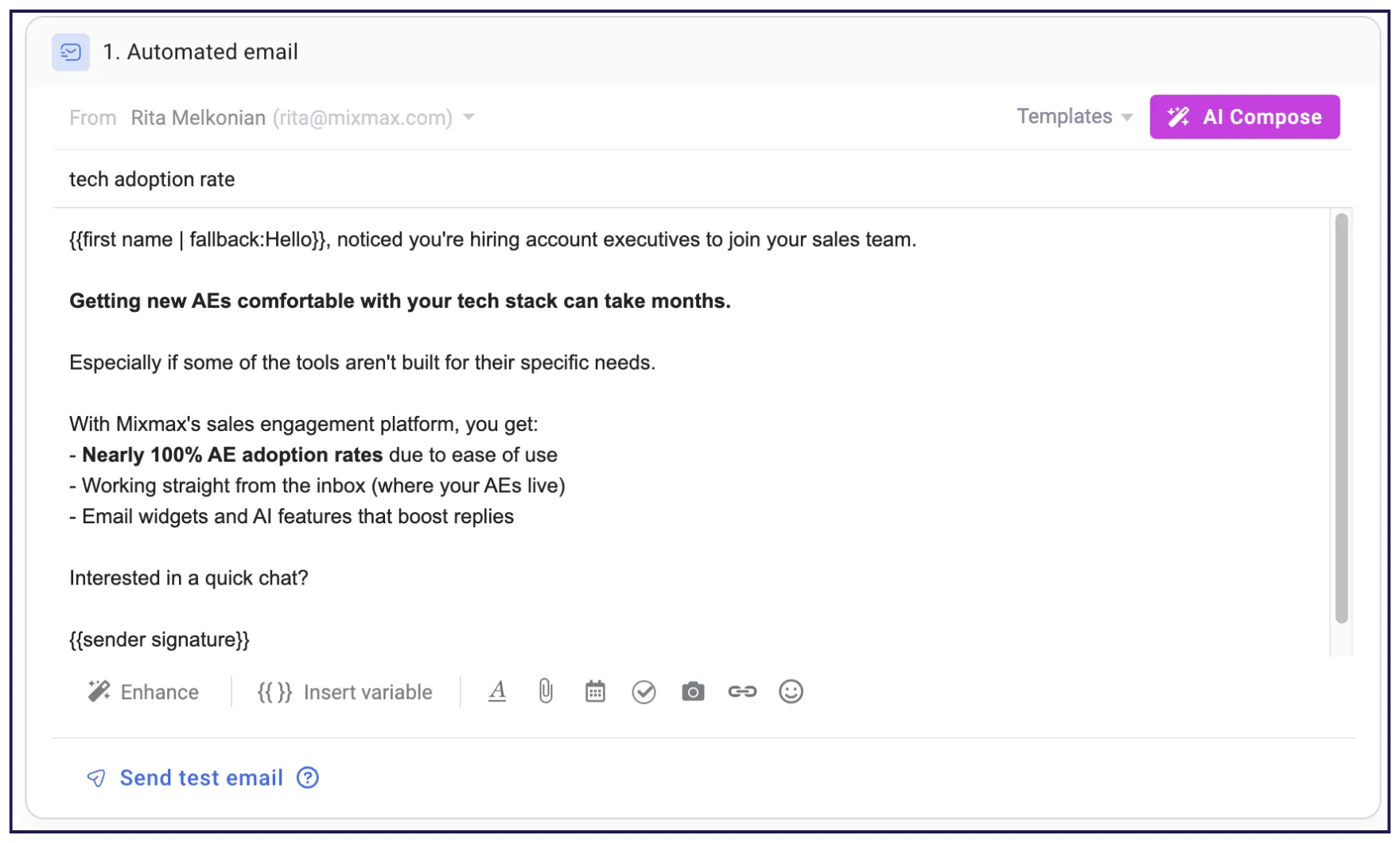
Consider this scenario: You’ve identified a promising lead and want to reach out with a personalized email. Instead of starting from scratch, you use AI Compose to draft an email based on the lead’s recent activities. Here’s how it might look:
Prompt: “Write a prospecting email to sales managers hiring new account executives to join their team. Make sure to mention that the adoption of an entire tech stack can be hard for new AEs. Our value is that Mixmax is built with AEs in mind, not just SDRs. And the adoption rate among AEs is nearly 100% since it’s so easy to use. AEs can also stay in their inbox to use Mixmax instead of context switching. Plus we have email widgets and AI features that help boost replies. At the end, ask if they’re interested in a quick chat.”
Result (with human tweaks):

Sending sales emails at the right time with AI Smart Send
Timing is everything in sales.
Send an email at the right moment, and you increase the likelihood of it being read and responded to. Send it at the wrong time, it might get buried and never seen.
This is where Mixmax’s AI Smart Send feature shines.
AI Smart Send analyzes recipient inbox data to determine the optimal time to send your emails, maximizing open and reply rates. It takes the guesswork out of timing, ensuring your messages land when your prospects are most likely to engage with them.
Key benefits of AI Smart Send
- Higher Engagement Rates: By sending emails when recipients are most active, you boost the chances of your emails being opened and acted upon.
- Increased Productivity: Let AI handle the timing, so you can focus on crafting compelling content and following up with leads.
- Data-Driven Decisions: AI Smart Send leverages data to make informed decisions, improving your overall email campaign performance.
Practical use case for Mixmax’s AI Smart Send
Imagine you’ve crafted the perfect email. Now, you want to ensure it gets read. With AI Smart Send, you can schedule your email to be sent at the optimal time for each recipient, when they’re most likely to check their inbox.
AI Smart Send can be used both within your inbox or within Mixmax Sequences (see images below) ⬇️
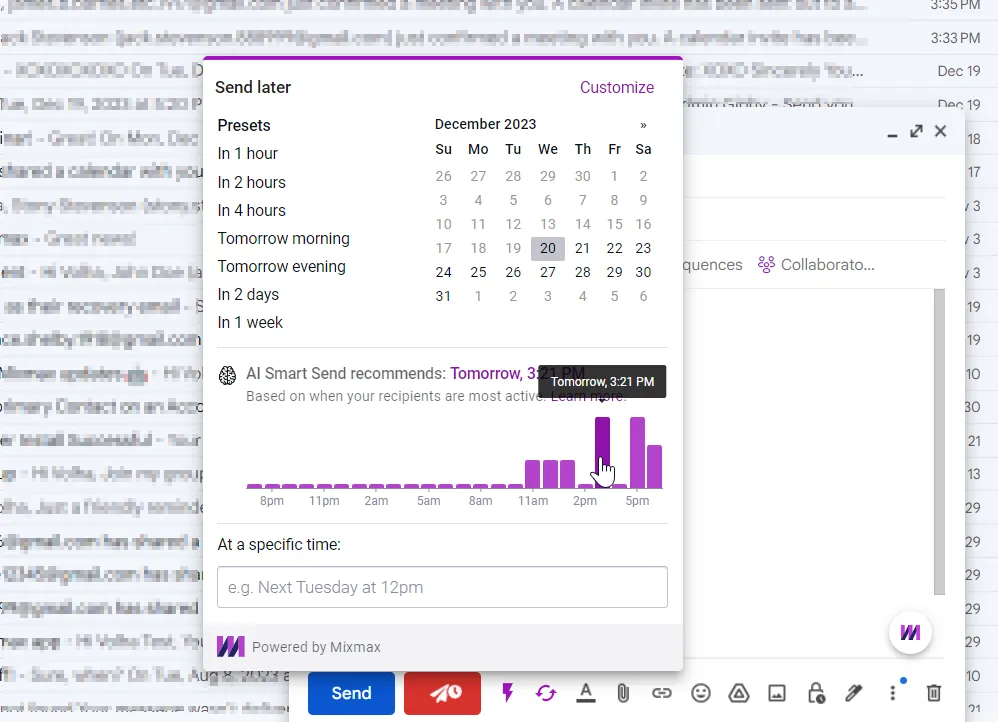
AI Smart Send (inbox version)
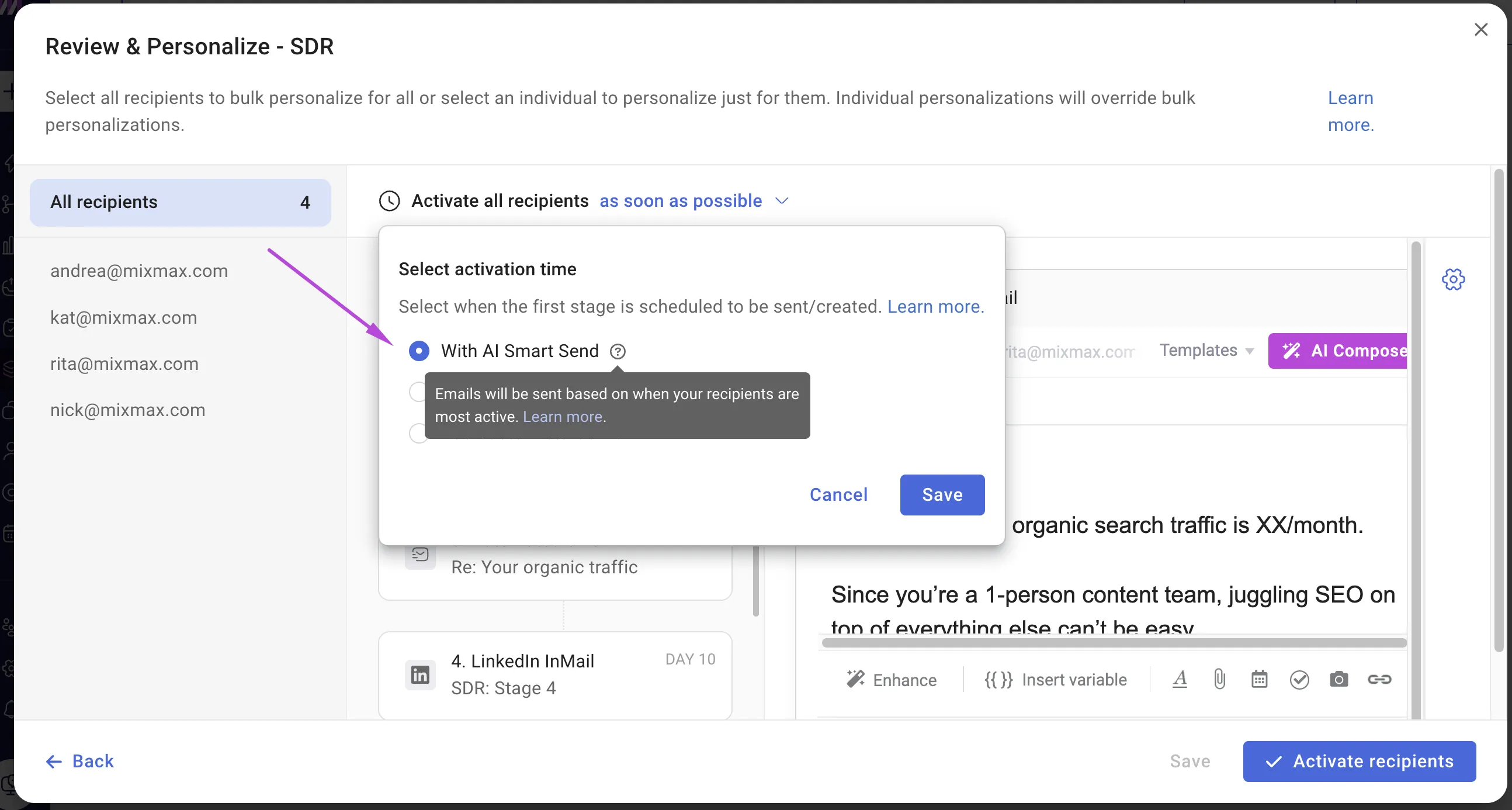
AI Smart Send (sequence version)
Best Practices for Implementing AI in Your Sales Process
Jumping into AI without a plan is like trying to build furniture without instructions. You might end up with something, but it probably won’t be what you wanted. Simply buying a new AI tool won’t magically fix your sales process. Success comes from a thoughtful approach that combines clear goals, the right technology, and, most importantly, your people. Think of it less as a tech problem and more as a strategy problem. Before you even look at a demo, you need to know what you’re trying to solve. Are you trying to save your reps time? Increase reply rates? Get better pipeline visibility? Answering these questions first is the key to getting real value from AI instead of just adding another subscription to your tech stack.
To get it right, you need to focus on a few core principles. It starts with defining exactly what success looks like and making sure your data is ready. Then, you have to ensure your new tool plays nicely with the systems you already use, like your CRM. Most critically, you need to remember that technology is only as good as the people using it. Getting your team on board is the biggest piece of the puzzle. Finally, you have to operate ethically, respecting customer data and privacy every step of the way. Nailing these practices will be the difference between a failed experiment and a fundamental improvement in how your team sells.
Start with Clear Goals and Implementation Steps
Before you do anything else, decide what you want AI to accomplish. Don’t settle for vague ideas like “improve sales.” Get specific. Are you trying to reduce the time AEs spend on account research by 30 minutes a day? Or maybe you want to increase the reply rate on your outbound sequences by 15%. According to research from IBM, defining these specific goals and how you’ll measure them is the critical first step. Once you have your goals, you need to look at your data. AI learns from the information you give it, so if your CRM data is a mess, your AI’s output will be, too. Clean, accurate data is the foundation for any successful AI implementation.
Integrate AI with Your CRM
Your CRM is your team’s source of truth. Any AI tool you bring in must connect directly to it. If your AI platform and your CRM don’t talk to each other, you create data silos. This forces reps to waste time switching between tabs and manually logging activities, which is exactly the kind of work AI is supposed to eliminate. As Salesforce points out, choosing tools that work smoothly with your existing CRM is essential. This is why Mixmax is built to work inside Gmail and sync bidirectionally with Salesforce and HubSpot. Every email, meeting, and call is logged automatically, so your CRM is always up-to-date without any extra effort from your reps. This keeps your data clean and gives managers a real-time view of the pipeline.
Remember the 10/20/70 Rule: Focus on People
It’s easy to get caught up in the technology, but the tech itself is the smallest part of the equation. There’s a concept called the 10/20/70 rule for AI implementation. It says that 10% of success is the AI algorithm, 20% is the data and tech setup, and the remaining 70% is all about your people and processes. The fanciest AI platform is worthless if your reps won’t use it. This is the number one reason sales tools fail. You have to choose tools that fit into your team’s existing workflow, not force them to learn a whole new system. That’s why adoption is so critical. When a tool lives where your reps already work, like their inbox, adoption happens naturally, and you can start seeing the benefits right away.
Ensure Ethical Use and Data Privacy
Using AI in your sales process comes with a responsibility to handle customer data ethically and securely. Trust is everything. Be transparent about how you’re using AI and always comply with privacy regulations like GDPR and CCPA. This isn’t just about avoiding fines; it’s about maintaining a strong, positive relationship with your customers. Good data hygiene is also a part of this. Using accurate, relevant, and ethically sourced data not only protects you and your customers but also ensures your AI tools produce the best possible results. When your AI operates on a foundation of clean data and ethical practices, you build a more sustainable and trustworthy sales process for everyone involved.
Common Mistakes When Using AI for Sales
We talked about the incredible potential AI has to change the world of sales. But let’s not overlook the pitfalls.
In this section, we’ll talk about the common mistakes to avoid when incorporating AI into your sales process.
Don’t Over-Rely on AI
Be careful not to rely too much on AI.
Although it can help make tasks easier and faster, it’s important to find a balance. Remember, making real connections and understanding what customers want are still crucial for sales success. Don’t forget to add a personal touch to your interactions and build genuine relationships.
Watch Out for Inaccurate Data
Another thing to avoid is neglecting the importance of data accuracy and quality. AI relies heavily on data inputs, and if the data is wrong or incomplete, it can lead to inaccurate insights and poor decision-making.
Make sure you have proper data collection processes in place and regularly validate and update your data sources.
Avoid the Copy-Paste Trap
We can try to explain this, but we’ll let Morgan J. Ingram do the talking.
“This is not a copy and paste method… That’s not going to work for you. You need to use your skills. You need to use your insight to then layer into the ideas that you’re creating through any AI tool to be successful.” - Morgan J. Ingram
Enough said.
Key takeaways
Here are the key takeaways from this blog on how to use AI in sales:
- AI can streamline sales prospecting, account research, email drafting, proofreading, and more.
- It can enhance sales discovery call prep by generating insightful questions.
- ChatGPT prompts for sales can help craft effective follow-up emails and analyze email performance.
- It can summarize articles, keeping you informed with less reading time.
- AI can assist in creating engaging sales email subject lines.
- It can generate product demo agendas for personalized presentations.
- AI can help in responding to objections with tailored email replies based on previous conversations.
When it comes to leveraging AI for personalized sales emails, Mixmax stands out. With its generative AI capabilities, you can compose customized sales emails with just a few clicks.
Modern sales guidelines are built into the backend of the AI feature so you don’t have to worry about that.
Here’s a little sneak peek:
_Oct_23_GIF.CdiU5nrf_pBLQQ.webp?dpl=dpl_FckNEoYymWEQRwmL8sK7tXJBEuut) Generative AI in Mixmax
Generative AI in Mixmax
You can check out all the details here.
Frequently Asked Questions (FAQ)
What Is AI in Sales?
AI (Artificial Intelligence) in sales refers to the application of intelligent algorithms and technologies to automate and enhance various sales processes. It involves using AI tools and techniques to streamline tasks, gain insights, and improve the effectiveness of sales activities.
How Can AI Improve Sales Effectiveness?
AI can improve sales effectiveness in several ways. It can automate repetitive tasks, such as data entry and lead qualification, allowing sales professionals to focus on more value-added activities. AI can also analyze large volumes of data to identify patterns, trends, and customer preferences, enabling sales teams to personalize their approach and make data-driven decisions.
What Are Common Use Cases for AI in Sales?
AI can be used in various sales-related tasks, including prospecting, lead scoring, sales forecasting, customer segmentation, sales call analysis, email personalization, account research, and customer relationship management (CRM). It can also assist in competitor analysis, market research, and pricing optimization.
How Can AI Help with Sales Prospecting?
AI can improve sales prospecting by automating the process of finding potential leads and qualifying them based on predefined criteria. It can analyze vast amounts of data from various sources, such as social media, websites, and databases, to identify promising leads and provide valuable insights about their needs and preferences. This helps sales teams prioritize their efforts and engage with prospects more effectively.
Will AI Replace Sales Professionals?
While AI can automate certain tasks and enhance sales processes, it is unlikely to replace human sales professionals entirely. AI is most effective when used as a tool to support and improve human capabilities. Sales is a relationship-driven field, and the human touch, empathy, and communication skills of sales professionals are still essential for building trust, understanding customer needs, and closing deals.
What Are the Risks of Using AI in Sales?
While AI offers numerous benefits, there are potential risks to be aware of. These include over-reliance on AI without maintaining human connections, the possibility of biased or inaccurate insights if the AI models are not properly trained or validated, and the security of customer data. It is important to strike the right balance between AI automation and maintaining personalized interactions with customers.