• Sales

The Sales Doctor: How to Diagnose Your Sales Process

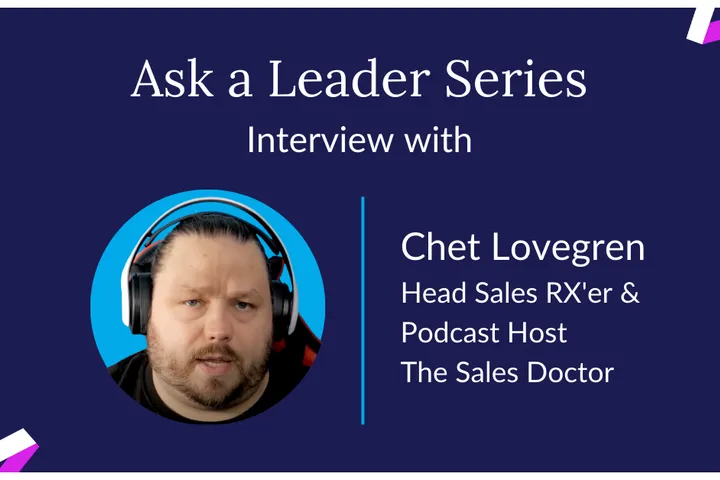
Ask a leader Chet Lovegren interview with Mixmax

Table of contents

    Learn more about Mixmax

    What truly makes a great sales leader? I went straight to an expert to find out: Chet Lovegren. As the host of the The Sales Doctor podcast, Chet offers a refreshing alternative to the usual sales advice, focusing instead on what delivers a real ROI. We talked about the #1 mistake he sees leaders make and the best way to motivate a team. You'll also hear about one of the biggest challenges he's overcome. His perspective as the-sales-doctor is one every leader should hear.


    Your nickname is "The Sales Doctor." What does that philosophy entail?

    It starts with a diagnostic approach

    Diagnosing the core problem

    It's simple. A doctor doesn't walk into an exam room and start listing off medicines. They ask, "Where does it hurt?" They listen. Sales should be the same. Too many reps lead with their product and prescribe a solution before they've even diagnosed the problem. The "Sales Doctor" philosophy flips that. Your first job isn't to sell; it's to understand. This means digging into a client's business, but also paying attention to digital body language. Knowing what they click, what they read, and when they engage helps you pinpoint their challenges before you even speak. This is especially true when you're talking to C-level executives who don't have time for a generic pitch.

    Prescribing a specific solution

    Only after you have a clear diagnosis can you prescribe a treatment. In sales, this means crafting a solution that is custom-fit to the problem you've uncovered. It’s not about pulling a standard proposal off the shelf. It's about connecting the dots for the executive and showing them exactly how your offering solves their specific problem. This is where you demonstrate your expertise. You're not just a vendor; you're a specialist who has listened. And with the right tools, you can use AI-powered workflows to deliver that targeted cure at the perfect moment, ensuring your message is both personal and timely.

    The goal is to build long-term trust

    This whole approach—diagnose then prescribe—isn't just a tactic to close one deal. It's a strategy for building a career. When you stop pitching and start solving, you change the entire dynamic of the relationship. You're no longer a salesperson trying to hit a quota; you're a trusted advisor. That trust is everything. It's what turns a one-time customer into a long-term partner who comes to you for advice and refers others. It’s how you build a reputation that precedes you. The goal isn't just to make a sale; it's to become the go-to expert in your field. That's the real prescription for a healthy sales career, and it's the core idea we explore on The Sales Doctor podcast every week.

    1. What's the #1 mistake you see sales leaders make?

    I think it's making knee-jerk reactions to things and then implementing processes and accountability behind those things without understanding what should really be done and why it's a problem.

    You know, is it a pain point? Or is it a problem in sales? We don't solve pain points, we solve problems. You don't go to the doctor for pain, you go to the doctor for problems, because problems typically lead to death. And it's the same thing in sales as far as leaders are concerned.

    Why do we spend so much time racking our brain and knee-jerk reacting to pain points that we might have, as opposed to looking at problems and how to solve actual problems and understanding why is it a problem?

    What can I do to solve it before just rolling a bunch of stuff on the wall and seeing what sticks.

    So I think one of the biggest mistakes I see sales leaders make all the time is having knee-jerk reactions to things and providing low-value, quick and easy fixes that don't amount to any ROI

    They treat symptoms, not the disease

    Chet’s point about knee-jerk reactions is spot on. It’s easy for leaders to see a problem, like a dip in revenue, and immediately try to fix it with a quick solution—a new sales contest, more activity requirements, or a different script. But these are often just bandages on a deeper wound. This approach treats the symptom, not the disease. A great leader, like a great doctor, doesn't just prescribe painkillers. They run the tests to diagnose the root cause before recommending a cure. The following are common symptoms that often get misdiagnosed in sales organizations.

    Sales teams are busy but not focused

    We’ve all seen it: reps who are constantly busy but their pipeline is empty. They spend their day firing off emails, making calls, and dutifully logging activities, but it doesn't translate into results. This "busy but not productive" state is a classic symptom. The knee-jerk reaction is to demand even more activity. But the real disease is often a lack of focus. The team doesn't have a clear way to know which accounts to prioritize or which actions will actually move a deal forward. Without clear signals, reps spend their energy on low-value tasks instead of the opportunities most likely to close. They need a system that tells them what to do next, right inside the tools they already use.

    Performance is inconsistent across the team

    In many sales teams, a small group of top performers carries the weight for everyone else. The rest of the team struggles to keep up, creating a huge gap in performance. A common reaction is to put more pressure on the middle and bottom tiers, which rarely works and often hurts morale. The real problem isn't a lack of effort; it's the absence of a scalable, repeatable process. Your top reps have habits and methods that work, but those insights are often stuck in their heads. The goal shouldn't be to just find more "A" players, but to build a system that allows your "B" players to perform like "A" players by giving them access to the same successful plays and AI-powered workflows.

    Deals get stuck and don't close

    A clogged pipeline is one of the most frustrating symptoms in sales. Deals that looked promising suddenly go quiet. Follow-ups get ignored. The forecast you committed to starts to look like a work of fiction. Leaders often react by pushing for more new pipeline at the top of the funnel, but that just adds more to the clog. The real disease is often a breakdown in the sales process itself. Reps lose track of follow-ups, miss buying signals, or fail to engage the whole buying committee. You need to know when a prospect is engaged and when they're pulling away. Having real-time engagement signals—knowing who opened your email and when—turns a guessing game into a clear action plan.

    Leaders are guessing instead of knowing

    This is the symptom that causes all the others. When leaders don't have a clear, accurate view of what's happening on the ground, they're forced to guess. They see that the team missed its number, but they don't know *why*. Was it bad leads? Poor rep performance? An ineffective sequence? They end up making decisions based on gut feelings and incomplete data from a CRM that reps hate updating. The disease is a lack of reliable information. When your sales platform lives where your reps work—like inside their Gmail—adoption is no longer a battle. Activity is logged automatically, giving leaders a true, real-time picture of pipeline health and rep performance so they can coach on facts, not hunches.

    2. What would you say is the best way to motivate a sales team?

    A lot of people are controversial about whether money is a great motivator or not. I think it is. It's definitely not the only motivator, but when you think of all the things that do motivate people, fear of loss, professional development, autonomy, all those things typically lead to more money in one way or another.

    So you get better at your job, you become better, you professionally develop, you typically get promoted, you're gonna make more money, right? Fear of loss, if you don't do well, and you get fired, you don't have money. Security, right? You build a lot of money over time because you stay gainfully employed–money.

    So I really dislike when people say money isn't the motivator, because it really is. So even if somebody leaves the company, to go be an SDR at another company, because they've been promised a better promotion, path to AE. And if they get AE, they're gonna make more money. And same thing with AEs who want to become enterprise sellers, and AES who want to become future managers and leaders.

    ## What frameworks do you recommend for complex B2B sales?

    To avoid those knee-jerk reactions we just talked about, you need a system. A sales framework gives your team a repeatable playbook for qualifying opportunities and moving deals forward. Instead of guessing what to do next, they have a clear map. For the big, complicated B2B sales that can make or break a quarter, I always come back to one framework in particular: MEDDIC.

    It’s a six-step qualification plan that helps your sales team figure out if a deal is actually worth chasing. The goal is to focus your team's energy on the opportunities they are most likely to win. It forces reps to go deep and understand the customer's world, which is the foundation of solving real problems instead of just reacting to pain points.

    The MEDDIC Framework

    MEDDIC is an acronym that stands for Metrics, Economic Buyer, Decision Criteria, Decision Process, Identify Pain, and Champion. Think of it as a checklist for de-risking a complex deal. By gathering intelligence for each of these six areas, you build a complete picture of the opportunity and dramatically increase your odds of winning. It’s about working smarter, not just harder, and making sure every activity is tied to a clear strategy.

    Metrics

    This is all about the numbers. You need to show the buyer, in quantifiable terms, how your solution impacts their business. Will it increase revenue, reduce costs, or improve efficiency? Don't just say it will; prove it with clear data. For example, "We can reduce your team's administrative work by two hours per day." This turns a vague promise into a tangible business outcome that a CFO can get behind.

    Economic Buyer

    This is the person who has the final authority to spend the money. It’s not always your day-to-day contact. The economic buyer is the one who can create a budget where none existed or reallocate funds from another project. Your job is to identify this person and understand what they care about. If you can’t get to the economic buyer, you don’t have a clear path to a signed contract.

    Decision Criteria

    These are the specific requirements the buyer will use to evaluate their options. It’s their scorecard for choosing a solution. This can include technical features, pricing models, support availability, and vendor reputation. You need to know these criteria inside and out. If you can, you should try to influence them by highlighting the areas where your solution is uniquely strong, helping to shape the evaluation in your favor.

    Decision Process

    This is the step-by-step plan the buyer’s company follows to make a purchase. Who needs to be involved? What are the stages of approval? Is there a technical review followed by a legal review? Mapping this out is critical for forecasting accurately. Managing these intricate steps can be tough, but AI-powered workflows can help you automate tasks and follow-ups based on the deal stage, ensuring you never miss a critical step.

    Identify Pain

    This goes back to the idea of solving problems, not just pain points. What is the fundamental business challenge that is driving them to seek a solution now? A strong pain is one that has significant consequences if left unsolved, like missing revenue targets or falling behind competitors. If the pain isn't strong enough, the deal will likely stall when other priorities come up.

    Champion

    A champion is your advocate inside the buyer's organization. This is someone who has influence, believes in your solution, and will sell on your behalf when you’re not in the room. They will give you inside information and help you connect with key stakeholders, including the Economic Buyer. Finding and developing a champion is often the single most important factor in winning a complex deal.

    A note on MEDDPICC

    For even more complex, high-value enterprise deals, you might see an expanded version of the framework: MEDDPICC. It adds two more layers of qualification that are crucial when navigating large organizations. These extra steps help you get ahead of the two things that kill big deals most often: bureaucracy and the competition.

    Paper Process

    This step focuses on the formal procurement and legal process. What contracts need to be signed? What are the terms and conditions? Is there a mandatory security review? Understanding the paper process early can prevent your deal from getting stuck in legal limbo for months, long after you’ve gotten verbal approval from the business side.

    Competition

    Who else are you selling against? This isn't just about knowing their names. It's about understanding their strengths, their weaknesses, and their strategy for this specific deal. Your champion can be a great source of information here. Knowing your competition allows you to position your solution more effectively and prepare for any objections that might come up.

    How MEDDIC compares to other methods

    MEDDIC is powerful, but it’s not the only sales methodology out there. The best framework often depends on the complexity of your sales cycle. Using a heavy-duty framework like MEDDIC for a simple, quick sale is overkill. It’s about picking the right tool for the job. Here’s how it stacks up against a few other popular methods.

    BANT

    BANT stands for Budget, Authority, Need, and Timeline. It’s a classic qualification framework that’s much simpler than MEDDIC. It’s best suited for less complex, transactional sales where the buying process is straightforward. If your deals are high-velocity and lower in value, BANT can be a quick and effective way to qualify leads without getting bogged down in unnecessary detail.

    SPIN Selling

    SPIN Selling is less of a qualification framework and more of a questioning technique. It focuses on guiding the conversation through four types of questions (Situation, Problem, Implication, and Need-Payoff) to help the buyer discover their own needs. SPIN is an incredibly valuable skill for any salesperson and works well *within* a larger framework like MEDDIC to uncover and amplify the customer's pain.

    NEAT Selling

    NEAT is a more modern framework that can be seen as a flexible alternative to MEDDIC. It stands for Need, Economic Impact, Access to Authority, and Timeline. It’s especially well-suited for the fast-moving world of SaaS sales. It keeps the core principles of understanding business pain and financial impact but is a bit lighter on process, making it a good fit for deals that are complex but not quite at the enterprise level.

    3. What makes a leader a great one?

    Transparency is a huge one.

    And it's not to say overshare, or pull back the company financials and let people know how scared they should be about their job security. If that's the situation your company's in right now, especially due to the recession.

    But it's about owning the relationship between you and your employees. So the scapegoating leadership or the board or whatever, you know, you have to have a tough conversation. I see too many people walk into tough conversations with the reps and go, "Look, if this keeps happening, so and so above me is not gonna let us continue having you here."

    But you need to own that relationship, you need to go and say, "Hey, we can't justify having you in the seat with the ROI that you're giving us. And we need to make a change. Let's work together to see this through. And if not, we can talk about what a transition plan looks like."

    But a great leader can take ownership of the relationship to their employees' performance, without scapegoating the higher-ups or the people above them for the reason for bad news. 

    They follow a clear methodology

    Great leaders don’t just react; they act with intention. Instead of making decisions based on gut feelings or surface-level pain points, they follow a structured process to get to the root of a problem. This is where a diagnostic approach, like The Sales Doctor’s C.A.R.E. plan, comes in. It’s about understanding the *why* behind a problem before trying to solve it.

    Consult and Assess

    The first step is to stop guessing and start investigating. The Consult phase involves observing your team’s daily operations and asking the right questions to understand how they work. Following that, the Assess phase is about digging into the information you’ve gathered to find the true cause of an issue. A great leader uses data to see what’s really happening in the pipeline. Tools that provide real-time engagement signals give leaders the raw data they need to accurately assess pipeline health and identify where deals are stalling without having to chase down updates.

    Recommend and Execute

    Once you’ve identified the core problem, you can move to the Recommend phase, where you present a specific, tailored plan to fix it. But a plan is only as good as its execution. The final Execute phase is about implementing that plan with the right training and support. For example, if your assessment reveals that reps are struggling with follow-ups, the execution might involve implementing AI-powered workflows to automate reminders and surface at-risk deals. This ensures the new process sticks because it actually helps your team close more deals, turning a plan into measurable results.

    4. What made you want to get into sales?

    I went to college to be a pastor. I have a pastoral studies degree with a minor in counseling. So being in front of people, speaking to people, leading people, helping people through trauma in hard times, is something that I'm used to.

    And so in sales, you do a lot of the same stuff. If you're in sales for the right reasons, meaning you want to help buyers, you want to educate buyers who want to transform their businesses, right? People are typically coming to you when they have problems that they're looking to solve that are detrimental to their business. And being able to solve those problems for them can help them come through the other side, seeing a better light at the end of the tunnel and hopefully being successful with whatever solution or service that you're providing.

    So I think it's kind of a similar thing, as well as transitioning that into leadership, right? Leading people, getting people bought in, motivating people to the extent of what you can as a leader when you're up there and doing all the rah rah rah and standing on the soapbox and delivering your speech and your passion. There are a lot of similar things that cross over.

    I was in hospitality for a while and I loved hospitality. But I looked at my life and I said, you know, I want to have a family. I can't be getting off work at 2 am closing down a restaurant. So I decided that I needed to find a nine-to-five that fit my skill set. And that's where sales came in.

    And what led you to start The Sales Doctor company?

    After years in sales and leadership, I kept seeing the same pattern. Companies would spend a fortune on a big, flashy sales kickoff or a one-day training event. Everyone would leave feeling energized and excited, but a week later, nothing had actually changed. Reps went back to their old habits, and the expensive training binders just collected dust. It was like giving a patient a single pill and expecting it to cure a chronic condition. It doesn't work that way in medicine, and it certainly doesn't work that way in sales.

    I realized the real problem wasn't a lack of information, but a lack of reinforcement. Sales teams don't need another guru yelling from a stage; they need a practical system for making good habits stick. I started The Sales Doctor to fix that. The philosophy is simple: diagnose the real problem before prescribing a solution. We don't do one-off events. We partner with companies to build sustainable processes that improve how their teams learn, remember, and execute every single day. It’s about creating long-term health for the sales organization, not just a temporary fix.

    Fighting "The Forgetting Curve"

    One of the biggest enemies in sales training is something called the "forgetting curve." It’s the idea that we naturally forget most of what we learn shortly after we hear it, unless it's actively reinforced. This is why traditional, one-and-done training fails. A sales team might retain about half of what they learned by the next day, but after a week, that number plummets to less than 10%. My mission is to fight this curve. We replace outdated, ineffective training methods with a system of continuous learning and application. It’s about embedding skills into the daily workflow so they become second nature, not just a distant memory from a workshop.

    Our core training services

    Our approach is built on a simple, four-step plan we call C.A.R.E.: Consult, Assess, Recommend, and Execute. First, we consult with leadership to understand their goals. Then, we assess the team to identify the root causes of their challenges, not just the symptoms. Based on that diagnosis, we recommend a specific course of action and then help execute it. Our core services cover the full sales cycle, from finding new customers and making confident cold calls to running effective discovery sessions and managing a healthy sales pipeline. We provide the strategy and the skills reps need to turn conversations into closed deals.

    Prospecting and Cold Calling

    Let's be honest, most reps dread prospecting and cold calling. It often feels like a high-effort, low-reward activity. We change that by giving teams a repeatable framework that builds confidence and consistency. When reps know exactly what to say and how to handle objections, they're more likely to pick up the phone and engage prospects effectively. Once you have the right methodology, you need a way to execute it. Using AI-powered workflows to manage your outreach helps ensure that the training sticks and that every prospect gets the right follow-up at the right time, directly from your inbox.

    Discovery and Pipeline Management

    Getting the first meeting is only the beginning. The real work happens during discovery and throughout the deal cycle. We teach reps how to ask better questions to uncover deep-seated business problems. But great discovery is useless if the opportunity gets lost in a messy pipeline. Effective pipeline management isn't just about updating Salesforce; it's about knowing which deals need your attention right now. A platform that provides real-time engagement signals—showing you who opened your proposal or which accounts have gone quiet—tells you exactly where to focus so you can keep deals moving forward and forecast accurately.

    5. What's one of the biggest challenges you've had to overcome?

    I was a professional seller for around seven years before I jumped into software sales. And it was about a nine-month process of me deciding I wanted to jump into software sales and actually landing my first software sales gig.

    It was because a lot of companies I would interview for, these SMB mid-market roles, they would want me to be an SDR because I didn't have any previous tech experience. But I didn't want to settle for an SDR job, to do that for a year to then get promoted to what I rightfully knew I was owed and what I could do with my skill set. Because I was essentially a full-cycle AE when I was working in commercial insurance prior to that.

    And it was funny because a lot of the commercial insurance deals I would close were 150 to $200,000 in annual insurance premiums that a business was paying us in exchange for a good or service. And the ACVs of a lot of these deals that these places I was interviewing at were like 10 to 15k. Like I've closed deals that were 10 or 20x the amount of ACV that your standard rep is closing in one deal, but yet, for some reason, because I don't know what the term KPI is, I can't get hired here.

    So I held out and I eventually landed an account executive role and I jumped right in, and it was nine months after doing that role successfully that I moved into a management role where I was coaching and leading people on a daily basis.


    Learning to speak the buyer's language

    Chet’s point about solving real problems, not just pain points, is critical. But to solve a problem, you first have to understand it from the buyer's perspective. This means going beyond surface-level discovery questions and learning to speak their language. The best sellers don't just present solutions; they frame them in a way that resonates with the buyer's internal monologue. Two powerful concepts from psychology can help you do this: Neuro-Linguistic Psychology (NLP) and hypnotic language patterns. These aren't about manipulation or mind tricks. They're about building deeper rapport and communicating so effectively that the buyer feels truly heard and understood.

    Neuro-Linguistic Psychology (NLP) in sales

    At its core, NLP is the study of how language influences our thoughts and behaviors. In sales, it’s a framework for building genuine connections. As noted on the Sales Doctor podcast, NLP techniques are essential for understanding a buyer's mindset. This starts with active listening—not just hearing their words, but paying close attention to the specific phrases they use to describe their challenges and goals. Do they talk about "bottlenecks" or "roadblocks"? Do they want to "grow" or "scale"? When you mirror that exact language back to them in your conversations and emails, you show that you’re truly listening. This builds a foundation of trust and makes the buyer feel understood, which is the first step to helping them solve their problem.

    Using hypnotic language patterns

    The term "hypnotic" might sound intense, but in sales, it simply means using engaging language to guide a conversation and help a buyer visualize a better future. It’s about painting a clear picture of what’s possible. Instead of just listing features, you create a narrative that captures their attention. For example, rather than saying "our tool saves time," you could say, "Imagine your team having two extra hours every day to focus on selling instead of admin work." This approach, also discussed on the Sales Doctor podcast, helps you connect your solution directly to their desired outcome. You can use AI-powered workflows to scale this by embedding proven, benefit-oriented language into your sequences, ensuring every prospect gets a compelling message that helps them see the value for themselves.

    Frequently Asked Questions

    What is the "Sales Doctor" philosophy? It's a simple but powerful idea: diagnose before you prescribe. Instead of leading with a product pitch, a great seller first acts like a doctor, asking questions and listening to understand the customer's core business problem. Only after you have a clear diagnosis can you present a specific solution that solves their actual issue, not just a surface-level pain point.

    What's the biggest mistake sales leaders make? The most common mistake is reacting to symptoms instead of solving the underlying disease. When leaders see a problem like a drop in revenue, they often implement quick fixes like a new sales contest. A better approach is to diagnose the root cause. Is the team unfocused? Is performance inconsistent? A great leader investigates the "why" behind the problem before creating a solution.

    How can I motivate my sales team if it's not just about money? While money is a significant motivator, it's often tied to other drivers like professional development, autonomy, and security. The desire for a promotion, more responsibility, or the fear of losing a job all connect back to financial outcomes. The key is to understand that even when reps pursue a better career path or more skills, the end goal is often tied to earning more.

    What is MEDDIC and when should I use it? MEDDIC is a sales framework for qualifying complex B2B deals. It's an acronym for Metrics, Economic Buyer, Decision Criteria, Decision Process, Identify Pain, and Champion. It provides a checklist to help you figure out if an opportunity is worth your team's time and energy. It's best used for large, strategic sales where you need to de-risk the deal and understand the buyer's organization deeply.

    How can I make sales training actually stick with my team? One-time training events rarely work because people naturally forget what they learn. This is known as the "forgetting curve." To make training effective, you need a system of continuous reinforcement. The skills and processes must be embedded into the team's daily workflow. This way, good habits become second nature instead of a distant memory from a workshop.

    Key Takeaways

    • Diagnose before you prescribe: The most common mistake in sales is offering a solution before fully understanding the problem. Great leaders and reps act like doctors; they investigate the root cause of an issue, not just the symptoms, to provide a specific, effective solution.
    • Great leaders own their relationships: True leadership means taking responsibility for your team's performance and having direct, honest conversations. Instead of blaming higher-ups for tough decisions, effective leaders own the situation and work with their reps to find a path forward.
    • Use a framework to focus your efforts: For complex B2B sales, a structured qualification framework like MEDDIC is essential. It forces your team to move beyond surface-level conversations and gather the critical intelligence needed to de-risk deals and focus energy on opportunities they can actually win.

    Related Articles

    Girl with Laptop

    Sign up to our newsletter to get fresh sales content delivered right to your inbox

    card_cta
    Horse
    Horse