






Relying on one champion is a huge gamble. We've all been there: your main contact changes jobs or gets overruled, and the deal dies. As an account executive, you can't afford that risk. This is why multithreading sales is your insurance policy. A multi-threaded sales approach means building relationships across the entire buying committee, not just with one person. It keeps your deal moving forward, no matter what. This guide breaks down a simple, repeatable process for successful multithreading in sales.
There are so many “behind the scenes” buyers involved in deals, especially in today’s market. The prospect you’re talking to most likely won’t make the final decision, so multithreading is crucial to accelerate the sales cycle.
Although simply asking your prospect, “who’s involved in the buying process?” is one way of going about it, there’s another way that may get you better results.
Does it involve some LinkedIn investigations?
Yes, yes it does.
Is it hard?
No, especially when you can automate most of it.
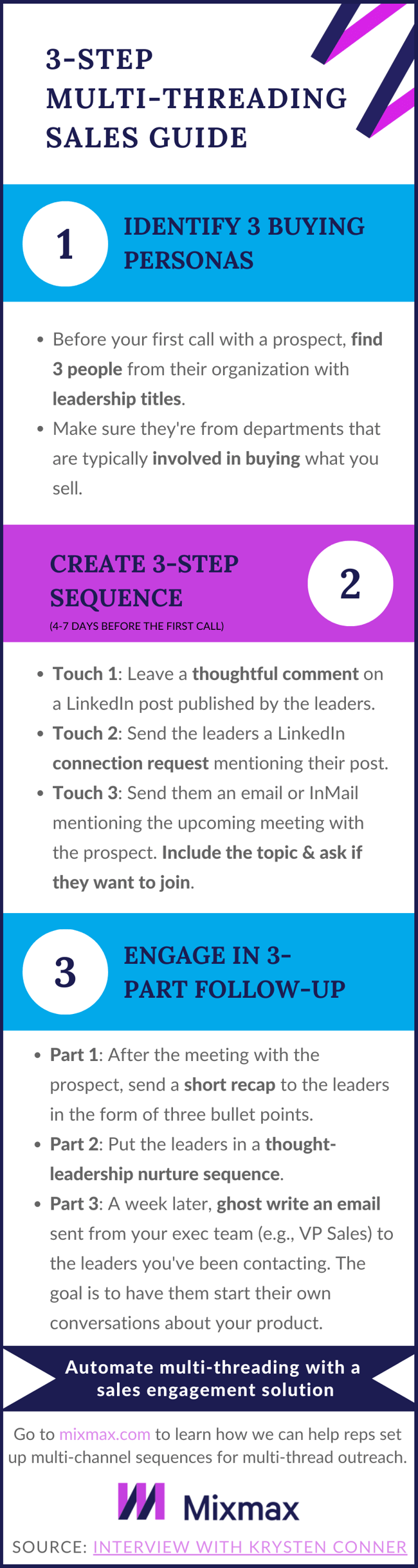
We interviewed UserGems Sales Strategist, Krysten Conner, and asked her what her foolproof multithreading process is. (You can watch the interview here).
This infographic is a representation of her 3-step guide for AEs looking to connect with buyers in leadership positions to avoid an excruciatingly long sales cycle.
Check it out ⬇️
What is Multithreading in Sales?
Beyond the Champion: Building a Web of Influence
At its core, multithreading in sales is about building relationships with multiple people inside a company you want to sell to. It’s easy to latch onto your first point of contact—your “champion”—and hope they can carry the deal across the finish line alone. But relying on a single person is a risky bet. Instead, top performers build a web of influence by connecting with everyone involved in the decision. This means reaching out to people in finance, IT, legal, and leadership. By creating multiple connection points, you’re not just selling to one person; you’re building consensus across the entire organization and embedding yourself into their process.
Uncovering Hidden Objections
When you only talk to one person, you only get one perspective. You miss the hidden concerns that can kill a deal at the last minute. By engaging directly with different departments, you can uncover and address their specific objections early on. The IT team might have security questions, finance will have budget concerns, and the end-users might worry about implementation. Having these conversations upfront allows you to proactively solve problems instead of being blindsided during the final stages. It turns potential roadblocks into opportunities to show how your solution meets everyone’s needs, making the final approval process much smoother.
De-Risking Deals When Contacts Leave
Let’s be honest: people change jobs. If your entire deal hinges on one champion and they suddenly leave the company, your deal dies with their exit interview. Multithreading is your insurance policy against this exact scenario. When you have established relationships with other stakeholders, the departure of one contact doesn’t derail your progress. The deal’s momentum continues because you have other allies who understand the value you bring. This strategy de-risks your pipeline and ensures that your hard work doesn’t vanish overnight, giving you a stable foundation to close the deal no matter who is in the room.
The Data Behind Multithreading: Why It’s Non-Negotiable
If you still think you can win big deals by relying on a single champion, the data tells a different story. The reality of modern B2B sales is that decisions are made by committee, and these committees are getting larger every year. Ignoring this fact is like trying to win a team sport by only passing the ball to one player. The numbers clearly show that the more contacts you have within an account, the higher your chances of success. Multithreading isn't just a "nice-to-have" strategy; it's a fundamental requirement for anyone serious about hitting their quota in today's complex selling environment. The proof is in the numbers, and they are too significant to ignore.
The Modern B2B Buying Committee is Bigger Than You Think
That one person you’ve been emailing back and forth with? They are just one piece of a much larger puzzle. The average B2B buying committee now involves 11 or more decision-makers. Each of these individuals has their own priorities, concerns, and the power to influence or even veto a deal. If you’re only connected to one or two people, you’re leaving your deal vulnerable to objections you’ll never even hear. You need to build relationships with the economic buyer, the end-users, the technical evaluators, and anyone else who has a stake in the outcome. Without a broad base of support, you’re simply not in control of the sale.
How Top Performers Use Multithreading to Win
The difference between an average sales rep and a top performer often comes down to their approach to account relationships. It’s not a coincidence that the best reps are masters of multithreading. In fact, research shows that 46% of top-performing salespeople have relationships with seven or more decision-makers in their most important customer accounts. They understand that winning complex deals requires building a coalition of support. They don't just find a champion; they create a network of them. This approach not only increases their win rates but also helps them build deeper, more resilient customer relationships that lead to future opportunities.
How to Identify the Full Buying Committee
Alright, so you’re sold on the *why* of multithreading. Now for the *how*. Identifying all the key players in a buying committee can feel like detective work, but it’s a skill you can master with a clear process. It starts with moving beyond the job titles on an org chart and understanding the specific roles people play in a purchasing decision. You need to map out the landscape of influence within the account. Who holds the budget? Who will use the product every day? Who needs to approve the technical and security aspects? Answering these questions is the first step to building a comprehensive multithreading strategy that leaves no stone unturned and ensures you’re talking to the right people at the right time.
Map Key Roles: The Economic Buyer, End-Users, and More
Start by mapping the buying committee. Your goal is to identify the key players and their roles in the decision-making process. Look for the economic buyer who controls the budget, the end-users who will interact with your product daily, and the gatekeepers in IT or security who need to give their approval. Each of these individuals has a different set of priorities and needs to be engaged accordingly. Use LinkedIn and your company’s CRM to piece together the puzzle. As you identify these contacts, log them in your system so you can track your outreach and ensure no one falls through the cracks. This map will be your guide for the entire sales process.
Ask for Introductions (and Test Your Champion)
Once you have a good relationship with your initial contact, don't be afraid to ask for introductions to other people on their team. A simple question like, "Who else besides you would be involved in evaluating this?" can open up new doors. This is also a great way to test how invested your champion really is. If they are hesitant to connect you with others, it might be a sign that they don't have the influence you thought they did. A true champion will be happy to make introductions because they believe in your solution and want to see it succeed within their organization. Their willingness to connect you is a strong indicator of a healthy deal.
Effective Multithreading Communication Strategies
Identifying the buying committee is only half the battle. Now you have to actually talk to them—and a one-size-fits-all message won't cut it. Each person you connect with has a different role, different priorities, and a different way of looking at the world. Your communication strategy needs to reflect that. Effective multithreading is about more than just sending more emails; it's about sending the *right* message to the *right* person at the *right* time. By tailoring your approach and using multiple channels, you can build the consensus needed to get your deal signed. This is where you can truly differentiate yourself and guide the deal to a successful close.
Tailor Your Message for Each Persona
You wouldn't give the same pitch to a CFO and an IT manager, so don't send them the same email. Speak the language of the person you’re communicating with. For the CFO, focus on ROI, cost savings, and financial risk. For the IT manager, talk about security, integration, and ease of implementation. For the end-user, highlight features that will make their day-to-day job easier. Using a tool like Mixmax, you can create and save different email templates for each persona, ensuring your message is always relevant. This targeted approach shows you’ve done your homework and respect their specific role in the process.
Use Peer-to-Peer Alignment
Sometimes, the most powerful introduction doesn't come from you. A great multithreading tactic is to align your internal team with their peers at the target account. Have your VP of Sales reach out to their VP of Sales. Have your Head of Security connect with theirs. This peer-to-peer communication builds credibility and can open doors that might otherwise be closed. It shows that your entire organization is invested in their success, not just a lone sales rep. This high-level alignment can accelerate trust and move the conversation forward in a way that a typical sales outreach simply can't.
Make Introductions Easy for Your Champion
Don’t just ask your champion for an introduction; make it incredibly easy for them to say yes. The best way to do this is by removing all the work on their end. Write a short, clear email for them to forward to the new contact. Include a brief explanation of why you want to connect and what value you can provide. With Mixmax, you can even save this as a template to use across all your deals. By drafting the message for them, you reduce the friction to zero. All they have to do is hit "Forward," making them far more likely to help you expand your network within the account.
Engage Across Multiple Channels
Email is essential, but it shouldn't be your only channel for communication. A true multithreading strategy involves engaging stakeholders wherever they are. Connect with contacts on LinkedIn, comment on their posts, and share relevant content. Pick up the phone to have a real conversation. With Mixmax's multichannel sequences, you can automate this process by building outreach cadences that include email, phone call tasks, and LinkedIn connection steps. This ensures you’re staying top of mind and building relationships across different platforms, creating a much stronger and more resilient connection to the account.
How Mixmax Simplifies Sales Multithreading
If you think this guide is intimidating and time-consuming, we’re here to tell you that it’s worth it. Plus, if you have a sales engagement solution that can automate parts of your multithreading, you’re all set.
Here are some of the features you can use to automate multithreading:
- Email sequences: For putting the leaders in a thought-leadership nurture sequence that triggers automated emails.
- Delegated sending: When you ghostwrite the email sent from your exec team.
- Templates: For the meeting recap you will send to the prospect and leaders.
- Rules (see image below): To trigger to-do tasks when it’s time to comment on a leader’s LinkedIn post or to send them a connection request.
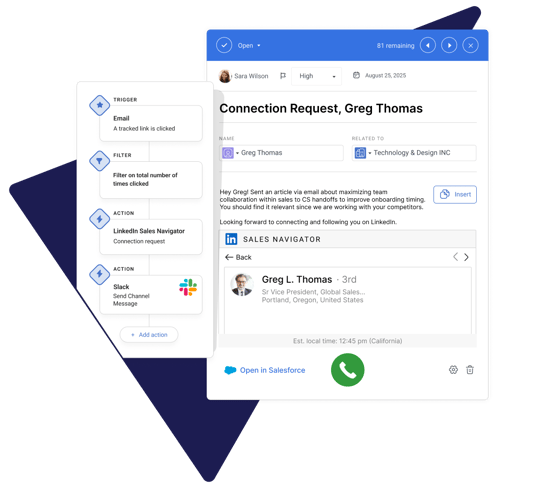
Mixmax rules: LinkedIn connection request
Ps. If you want to book a demo to talk to a sequence & rules expert, go here.
Engage the Whole Buying Committee with AI-Powered Workflows
Multithreading in sales simply means you’re building relationships with several different people inside a company you want to sell to. In any complex deal, the decision rarely comes down to one person. Engaging multiple stakeholders is your best defense against a stalled deal or a surprise "no" from a hidden decision-maker. Juggling these connections can feel like a full-time job, but it doesn’t have to be. This is where having a smart system comes into play, helping you manage outreach without letting anyone fall through the cracks.
You can use AI-powered workflows to automate parts of this process. For example, you can create a sequence that sends a series of targeted, personalized messages to different contacts at the same account over time. This ensures you’re consistently adding value and staying top-of-mind with the entire buying committee, not just your primary contact. It’s about working smarter, using automation to build wider, more resilient relationships across the organization so your deal has multiple paths to success.
Keep Your Internal Team Aligned in Gmail
Effective multithreading isn’t a solo mission; it’s a team sport. You don't have to be the expert on every single topic. In fact, your real power often comes from your ability to connect the right people from your company with their counterparts on the buyer's side. Bringing in a technical specialist to talk to their head of engineering or asking your VP of Sales to connect with their VP can build incredible trust and momentum. This shows you’re bringing the full force of your organization to the table.
To do this well, your internal team needs to be perfectly in sync. Constant app-switching and lost context are deal-killers. When your sales execution platform works inside Gmail, everyone stays on the same page without extra effort. You can loop in a colleague, share deal history, and coordinate your next move right from your inbox. This keeps your internal team aligned, allowing you to present a united, organized front to the customer and move the deal forward together.
Common Multithreading Mistakes to Avoid
While multithreading is one of the most effective ways to de-risk your deals and accelerate sales cycles, a clumsy approach can do more harm than good. If you’re not careful, you can alienate your champion, create confusion, or come across as someone who is just trying to go over people’s heads. The goal is to build a wide web of support within the account, not to burn your bridges. Knowing the common pitfalls is the first step toward avoiding them and turning multithreading into your superpower.
The most frequent stumbles happen when reps move too fast or wait too long, fail to align their own team, or inadvertently create more work for their main contact. Each of these mistakes is avoidable with a bit of strategy and foresight. Think of it less as a rigid set of rules and more as a guide to navigating complex organizational politics with grace. By understanding what not to do, you can approach each account with the right mix of patience, proactivity, and respect for your champion’s position.
Asking for Introductions Too Early
It’s tempting to end your first call by immediately asking your new contact, "Who else is involved in this decision?" But pushing for introductions before you’ve established trust and provided value can put your champion in an awkward position. They don’t know you well enough to put their own reputation on the line by connecting you with their boss or colleagues. You have to earn the right to ask for that introduction. Rushing this step can make you seem transactional and self-serving, which is the opposite of the consultative relationship you want to build.
Instead of asking for a direct introduction, try a softer approach. At the end of a valuable meeting, ask something like, “Is there anyone else who should know about this project?” This question reframes the request. You’re not asking them to be a gatekeeper; you’re inviting them to collaborate with you on the project's success. It shows you respect their role while helping you map the account and identify other key players without applying pressure.
Waiting Too Long to Start
The opposite mistake is just as dangerous: waiting too long to begin multithreading. If you put all your energy into a single point of contact, your entire deal is at risk. What happens if your champion leaves the company, changes roles, or their project gets deprioritized? Your deal dies on the vine because you have no other relationships to fall back on. Single-threading is one of the fastest ways to lose a deal you thought was a sure thing. You need to start building other connections early in the process.
You don’t have to wait for a formal introduction to get started. Before your first big meeting, do some research on LinkedIn to identify other potential stakeholders. You can reach out to these individuals with a connection request or share a relevant piece of content to begin warming them up. This proactive approach sets the stage for future conversations. By the time you do get an introduction, you’re no longer a stranger, making the entire process smoother and more effective.
Ignoring Peer-to-Peer Alignment
Great multithreading goes beyond just you connecting with multiple contacts. It’s about connecting your entire organization to the buyer’s organization at multiple levels. One of the most powerful, yet often overlooked, strategies is peer-to-peer alignment. This means having your own leaders or executives reach out to their direct counterparts at the prospect’s company. A message from your VP of Sales to their VP of Sales, or from your CEO to their CEO, carries a different kind of weight.
This high-level engagement builds trust and credibility in a way that an AE alone cannot. It signals that this deal is a strategic priority for your company, not just another transaction on your forecast. Executive alignment can help unblock stalled deals, reinforce the value proposition at the highest levels, and transform the relationship from a simple vendor-client dynamic into a true strategic partnership. It shows you’re invested in their success from the top down.
Creating More Work for Your Champion
Your champion is your internal guide, but they are also busy with their own job. Every time you ask them for something, you’re adding another task to their to-do list. The easier you make it for them to help you, the more likely they are to do it. This is especially true when asking for introductions to other people in their organization. A vague request like, “Could you introduce me to your boss?” requires them to stop what they’re doing, think about what to write, and craft an email.
Remove that friction completely. If you want an introduction, write the introduction email for them. Draft a short, clear, and compelling message that they can simply copy and paste. This small gesture shows you respect their time and makes it incredibly easy for them to say yes. You can keep these drafts as templates in Mixmax, so you’re always ready to provide one. It’s a simple tactic that dramatically increases your chances of getting connected to the next key stakeholder.
Frequently Asked Questions
What is multithreading in sales? Multithreading is the practice of building relationships with multiple people at a company you are trying to sell to. Instead of relying on a single contact, or "champion," you connect with everyone involved in the buying decision, from end-users to leadership. This protects your deal if your main contact leaves and helps you uncover potential issues early.
Why is multithreading so important for sales reps? Relying on one contact is a huge risk. If that person leaves the company or gets overruled, your deal can die instantly. The average B2B purchase now involves 11 or more decision-makers. By building multiple relationships, you ensure the deal's momentum continues, gain different perspectives on the problem you're solving, and increase your chances of closing the deal.
When is the right time to start multithreading a deal? You should start early, but not on the very first call. First, focus on building a strong relationship with your initial champion and proving your value. Once you have established some trust, you can begin identifying other key players. A good approach is to ask, "Who else on the team should be aware of this project?" This helps you map the organization without putting your champion in an awkward position.
How can I identify the other people on the buying committee? Start by researching the company on LinkedIn to identify potential stakeholders in different departments like finance, IT, and leadership. You can also ask your champion for introductions. To make it easy for them, draft the introduction email yourself so all they have to do is forward it. This removes the work on their end and makes them more likely to help you connect with others.
How can Mixmax help with my multithreading strategy? Mixmax helps you manage these multiple relationships without getting overwhelmed. You can use AI-powered workflows to automate outreach to different contacts, ensuring no one falls through the cracks. You can also save email templates tailored to different roles, like a CFO or an IT manager, so your message is always relevant. Because it works inside Gmail, your whole team can stay aligned on deal progress without switching apps.
Key Takeaways
- Build a web of influence, not a single point of failure: Relying on one champion is a huge risk. Multithreading means building relationships with multiple decision-makers across the buying committee, from finance to IT, to protect your deal if your main contact leaves or gets overruled.
- Map the committee and tailor your message: Identify the key players like the economic buyer, end-users, and technical evaluators. Then, speak their language. Discuss ROI with the CFO, security with IT, and daily efficiency with users to make your message relevant to each stakeholder.
- Make it easy for your champion to help you: Don't just ask for introductions; remove the friction. Write the introduction email for your champion to forward. This simple step respects their time and makes them far more likely to connect you with other key people in the account.
Related Articles
- Multithreading sales: The ultimate guide to win more deals | Mixmax
- 10 Top Sales Prospecting Challenges & How to Overcome Them | Mixmax
- 9 Sales Prospecting Best Practices for Higher Success Rates | Mixmax
- 10 Actionable Sales Productivity Tips to Close More Deals | Mixmax
- 55 Sales Prospecting Questions to Get Your Prospects Talking | Mixmax