
Let’s be honest, the idea of using AI for customer success can feel a little strange. We build relationships on human connection, not algorithms, right? But what if you’re spending all your time reacting to problems instead of actually connecting? The right customer success AI can change that. Instead of just putting out fires, you can anticipate needs and spot opportunities your team might otherwise miss. This guide shows you how specific AI tools for customer success help you shift from reactive to proactive, freeing you up to build even stronger relationships.
After all, successful customer success is about building personal relationships with customers, and automation has a tendency to remove personality and warmth from client interactions.
But, smart customer success teams aren’t outsourcing their nuanced conversations to AI-powered chatbots.
Instead, they’re using AI tools to automate routine tasks and uncover customer insights so they can spend more time having high-quality conversations with buyers.
Today, you’ll learn five ways to integrate AI into your CS workflows to boost productivity, improve renewal rates, and enhance the overall customer experience — all while keeping your CS strategy human-centric.
- Why use AI for customer success?
- 5 ways to use AI for customer success
- Check out Mixmax for customer success
How Can AI Improve Customer Success?
AI software tools and generative AI are becoming popular productivity boosters for CS teams.
In fact, a 2024 survey of Customer Success professionals found that 52% of CS teams are already using artificial intelligence in some shape or form.
The majority of respondents are using AI tools for tactical rather than strategic purposes — e.g., writing faster emails vs. using AI-powered data analysis to inform CS goals.
Going forward, however, AI will become a more popular tool for big-picture decision-making, providing CS teams with data-driven insights that guide the creation of effective onboarding, expansion, and save strategies.
In fact, in the same report, CSMs predicted that AI’s greatest impact will be on product engagement and customer onboarding:
When it comes to automation**, Customer Success pros think AI will be most helpful for data analysis tasks:
- Pre-call customer research
- At-risk customer identification
- Deeper insight into customer preferences
- Customer journey mapping
Stronger analysis means a deeper understanding of your customers, which enables you to conduct more personalized outreach, upsell recommendations, and strategic advice (because the best CS managers act as trusted advisors).
Overall, AI helps customer success teams do more with less.
Mark Higginson, Chief of Customer Success at ScreenSteps, agrees:
“By automating routine tasks and providing data insights, AI allows our team to focus on higher-value activities, which helps us in achieving our customer success goals without burnout.” — Mark Higginson, State of Customer Success Report
5 Actionable Ways to Use AI in Customer Success
Below are five ways CS teams can boost productivity and performance with artificial intelligence.
1. Improve customer onboarding and training
Every kid learns to ride a bike differently. Some hop on and ride off with little help at all. Others need a lot of encouragement, instruction, and steadying.
The same can be said for your newly acquired customers.
The difference is that clients don’t scream, wobble, and tell you what’s bothering them. They just truck on and then complain later, writing on review sites that your company’s onboarding process is weak.
That’s where AI comes into play.
Customer success leaders can use it to better understand customer needs and provide more personalized onboarding experiences that deliver the right educational content for them.
Here are some ways to incorporate AI into your onboarding process:
- Analyze welcome email and onboarding survey responses to get a better sense of how much hand-holding the customer will need.
- Embed AI chatbots into apps and platforms so customers can ask questions about features and receive personalized guidance.
- Use machine learning to better understand product usage patterns so you can spot teaching and training opportunities.
- Measure the sentiment of customer answers to open-ended questions about their onboarding experience.
- Leverage AI-powered translation tools to provide onboarding in the customer’s native language.
- Create quality training videos with AI video generation platforms like Synthesia (without actors, cameras, or lighting).
By using these AI-forward techniques to personalize onboarding, your CS team will generate higher usage rates and less churn.
2. Use AI for proactive education
The best customer support is the kind your clients never have to ask for. Instead of waiting for them to run into a problem, you can use AI to educate them proactively. AI tools excel at delivering tailored communication at scale, sending relevant, data-driven insights to customers throughout their journey with your product. This approach shifts the dynamic, positioning your customer success managers (CSMs) as strategic partners who anticipate needs, rather than just reactive problem-solvers. It’s about providing value before it’s requested, which builds incredible trust and loyalty over time.
So, how does this work in practice? AI can analyze customer interactions and product usage data to better understand customer needs and goals. It can also perform sentiment analysis on emails and support tickets to gauge how a customer is feeling, even if they don’t state it directly. Based on these insights, AI can help you curate and share relevant industry trends or product tips that help them succeed. This ensures customers are constantly discovering new ways to get value from your product, which keeps them engaged and satisfied long-term.
Proactive education is also a powerful tool for reducing churn. AI can help identify at-risk customers by spotting dips in engagement or negative sentiment. This is where AI-powered workflows become invaluable; you can set up triggers to automatically send helpful resources or personalized check-ins to these customers, strengthening the relationship before it sours. By automating this outreach, you free up your CSMs to focus on higher-value activities, like preparing for important client meetings and providing strategic advice that drives expansion.
2. Automate simple customer support issues
According to the State of Customer Success Report, over 45% of CSM teams handle some or all of the company’s inbound customer inquiries.
That’s far too high a number — CSMs have better things to do than help customers recover lost passwords.
To lighten the load, consider building an AI-powered support chatbot that understands natural language.
That way, customers can get personalized answers to simple questions about billing and technical issues, without inconveniencing their CSM.
You can connect these chatbots to your company’s knowledge base so they can recommend tutorials and guides that solve the customer’s issue.
How do you build these bad boys?
Most customer service software tools now offer the ability to build custom AI chatbots.
For example, Salesforce offers Agentforce, which allows you to build AI agents in minutes using templates. You can even use generative AI to define the role of the chatbot:
With AI taking over basic inquiries, CSMs will have more time to focus on proactively building relationships with clients, developing account expansion strategies, and more.
Learn the six customer success automation rules that boost renewals.
3. Implement smart ticket routing
When a customer has a problem, the last thing they want is to be bounced between departments. Smart ticket routing uses AI to prevent this by automatically analyzing and directing incoming support tickets. Instead of just lining up requests in a queue, AI can send customer issues to the most qualified agent based on the problem’s topic, urgency, and even the customer’s history. This means technical questions go straight to engineers and billing issues go to finance, leading to much quicker resolutions.
This level of automation frees up your CSMs to focus on strategic initiatives instead of playing traffic cop with support requests. By integrating AI-powered workflows, you can even use predictive analytics to flag tickets from at-risk accounts, pushing them to the front of the line for immediate attention. It’s a simple way to improve response times and deliver a more personalized, efficient customer experience.
3. Identify at-risk customers
AI has the potential to identify at-risk customers so you can swoop in and save them before it’s too late.
It does this by analyzing large amounts of customer data:
- Purchase history
- Product usage
- Feedback and survey results
- Email engagement levels
How do you set this up?
Churn prediction software is your best bet.
Akkio, for instance, automatically detects customer patterns that indicate an account is likely to churn. It can even spot when new customers might need extra onboarding support.
The machine learning algorithm bases its predictions on behavioral data, transaction history, customer demographics, engagement levels, and more. Users can upload this data from their CRM or other data sources, and Akkio will automatically clean and analyze it.
Now, if you’re a seasoned CS pro, your gut is still a strong indicator that an account has gone sour.
But these machine learning algorithms can interpret online behavior about as well as you can read into the facial expressions of an old client.
And with customer activity happening increasingly online, it’s best to have both prediction methods in your repertoire.
P.S. You can learn more about machine learning in sales here.
Generate predictive customer health scores
In customer success, you can’t afford to guess how a client feels about your product or service. Predictive customer health scores take the guesswork out of the equation by using AI to provide a clear, data-driven look at customer satisfaction and potential churn risk. Instead of reacting to problems after they happen, these scores let you get ahead of them. By analyzing multiple data points at once—like product usage, support tickets, and communication frequency—AI tools can build a comprehensive health score that gives you a real-time pulse on every customer relationship, letting you know who needs your attention most.
AI analyzes usage data and interaction history to predict churn risk and identify expansion opportunities, allowing Customer Success Managers (CSMs) to act before issues escalate. This proactive approach is a game-changer for any CS team. It helps you move from a reactive, fire-fighting mode to a strategic, preventative one. When you can clearly see which customers are at risk, you can focus your energy on targeted interventions that make a real difference and improve your overall customer retention rates, ensuring small issues don’t turn into reasons for leaving.
Stronger analysis means a deeper understanding of your customers, which enables you to conduct more personalized outreach, upsell recommendations, and strategic advice. As noted in the State of Customer Success Report, CSMs are increasingly using AI for data analysis to map customer journeys and pinpoint preferences. This deeper insight allows you to tailor your communication and strategy, transforming your role from a simple account manager to a trusted advisor who truly understands the customer’s goals and challenges, leading to more meaningful and productive conversations.
For instance, tools like Akkio use machine learning algorithms to find patterns that signal an account is likely to churn. By integrating behavioral data, transaction history, and engagement levels, these platforms offer a detailed view of customer health. Once a low score is flagged, you can use AI-powered workflows to automatically trigger a re-engagement sequence, ensuring no at-risk customer slips through the cracks and your response is both immediate and personal.
4. Form stronger relationships through more informed conversation
AI robots won’t be taking CSM positions anytime soon. Genuine trust is built on human conversation.
Cristy Rahman, Customer Success Specialist, makes this very clear:
“Good customer success involves knowing your clients at a personal level by disarming them and letting them lean on you to share more than they would with anyone else… all things that cannot be replaced by AI…” — Cristy Rahman, State of Customer Success Report
While CSMs shouldn’t have AI tools speak to clients for them, they should use these tools to better understand the businesses and industries they serve.
Because when you know your buyer’s situation, you can ask pointed questions and provide informed insights, which lead to conversations that make the client go “wow, they know their stuff. I like talking to them. I always learn something new.”
A simple way to use AI to become a better conversationalist is with ChatGPT.
Before a client meeting or conference, ask the chatbot various questions about your industry (aka market research) that will prepare you for deep conversation:
- What are some recent trends and shifts in [industry]?
- My client is a [company type]. What are some problems they might be having in [year]?
- Who are the major competitors in this industry, and what differentiates them?
- What does the future of this industry look like in the next 3-5 years?
Let’s take an example.
Say you’re a CSM for a proptech company and you have a meeting with the new VP of Facilities Management for a warehousing company. Your old contact unfortunately left the company, and now you have to prove your expertise all over again.
To refresh your memory, you might ask ChatGPT the following:
Prompt: “What are some of the biggest challenges warehousing companies have been facing over the last few years?”
After reading through these ten categories of challenges, select a few to ask about in conversation — “How have you been handling the [challenge]?” (it’s best to ask about a challenge that an upsell or cross-sell could solve).
In sum, AI chatbots like ChatGPT are great for streamlining industry research so you can easily learn industry trends to have more interesting conversations with customers.
Leverage conversation intelligence
Think about all the time you spend re-listening to recorded calls to find that one specific thing a customer said. Conversation intelligence tools use AI to do this work for you. Instead of scrubbing through an hour-long recording, you can simply ask the tool a question like, “What were the customer’s main goals for this quarter?” The AI will analyze the transcript and provide a direct answer. Some tools can even show you exactly where in the conversation they found the information, so you can quickly double-check the context. This gives you a faster, more accurate way to understand customer sentiment and key discussion points, helping you prepare for your next interaction with a much deeper level of insight.
Streamline meeting preparation and follow-up
Meeting prep and follow-up are non-negotiable for building strong customer relationships, but they can eat up a huge chunk of your day. AI can handle the administrative heavy lifting so you can focus on the strategic parts of the conversation. Before a meeting, AI can help you prepare by outlining key topics based on recent customer support tickets or previous call notes. After the call, it can generate a concise summary, pull out a list of action items, and even draft a follow-up email for you to review and send. By using AI-powered workflows to manage these tasks, you can send timely, accurate follow-ups in minutes instead of hours, ensuring no detail or commitment gets missed.
5. Personalize customer engagement
Whether it’s a pitch for an upsell or a simple check-in message, CSMs can use an AI-powered sales engagement platform to write more personalized engagement emails.
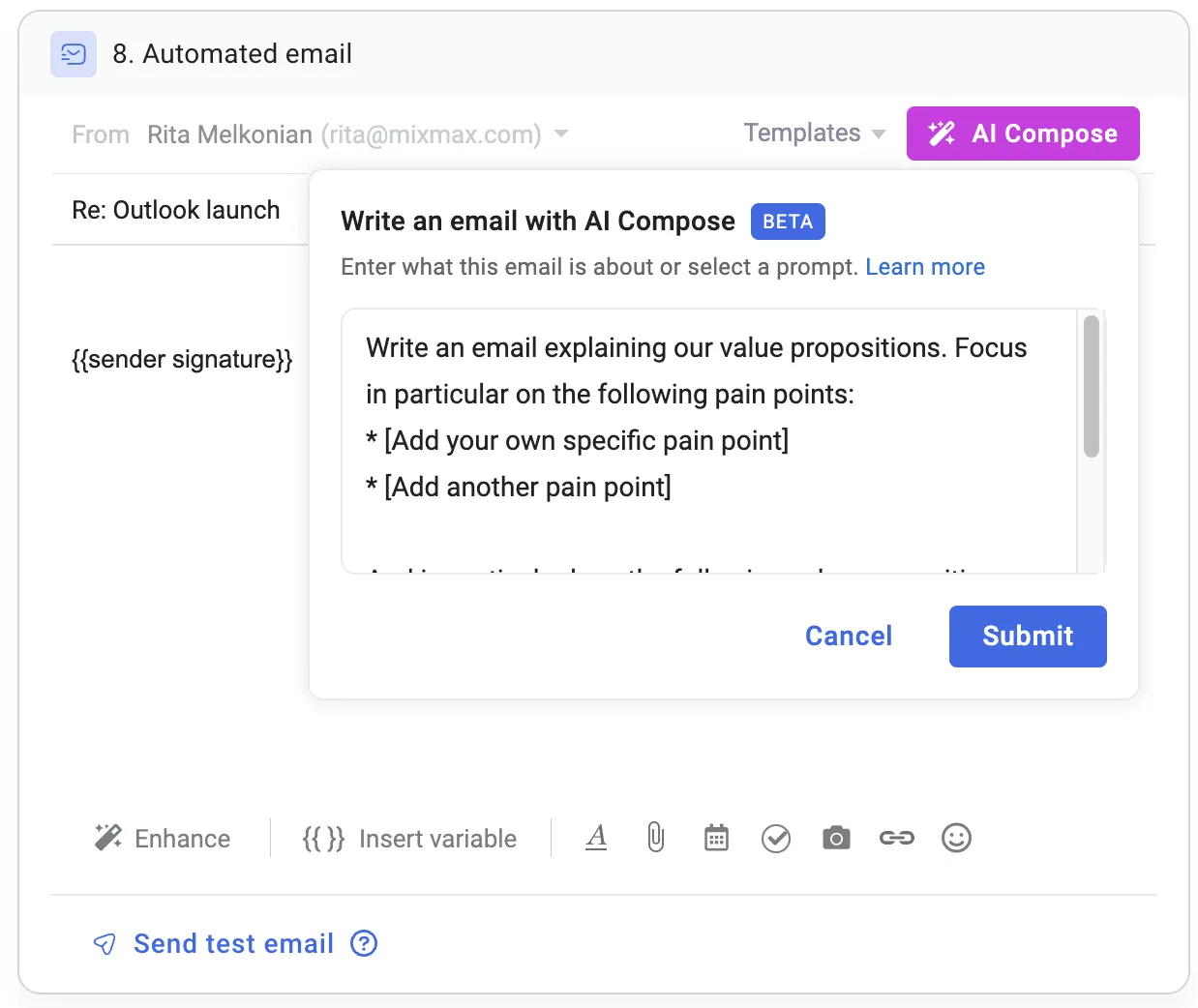
Mixmax, for example, offers an AI writing assistant called AI Compose. By feeding it text prompts, CSMs can generate high-quality email content and subject lines in seconds.

Mixmax also offers AI Smart Send, which uses machine learning to identify the best times to send emails to customers. The result? Higher open rates and better engagement.
Further, CSMs can use the AI sequence builder to generate multi-channel outreach sequences that align with specific customer success goals.
Simply submit details about your sequence’s target customer segment and your value proposition and voila — you’ve created a multichannel campaign with targeted emails that your success team can use to promote new products, re-engage customers, and facilitate renewals.
Barriers and Challenges to AI Adoption in Customer Success
While the benefits are clear, switching to an AI-assisted customer success model isn’t always a walk in the park. Like any significant operational shift, it comes with a few hurdles. Understanding these potential roadblocks is the first step to creating a smooth and successful transition for your team. From technical puzzles to the very human fear of change, being prepared for these challenges will help you address them head-on and keep your implementation on track. Let’s look at some of the most common barriers teams face when bringing AI into their CS workflows.
Lack of AI expertise and integration issues
One of the biggest initial challenges is that many companies simply don’t have a deep bench of AI experts on staff. This skills gap can make it difficult to choose the right tools and implement them effectively. On top of that, getting new AI software to communicate with your existing systems, like your CRM or other legacy platforms, can be a significant technical challenge. According to research from Gainsight, these integration issues are a common pain point, requiring careful planning and sometimes specialized technical help to ensure all your platforms work together seamlessly without disrupting your current operations.
Concerns about AI reliability and team resistance
It’s natural for people to be wary of new technology, especially when it involves their jobs. Some CSMs might worry that AI will make their roles obsolete or simply don’t trust its reliability yet. This resistance is often rooted in a fear of change. As one CSM on Reddit noted, overcoming this requires showing your team how AI acts as a helpful assistant, not a replacement. The goal is to demonstrate how these tools can handle repetitive tasks, freeing them up to focus on the strategic, relationship-building work that humans do best and that truly drives customer loyalty.
Data security and privacy risks
Whenever you introduce a new tool that handles customer information, data security becomes a top priority. Companies are rightfully concerned about the privacy implications of feeding sensitive customer data into AI models. Establishing clear governance and strict protocols for how data is used, stored, and protected is non-negotiable. This isn’t just about compliance; it’s about maintaining the trust you’ve built with your customers. You need to ensure that your AI adoption strategy includes a robust plan for data security from day one.
Best Practices for Implementing AI in Customer Success
Navigating the challenges of AI adoption is much easier when you follow a clear set of best practices. Instead of just flipping a switch and hoping for the best, a thoughtful and strategic approach will ensure you get the most out of your new tools while keeping both your team and your customers happy. By focusing on collaboration, transparency, and continuous learning, you can integrate AI in a way that enhances your human-centric approach to customer success rather than undermining it. These guiding principles will help you build a solid foundation for long-term success.
Keep a human in the loop
The most effective way to use AI in customer success is to treat it as a co-pilot, not an autopilot. As the team at ChurnZero puts it, AI works best as an “engine” powered by human “pilots.” AI can analyze data, surface insights, and automate routine tasks, but it’s the CSM who brings empathy, strategic thinking, and relationship-building skills to the table. This blend of AI-driven efficiency and human intuition is what creates a truly exceptional customer experience. Always ensure that a person has the final say in customer interactions and strategic decisions.
Be transparent with customers
Honesty is crucial for maintaining trust. If you’re using an AI chatbot for initial support queries or an algorithm to personalize communications, be upfront about it. Zendesk advises that telling customers when and how you’re using AI shows that you’re operating responsibly and gives them confidence in your process. This transparency manages expectations and prevents situations where a customer feels like they’re being tricked by a robot. It reinforces that you value your relationship with them and are using technology to serve them better, not to replace genuine connection.
Focus on continuous improvement
AI is not a “set it and forget it” solution. To remain effective, AI models need to be constantly trained and refined based on real-world interactions. This means regularly reviewing the AI’s performance, gathering feedback from your team, and making adjustments to the algorithms and workflows. Think of it as an ongoing learning process for both your team and the technology. By committing to continuous improvement, you ensure that your AI tools stay accurate, relevant, and aligned with your evolving customer success goals.
How CSMs Can Develop Essential AI Skills
As AI becomes more integrated into customer success, CSMs have a fantastic opportunity to expand their skill sets and become even more effective in their roles. This isn’t about becoming a data scientist overnight. Instead, it’s about learning how to work alongside AI to make smarter decisions and build stronger relationships. By focusing on a few key capabilities and adopting the right mindset, you can confidently use AI to your advantage. Here’s how you can start developing the essential skills to thrive in an AI-powered CS environment.
Master key AI capabilities
To get started, focus on understanding the core functions that AI can perform to make your job easier. According to Gainsight, CSMs can get immediate value by using AI for tasks like generating text for emails and meeting agendas, summarizing calls, and quickly finding answers to customer questions. These capabilities are designed to handle the time-consuming administrative work, giving you more time to focus on strategic initiatives and direct customer engagement. Familiarizing yourself with these practical applications is the first step toward making AI a natural part of your daily routine.
Summarizing calls and extracting data
Imagine finishing a long customer call and instantly having a concise summary with key takeaways and action items waiting for you. AI-powered meeting tools can do just that by transcribing and analyzing call recordings. This eliminates the need for frantic note-taking and ensures you never miss an important detail or commitment. It allows you to be fully present in the conversation, knowing that the AI is capturing the necessary information for your follow-up and CRM updates, making your post-call workflow incredibly efficient.
Classifying information and sentiment
AI is also incredibly skilled at sifting through large volumes of customer feedback—from surveys, support tickets, and emails—to identify trends and gauge sentiment. It can automatically classify feedback as positive, negative, or neutral and categorize issues by topic, such as “billing problem” or “feature request.” This allows you to quickly spot at-risk customers, identify widespread issues, and prioritize your outreach without having to manually read through every single piece of feedback, giving you a clear, data-backed view of customer health.
Adopt a conversational approach with AI
Interacting with generative AI is more of a conversation than a simple search. Instead of typing a query and expecting a perfect answer on the first try, think of it as a dialogue. You provide an initial prompt, review the output, and then offer feedback or ask follow-up questions to refine the result. For example, you might ask it to make the tone more formal, shorten the response, or add specific details. This iterative process helps the AI better understand your intent and deliver a much more accurate and useful outcome.
Train AI to match your style and tone
One of the best ways to keep your communications authentic is to train your AI tools to write like you. Many modern platforms allow you to feed the AI samples of your writing, so it can learn your specific style, tone, and vocabulary. This ensures that when you use AI to help draft an email or create a follow-up sequence, the output sounds genuinely like you, not a generic robot. By personalizing the AI’s voice, you can maintain consistency and warmth in your customer interactions, even when using AI-powered workflows to help you scale your engagement efforts.
Bring AI to Your Customer Success Workflow
Is your customer success team spending enough time engaging with customers?
Mixmax is an easy-to-use, AI-powered sales engagement platform for your entire revenue department, from SDRs to customer success reps.
It helps you reach your customers in a personalized manner via automated multichannel sequences, AI email generation, and more.
Sign up for a free trial below to learn how Mixmax can help your CS team do more with less ⬇️
Streamline tasks with AI-powered workflows
Customer Success Managers often get bogged down by administrative work that pulls them away from building strong customer relationships. Think about the time spent on manual data entry, updating CRM records, and sending repetitive follow-ups. AI is the perfect assistant for these jobs. It handles the routine stuff, allowing CSMs to shift from being task-handlers to strategic advisors who have a real impact on customer growth and retention. This shift improves efficiency and helps prevent burnout by letting your team work on more fulfilling, high-value projects.
This is where AI-powered workflows come in. You can set up triggers that automatically handle next steps based on customer actions. For example, if product usage drops, a workflow can schedule a check-in task for the CSM. Or, if a client opens a renewal email three times, it can trigger a notification for a follow-up call. This intelligent automation ensures your team can engage proactively, not just reactively, so no opportunity is missed and you can focus on what really matters: the customer.
Frequently Asked Questions
Is the goal of AI to replace customer success managers? Not at all. Think of AI as a highly efficient assistant, not a replacement. Its purpose is to handle the repetitive, time-consuming tasks that can bog you down, like summarizing calls, analyzing usage data, or drafting routine emails. This frees you up to focus on the strategic, relationship-driven work that truly matters—building trust, understanding client goals, and acting as a valued advisor.
I’m not a tech expert. How can I start using AI in my daily work? You don’t need a technical background to get started. A simple and effective first step is to use a tool like ChatGPT for meeting preparation. Before a client call, ask it to summarize recent trends in their industry or list common challenges for their type of business. This gives you instant talking points and helps you lead more insightful, valuable conversations.
How can I use AI to build stronger relationships without sounding like a robot? The key is to always keep a human in the loop. Use AI to generate ideas or first drafts, but you should always be the one to add the final, personal touch. For instance, let an AI tool create a meeting summary, but you should write the follow-up email that goes with it. This approach combines the speed of automation with the authenticity and empathy that only you can provide.
What’s the difference between using AI for proactive vs. reactive support? Reactive support is what happens after a customer has a problem and reaches out for help. Proactive support uses AI to get ahead of those issues. AI tools can analyze data to identify early warning signs, like a dip in product usage or negative sentiment in an email. This allows you to reach out with helpful resources or a personal check-in before a small issue becomes a reason for them to leave.
My team is worried about data privacy. How can we use AI responsibly? That’s a completely valid concern, and it should be a priority. The best approach is to choose reputable AI platforms that have robust security measures in place. It’s also important to be transparent with your customers about how you use technology to support them. By establishing clear internal guidelines and putting security first, you can use AI to enhance your workflow while maintaining the trust you’ve worked so hard to build.
Key Takeaways
- Reclaim your time for relationship-building: Let AI-powered workflows manage administrative tasks like summarizing calls and routing support tickets. This frees you up to focus on the strategic, human-centric work that builds lasting customer loyalty.
- Shift from reactive to proactive support: Use AI to analyze customer data and predict potential issues before they escalate. By identifying at-risk accounts early, you can provide targeted support that prevents churn and strengthens the partnership.
- Use AI as your research assistant: Prepare for meetings more effectively by using AI to gather insights on industry trends and customer challenges. This allows you to lead more informed, valuable conversations that position you as a trusted advisor.