
You know that physical Action button on newer iPhones? It’s a single, programmable shortcut to a function you use all the time, like opening the camera. That same principle of one-click convenience exists in the software you use for work. It’s called the more actions button, and it serves the exact same purpose: to give you quick access to your most needed tasks. Whether you’re in your CRM or your inbox, this button provides a menu of relevant next steps, turning a static page into a dynamic workspace that helps you move work forward.
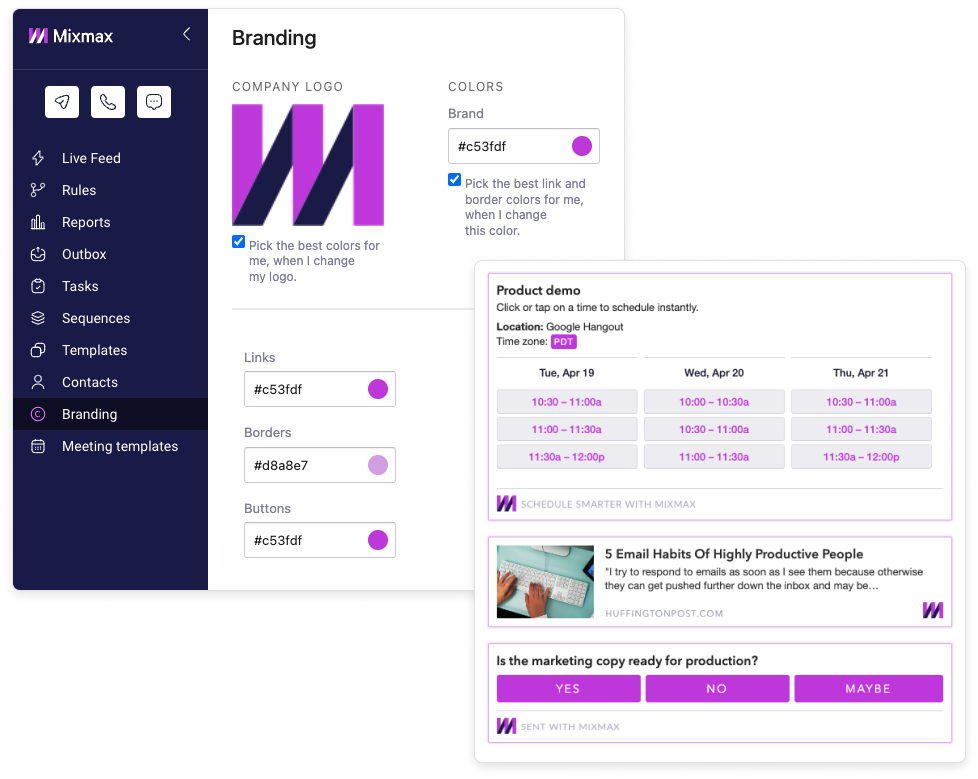
When you’re writing emails in plain text, getting your readers to see what action to take is challenging. Now, with Mixmax Call to Action buttons, you can add visually enticing buttons instantly.
Call to Action buttons are a great way to connect your contacts to your website and social media profiles.
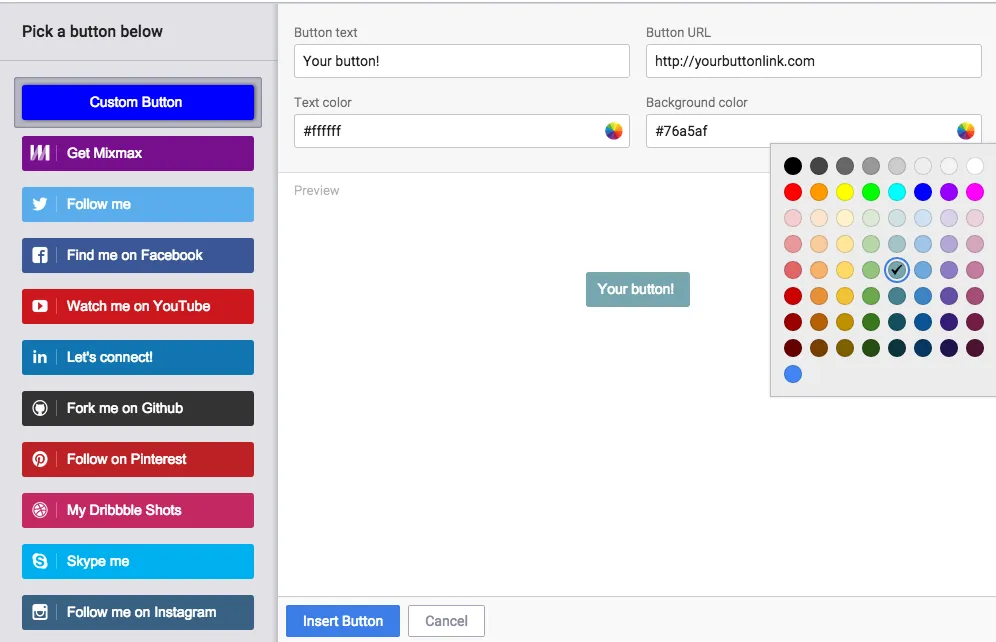
We’ve integrated with Facebook, Twitter, Pinterest, Instagram, Skype, Dribbble, YouTube and more to enhance your email with distinctive links that help drive traffic to your shared links. You can also create custom buttons with your own text and colors.
What Does the More Actions Button Do?
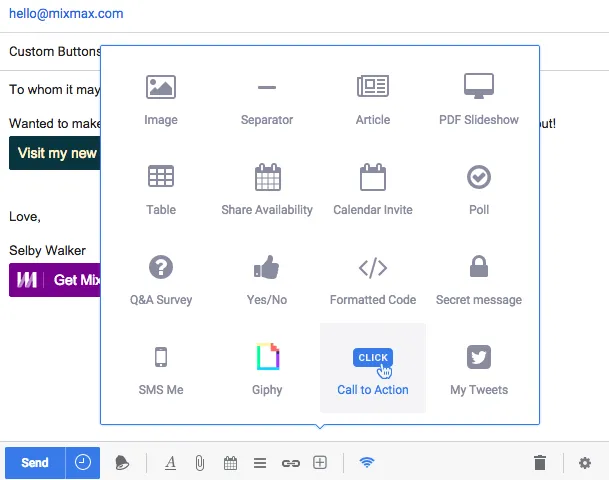
When writing a message in Mixmax, click the plus icon in the bottom toolbar of your Compose window.
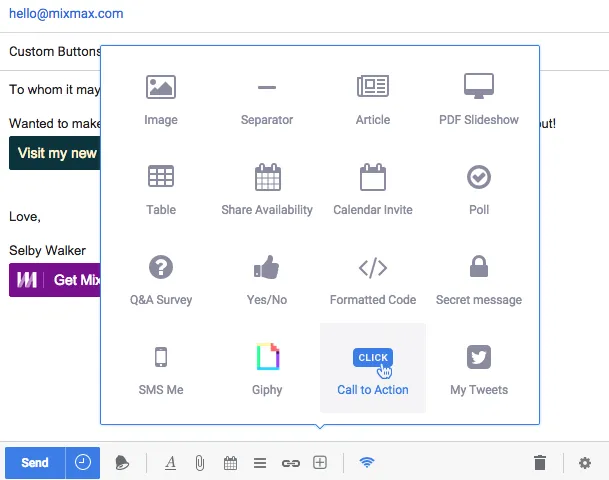
Then, click “Call to Action” to open the button options menu. Customize the button to your specification and click Insert Button to add it to your email.
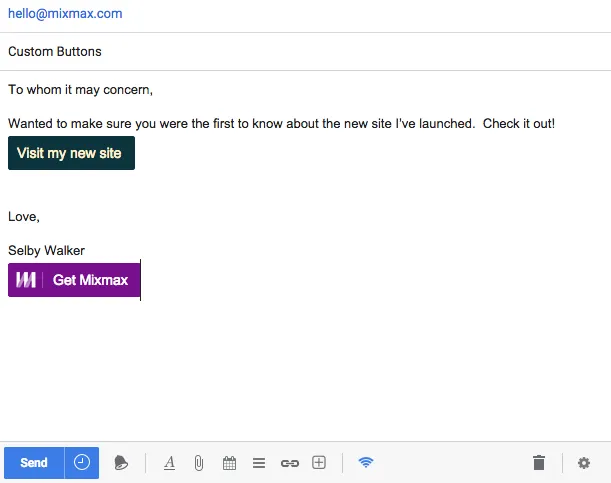
You can add Call to Action buttons to any area of your email, including your custom signature. When you need to direct your reader’s focus to an important action, Mixmax Call to Action buttons are a great tool to get the job done.
Install for free to try it out right now. Call to Action buttons are another example of how Mixmax makes email more powerful for professionals. If you have thoughts on how we can boost your productivity or supercharge your email, we’d love to hear from you. Reach out to us at hello@mixmax.com and follow us @Mixmax.
The “More Actions” Button in Software Applications
Beyond a simple call to action, many software applications use a “More Actions” button, often shown as three dots or a plus symbol. This small but mighty feature acts as a menu for contextual tasks. It’s designed to keep you in your workflow, giving you a list of relevant next steps without forcing you to navigate to a different screen. Think of it as a command center for whatever you’re currently working on, whether it’s a customer account in your CRM or an email thread in your inbox. The goal is to keep the main interface clean while making sure your most common tasks are just a click away.
Definition and Purpose in Your Workflow
The “More Actions” button is a user interface element that contains a dropdown menu of secondary actions related to a specific item on your screen. Its primary purpose is to reduce clutter and help you maintain focus. Instead of overwhelming you with every possible option at all times, it neatly tucks away tasks that are useful but not essential for the immediate view. For sales reps, this is crucial. It means you can send an approved email, log a call, or create a task right from an account page, keeping you in a productive flow instead of making you hunt through different tabs to get things done.
Example Actions in a Business Context
In a business setting, the options inside a “More Actions” menu are tailored to your role. For example, after a client call, you might see options to create a follow-up medical inquiry, place a new product order, or start an inventory check. These are all logical next steps that the software anticipates you might need to take. This contextual awareness is what makes the feature so effective. It turns a static page into a dynamic workspace, prompting you with relevant actions that help move deals and relationships forward without interrupting your momentum or requiring you to switch applications.
Starting AI-Powered Workflows
Modern sales tools take this concept even further by letting you kick off entire automated sequences from a “More Actions” menu. For instance, right from an email thread in your inbox, you could add a prospect to a multi-step outreach campaign. Mixmax uses this principle to help reps trigger AI-powered workflows without ever leaving Gmail. This saves a massive amount of time that would otherwise be spent on manual data entry and task creation, ensuring important follow-ups never slip through the cracks and freeing you up to focus on selling.
How Configuration and Permissions Work
What you see in the “More Actions” menu is rarely the same for everyone on your team. These menus are typically configured by an administrator based on user roles and permissions. A sales manager might see options for running reports or reassigning accounts, while an individual rep will only see actions relevant to their own tasks. This ensures that the interface remains simple and secure. You only get the tools you actually need, which prevents accidental clicks and keeps you focused on the actions that fall within your responsibilities, making the software feel tailored specifically to you.
Availability Across Platforms
This design pattern isn’t limited to your desktop. The “More Actions” button is a standard feature you’ll find across web browsers, tablets, and smartphone apps. This consistency is key, as it creates a predictable and intuitive user experience no matter which device you’re using. Whether you’re updating an account on your laptop in the office or logging a quick note from your phone on the go, you know exactly where to look for your next set of actions. This makes it easier to learn and use complex business software, ensuring you can be productive from anywhere.
The Physical “Action Button” on Devices
The idea of having quick access to your most-needed tasks isn’t just for software. It has a physical counterpart: the “Action button” found on devices like the iPhone. This feature takes the same principle of convenience and applies it to hardware. It’s a single, customizable button on the side of your phone that you can program to perform a specific task instantly. Instead of unlocking your phone, finding the right app, and navigating its menu, you can just press a button. It’s the real-world equivalent of a one-click workflow, designed for speed and efficiency in your daily life.
Definition and Context on Hardware
The Action button is a programmable physical button on certain iPhone models that gives you a shortcut to a function you use frequently. By default, it might be set to toggle Silent mode, but its real power lies in customization. The purpose is to eliminate the small, repetitive steps you take dozens of times a day. Think about how many times you open the Camera app or turn on a flashlight. The Action button lets you bypass the screen entirely for these common tasks, making your device feel more responsive and integrated into your physical movements and habits.
How to Customize the Action Button
You can easily choose what the Action button does by going into your phone’s Settings. Apple provides a list of preset functions you can assign to it, such as opening the Camera, turning on the flashlight, starting a voice memo, or activating a Focus mode. The process is straightforward, allowing you to customize the button in just a few taps. This lets you tailor your device to your specific needs, turning a generic piece of hardware into a personalized tool that anticipates your most common actions.
Common Customization Options
The most common uses for the Action button reflect everyday needs. You can set it to instantly open the Camera, so you never miss a candid moment. If you’re often in meetings, you might program it to turn on your “Do Not Disturb” Focus mode with a single press. Other popular options include launching the Magnifier for reading small text or starting a Voice Memo to capture a quick thought. It’s all about identifying your most frequent action and making it effortless, saving you a few seconds each time—which quickly adds up over the course of a day.
Advanced Functionality with Shortcuts
For those who want to take it a step further, the Action button can be linked to Apple’s Shortcuts app. This unlocks nearly limitless possibilities. You can create a custom shortcut that performs a series of actions at once. For example, a single press could start your workout playlist, open your fitness tracking app, and text your friend that you’re starting. As users on platforms like Reddit have shown, you can even program different actions for a single press versus a double press, turning one button into a multi-function command center.
Disabling the Action Button
Of course, a physical shortcut is only useful if you want it. If you find you’re pressing the Action button by accident or you simply prefer not to use it, you have the option to disable it completely. In the same settings menu where you customize its function, you can choose to assign no action to it. This ensures the button won’t do anything when pressed, giving you full control over your device’s functionality. It’s a small detail, but it underscores the user-centric design philosophy: the feature is there to help, but only if you want it to.
Frequently Asked Questions
What’s the difference between a “Call to Action” button and a “More Actions” button? A Call to Action button is for your audience. It’s a visual button you place inside an email to guide your reader to a specific link, like your website or social media profile. A “More Actions” button is for you, the software user. It’s a menu within your application that gives you a list of relevant tasks you can perform, like logging a call or adding a contact to a sequence.
Why hide options behind a button? Isn’t it better to see everything at once? Showing every possible option on a screen creates a lot of clutter. A “More Actions” button keeps your workspace clean so you can focus on the task at hand. It presents a short, smart list of next steps that are relevant to what you are currently doing. This design helps you make decisions faster without getting overwhelmed by choices you don’t need at that moment.
How does a “More Actions” button actually help me in my sales role? It keeps you in a productive flow. Instead of leaving your inbox to update your CRM, you can trigger your next step right from an email thread. For example, you can add a prospect to an outreach sequence or log a call without switching tabs. This saves a significant amount of time on administrative work, letting you focus on building relationships and closing deals.
Can I change what appears in the “More Actions” menu in my software? While you usually can’t edit the menu yourself, your team’s administrator often can. They typically configure the options based on user roles. A sales manager might see actions related to reporting and account assignment, while a sales rep sees actions for managing their own pipeline. This ensures the tools you see are tailored to your specific responsibilities.
You mentioned advanced workflows. Can these buttons really do more than just one simple task? Yes, they can trigger multi-step processes. On a device like an iPhone, the physical Action Button can launch a custom Shortcut that performs several actions at once. In sales software, a “More Actions” button can initiate entire AI-powered workflows. With Mixmax, for example, you can add a prospect to a multi-touch outreach campaign with a single click, right from your Gmail inbox.
Key Takeaways
- Keep your workflow in one place: The “More Actions” button in software, often shown as three dots, gives you a menu of next steps without forcing you to switch screens. This lets you add a call to action or start an AI-powered workflow right from your inbox.
- Get one-click access to key tasks: The programmable Action button on newer iPhones is the physical version of this concept. It provides an instant, real-world shortcut to your most used function, like opening the camera or a specific app.
- Save time by reducing extra steps: Both digital and physical action buttons are designed to make your most common tasks faster. By placing important functions a single click away, they help you stay focused and move work forward without interruption.
Related Articles
- Grab More Attention with Call to Action Buttons | Mixmax
- Salesforce Action Buttons | Mixmax
- Cold Email Call to Action Examples that Actually Get Answered | Mixmax
- How to create email sequences that drive sales [+ free template]
- Sales Outreach Software That Lives in Your Inbox | Mixmax
.-3INYKdL.png)