Your team puts real effort into your company’s social media, sharing product updates and customer wins. The problem? That great content usually only reaches your existing followers. Your sales prospects—the people you email every day—likely miss it completely. There’s a simple fix. When you embed a tweet in an email, you give your best social content a second life. It’s a smart way to add value, show some personality, and make your outreach more interesting without starting from scratch.
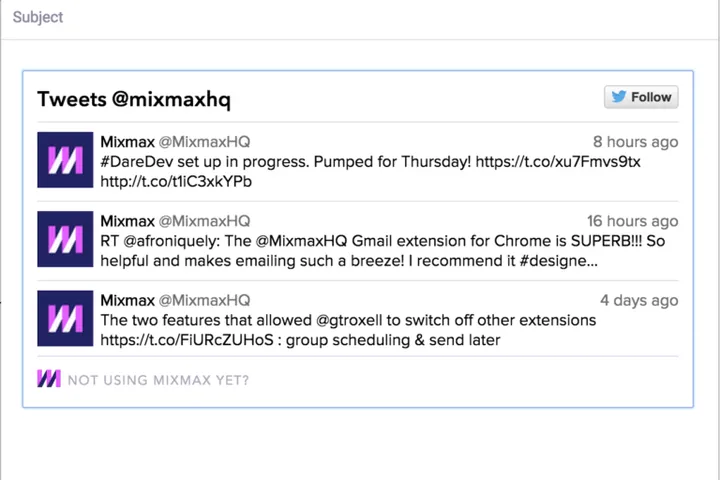
Now you can embed a live Twitter feed directly in your email – that works in every email client! It’s refreshed every time your recipient opens your email, so your recipient never misses a tweet.
Introducing the latest app from Mixmax: My Tweets:
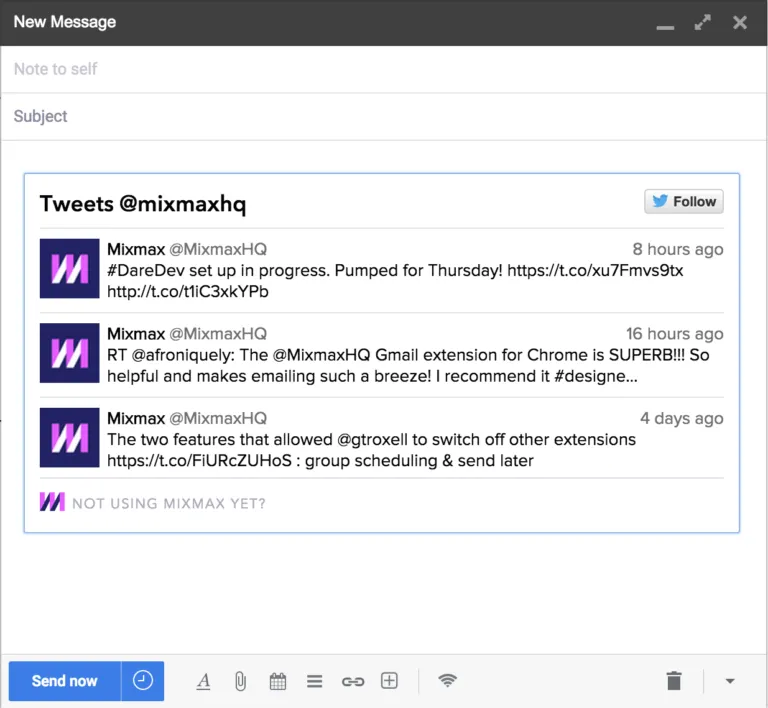
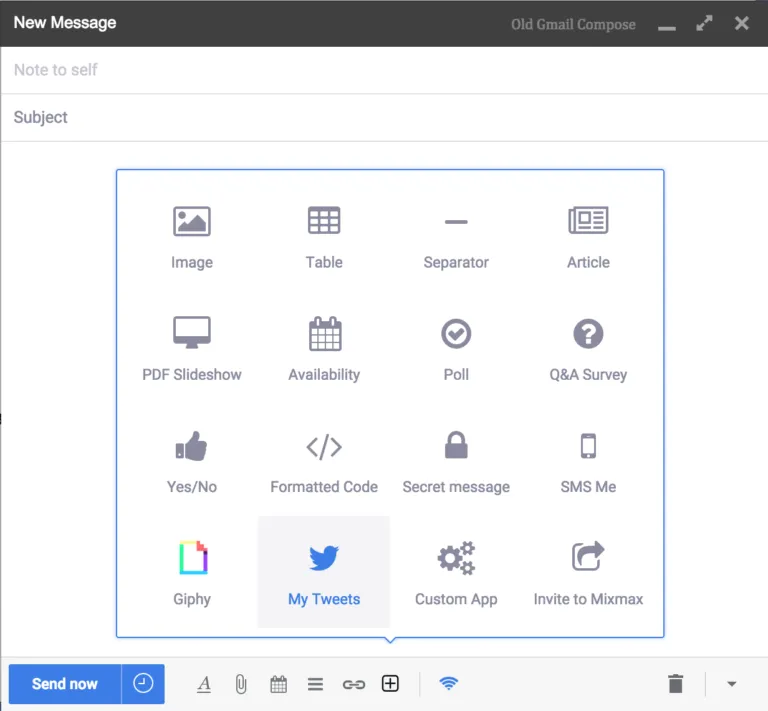
To add it to your email, open the Mixmax app menu and select My Tweets:
My Tweets is especially great for:
- Embedding in your email signature, so your recipients can follow your Twitter without leaving the email
- An event invitation, to let the recipients know the latest details without sending a follow up email
- When sending your resume to let the company learn more about you
Related Post: 7 Tips to Make Follow-Up Emails More Effective
How to Embed a Tweet in Your Email
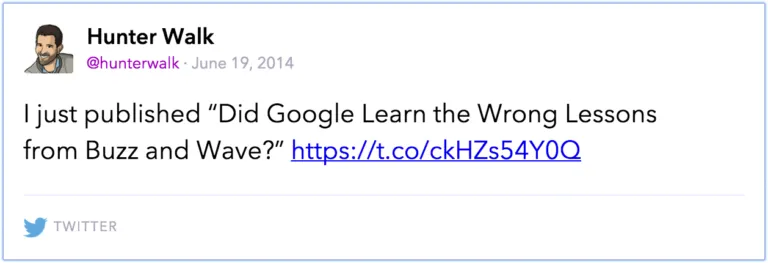
Just want to embed a single tweet? We’ve got you covered. Just paste a tweet url (e.g. https://twitter.com/hunterwalk/status/479722710721765376) in Mixmax and it’ll resolve to a beautiful preview:
Why You Should Embed Social Media in Emails
Embedding a tweet or a social feed isn’t just a neat trick; it’s a smart way to make your emails more effective. It bridges the gap between your direct outreach and your public presence, giving your messages more context and life. In a world of overflowing inboxes, static text can easily get lost or ignored. When you bring a piece of your social world into an email, you’re adding a dynamic, visual layer that static text just can’t match. It can stop someone from scrolling, grab their attention, and give them a reason to engage with your message on a different level. It’s about making your emails work harder for you.
Reach a Wider Audience
Your social media content deserves a bigger audience than just your followers. With most internet users on social media, embedding posts helps you reach people where they’re already comfortable. Think of it as cross-promotion that works in your favor. A great tweet or a helpful LinkedIn post can find a new life inside an email campaign or a sales follow-up. It extends the value of the content you’re already creating and gives your email recipients a direct window into your brand’s personality and recent activity without making them leave their inbox to go find you. This is an easy way to get more mileage out of your best content.
Build Trust with Social Proof
Trust is everything, especially in sales. Embedding a tweet that features a customer testimonial or a positive review is a powerful form of social proof. It’s one thing for you to say your product is great, but it’s far more convincing when a real customer says it. This tactic helps build credibility by showing, not just telling. Instead of just linking to a case study, you can place a glowing tweet directly in your email. It feels authentic and transparent, helping to warm up a cold lead or reassure a prospect who is on the fence about making a decision.
Increase Click-Through Rates
Emails that feel more human and interactive get better results. In fact, emails that include user-generated content, like customer photos or reviews from social media, can see a 73% higher click-through rate. When you embed a tweet, you’re breaking up the monotony of plain text and adding a visual element that draws the eye. This can lead to more clicks on your call-to-action, whether you’re trying to book a meeting, share a resource, or direct them to your website. It’s a simple change that can have a big impact on your engagement metrics and help you get more responses.
Alternative Ways to Embed a Tweet
If you don’t have a tool that automatically embeds tweets for you, don’t worry. You still have a few options to get the job done. These methods range from simple and static to a bit more technical, but they can all help you get that key piece of social content into your email. The best choice depends on what email client you’re using and how interactive you need the embedded tweet to be. It’s important to consider the trade-offs between simplicity and functionality, as a method that works perfectly in Gmail might look broken in Outlook. Here are a few of the most common approaches people take.
The Screenshot Method
The easiest and most reliable way to “embed” a tweet is to simply take a screenshot of it. Crop the image so it looks clean, and then insert it into your email just like any other picture. While this method is completely static—your recipient can’t click on links or interact with the tweet—it has one major advantage: it will show up correctly in every single email client. It’s a foolproof way to make sure everyone sees the content exactly as you intended. When you’re trying to make a good impression, the last thing you want is a broken email that looks unprofessional.
Using Twitter’s Official Tool
For a more interactive option, you can use Twitter’s own publishing tool. First, find the tweet you want to share on X.com. Click the three-dot menu on the tweet and select “Embed Post.” This will take you to the Twitter Publish tool, where you can copy a block of HTML code. You can then paste this code into an email client that supports HTML, like Gmail. The result is a richer, clickable version of the tweet, but be aware that it might not render perfectly in all email clients, especially older or more restrictive corporate versions of Outlook.
Using a Chrome Extension for Gmail
If you work primarily in Gmail, a dedicated Chrome extension can often add this functionality directly to your compose window. These tools are designed to handle the code for you, making the process much smoother. However, relying on multiple single-purpose extensions can sometimes slow down your browser or create conflicts. This is why many sales teams prefer an all-in-one platform where features like AI-powered workflows and content embedding are already built-in. It keeps your inbox clean and ensures all your tools work together perfectly without any extra hassle.
Why It’s Not So Simple
The Twitter feed is displayed as an iframe on clients that support it (currently Mac Mail and iOS Mail), and then falls back to a dynamic image on others. The iframe and image are generated dynamically each time they are requested, so the tweets are always kept up to date.
This is yet another way the Mixmax platform gives your email superpowers. Email us hello@mixmax.com or tweet us @Mixmax if you’d like to make one of your own!
Common Problems and Technical Limits
Embedding a live tweet sounds simple, but a few technical hurdles can get in the way. Most issues come down to how different email clients handle code and content. Understanding these limits helps you know what to expect and how to troubleshoot if things don’t look right. From security restrictions to formatting quirks, here are the most common problems you might run into.
Email Client Code Blocking
The biggest challenge is that most major email clients, including Gmail and Outlook, block interactive code like JavaScript or iframes for security reasons. This is the code social media platforms often use for their live embeds. When an email client blocks this code, your embedded tweet might show up as a blank space, a broken link, or not at all. It’s a protective measure to prevent malicious scripts from running inside an email, but it means that true, live-updating embeds are often not possible without a specialized tool that can create a safe fallback.
Formatting Issues
Even when an embed works, it might not look the same everywhere. One email client might display a fully interactive tweet, while another shows a static image. This is because each client has its own rules for rendering HTML. For example, a tool like Mixmax gets around this by displaying the tweet as an iframe for clients that support it (like Apple Mail) and automatically creating a dynamic image as a fallback for others. This ensures the content is always visible, even if the format changes slightly depending on where your recipient opens the email.
Public Account Requirement
This one is straightforward but easy to forget: you can only embed tweets from public Twitter accounts. If you try to embed a tweet from a protected or private account, it simply won’t work. The content isn’t publicly accessible, so the embedding tool has nothing to pull from. Before you spend time troubleshooting a broken embed, always double-check that the tweet is from a public account and that the link is correct. This simple check can save you a lot of frustration.
Best Practices for Embedding Content
Once you understand the technical limits, you can use a few best practices to make sure your embedded content looks great and performs well. These simple steps help create a better experience for your readers, improve accessibility, and maintain a professional look for your emails. Following these guidelines will help you avoid common pitfalls and get the most out of embedding social content in your outreach.
Always Test Your Emails
Before you send your email to your entire list, send a test to yourself and view it in different email clients (like Gmail, Outlook, and on your phone). This is the only way to be sure your embedded tweet appears as you intended. Testing helps you catch any formatting errors or broken elements ahead of time. If you find the embed code isn’t working reliably, you can always use a screenshot of the tweet instead and link it to the original post. It’s a simple but effective backup plan.
Use Alt Text for Accessibility
Whenever you embed an image—whether it’s a screenshot of a tweet or a dynamic image fallback—always include alt text. Alt text is a short, written description of an image that is read aloud by screen readers for visually impaired users. It also appears if the image fails to load for any reason. Writing descriptive alt text ensures that everyone receiving your email can understand the content, making your communications more inclusive and accessible.
Keep Image File Sizes Small
Large image files can make your emails slow to load, especially on mobile devices with poor connections. Slow-loading emails can frustrate recipients and even trigger spam filters. To avoid this, make sure any images you use, including fallbacks for your embeds, are optimized for the web. Keeping image file sizes small helps your emails load quickly and improves the overall user experience, increasing the chances that your message gets read.
Limit the Number of Embeds
While embedding social posts can add value, overdoing it can make your email feel cluttered and distracting. A busy layout can overwhelm the reader and dilute your main message. As a general rule, try to limit social embeds to just one or two per email. This keeps the focus on your core content while still providing a nice visual touch. Choose the most impactful tweet to feature rather than trying to include several at once.
Keep the Design Consistent
Your embedded content should feel like a natural part of your email, not something that was just dropped in. Pay attention to the design elements surrounding the embed. Try to keep your email design consistent by using similar spacing, fonts, and colors that align with your brand. This creates a more polished and professional look, ensuring that the embedded tweet enhances your email’s appearance rather than disrupting it.
Frequently Asked Questions
Will an embedded tweet look the same for everyone who receives my email? Not always. Different email clients like Gmail, Outlook, and Apple Mail have their own rules about displaying interactive content. For security, many block the code needed for a live embed. A good tool gets around this by showing a live, clickable feed when possible and automatically providing a clean, dynamic image as a fallback for more restrictive clients. This ensures your email always looks professional, no matter where it’s opened.
What’s the difference between embedding the ‘My Tweets’ feed and just a single tweet? The “My Tweets” feature embeds a live feed that automatically updates with your latest posts every time your recipient opens the email. This is perfect for an email signature or an event invitation where you want to share ongoing updates. Embedding a single tweet is better for making a specific point, like showcasing a customer testimonial or sharing a relevant piece of news. You just paste the tweet’s URL, and it appears as a static preview.
Why is taking a screenshot sometimes a better option than a live embed? A screenshot is the most reliable method because it’s just an image. It will look exactly the same in every single email client, with zero risk of appearing broken or distorted. While your recipient can’t interact with it directly, it’s the safest choice when you absolutely need the content to display perfectly, especially when reaching out to a high-value prospect for the first time.
Can I embed tweets from a private or protected account? No, you can only embed tweets from public accounts. Embedding tools need to be able to publicly access the content to display it in an email. If an account is set to private, its tweets are not publicly available, so there is nothing for the tool to pull and show. Always double-check that the account is public before trying to embed its content.
Will adding a live tweet feed slow down my email or get it marked as spam? When done correctly, it shouldn’t cause problems. Platforms like Mixmax are built to be lightweight, so the embedded content doesn’t bloat the initial email file. As for spam filters, they look at many factors. As long as your email has valuable text content and you aren’t overstuffing it with embeds, a single, relevant tweet is unlikely to cause a deliverability issue.
Key Takeaways
- Add social proof to your outreach: Embedding a tweet brings customer testimonials or positive feedback directly into your email, making your message more credible and visually interesting.
- Choose the right embedding method for your goal: A screenshot is a foolproof way to show a tweet and works everywhere. For a live feed, use a tool that automatically provides a fallback image so your email never looks broken.
- Test your emails across different clients: Before hitting send, check how your embedded tweet looks in Gmail, Outlook, and on a phone. This simple step helps you catch formatting errors and ensures everyone has a good experience.