








Your sales team needs a tool that lives where they work—their inbox and CRM. When a platform forces constant tab-switching or struggles with data accuracy, it becomes a roadblock, not a resource. If this sounds familiar, you're likely searching for strong Apollo.io alternatives. You need a tool that simplifies prospecting and outreach without the friction. Finding the right apollo.io alternative isn't easy, but we've got you covered. We'll walk through the top platforms built for seamless, AI-powered workflows that let your reps sell instead of fighting their software.
And we don’t blame you.
If you’re not vetting different solutions, you might end up with a sales engagement and intelligence solution that’s incompatible with your teams' needs.
You’ll have wasted time, effort, and money on something that doesn’t work for you. And then you’d be stuck having to choose between two scenarios:
- Keeping the solution because you think it’s too late to turn back and everyone will hate you if you do because they’ve already spent weeks learning how to use it.
- Looking for a new solution that’s actually right for your team and that has an easy enough implementation process that makes the switch worth it.
If you’re already using Apollo.io and aren’t happy with the results, this is your sign that it’s never too late to switch.
And if you haven’t made a decision yet, let’s help you find out whether Apollo.io is going to make you happy, or if there are other solutions better suited for your needs.
Before we dive in (and before you waste your life reading through the entire blog), we want to mention that Apollo.io is primarily a sales/data intelligence platform, but it also has some sales engagement features.
If you’re looking for data intelligence alternatives, jump to this section. If you’re looking for sales engagement solution alternatives, jump here.
Ok, let’s go.
Is Apollo.io Right for Your Team?
Apollo.io is a sales intelligence platform that provides data-driven insights to help sales teams close more deals.
Target market for Apollo.io
- Sales teams in B2B organizations.
- Startups and medium-to-large size companies.
- Teams looking for a data intelligence platform.
Key features
- Comprehensive B2B database: Provides access to a vast database of B2B contacts, companies, and other relevant information. The database is constantly updated to ensure the accuracy and freshness of the data.
- AI-driven prospecting: Uses artificial intelligence to help sales teams identify the best prospects for their products or services. It also includes job change alerts to keep sales teams up-to-date on changes within their target accounts.
- Buying intent data: Provides insights into the buying behavior of prospects, including their level of interest and the likelihood of them making a purchase.
- Lead scoring: Uses algorithms and data to assign a score to each prospect, indicating their likelihood of becoming a customer. This helps sales teams prioritize their outreach efforts.
- Data enrichment: Enhances the data in the database by adding additional information, such as job titles, email addresses, and social profiles, to help sales teams have more detailed and up-to-date information about their prospects.
- Sequences: Automates email outreach based on pre-set rules.
Although Apollo.io offers some sales engagement functionality such as email automation, templates, and sequences, it’s not its strong suit. Apollo.io is generally used alongside other sales engagement platforms.
So if you’re looking for a full-fledged sales engagement solution, Apollo.io isn’t it. If you’re looking for a data intelligence solution, it might be the right fit for your team.
Let’s take a closer look.
Common Challenges with Apollo.io
While Apollo.io is a popular tool, it’s not without its drawbacks. Many teams find that certain limitations get in the way of their sales process. Before you commit, it’s worth understanding the common hurdles users face, from unreliable data to a confusing pricing structure. These issues can directly impact your team's efficiency and your bottom line, so let's break them down.
Data Accuracy and Quality
Let’s be real: no data intelligence platform is 100% perfect. But consistent data quality is non-negotiable for any sales team. Users report that Apollo.io’s data can be hit-or-miss, with some sources citing a general data accuracy of only 73%. This inconsistency often translates into high email bounce rates—sometimes between 30% and 80%—and phone number accuracy hovering around 40%. For a sales rep, this means a significant amount of time is wasted on dead-end outreach, which can also harm your sender reputation. Inaccurate data doesn’t just slow you down; it prevents you from connecting with qualified leads who are ready to buy.
Confusing Pricing and Hidden Costs
Apollo.io’s pricing might look appealing at first glance, but it can be deceptive. The platform operates on a credit system, where basic plans are affordable but quickly become insufficient. Essential functions, like accessing mobile numbers or exporting data, consume credits rapidly, forcing you to purchase more to keep your campaigns running. This model can feel restrictive and often leads to unpredictable, higher-than-expected costs. For teams trying to manage a budget, these hidden expenses are a major drawback, making it difficult to forecast your spending and prove the tool's ROI when the bills keep climbing unexpectedly.
Privacy and Compliance Gaps
With ever-stricter data privacy laws, compliance is critical. This is an area where Apollo.io has some notable gaps. For instance, the platform only screens new direct dial requests against "Do Not Call" (DNC) lists in the UK and the US. If your team sells to customers in other regions, this limited screening exposes your business to significant compliance risks and potential fines. Competing platforms often check against DNC lists in a dozen or more countries, offering a much safer alternative for global sales teams. Overlooking this detail can lead to serious legal and financial consequences down the road.
User-Reported Issues
Beyond the data and pricing, many users point to functional problems with the platform itself. Common complaints include a buggy interface and a user experience that can be difficult to manage, leading to frustration and lost productivity. Businesses often start looking for alternatives when they realize Apollo.io’s automation features are too limited for their needs. When your tools can't keep up, your team is stuck doing manual work instead of selling. This is why many teams prioritize solutions with more flexible, AI-powered workflows that can handle complex, multi-step processes without constant oversight.
How Much Does Apollo.io Cost?
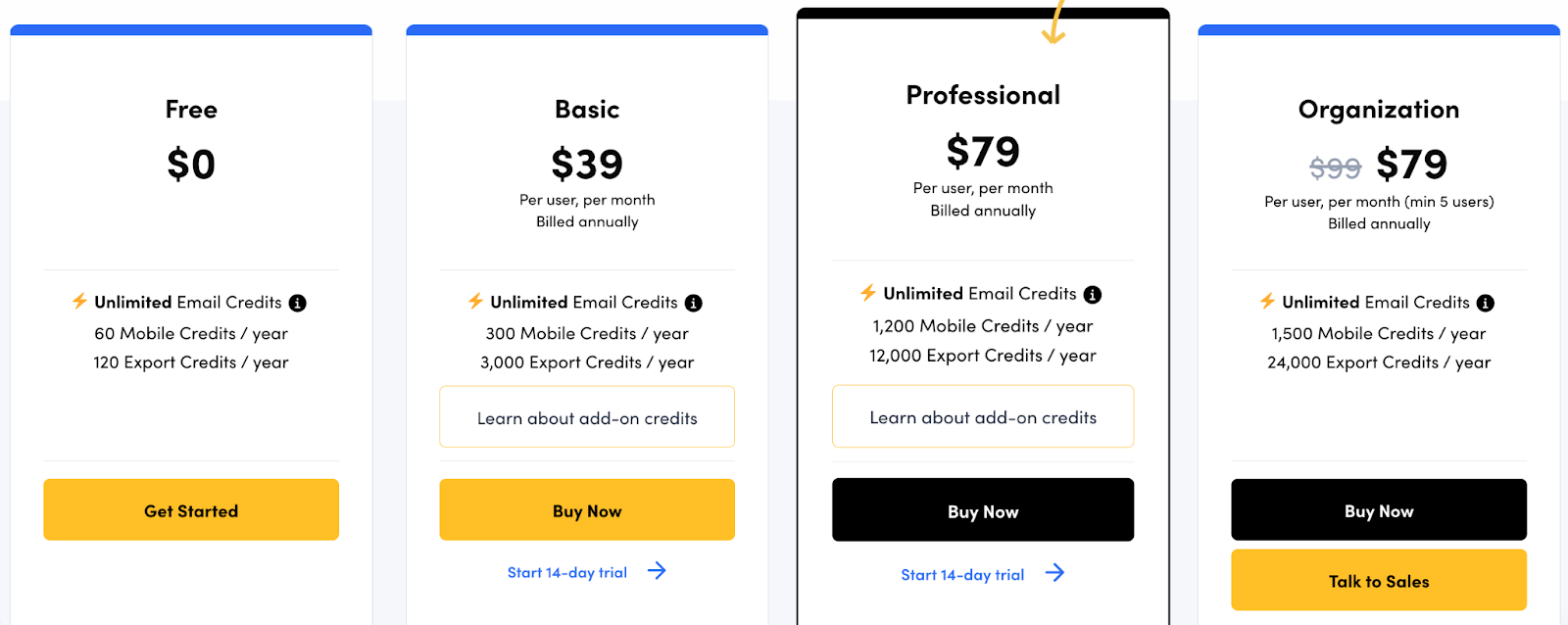
Here’s a breakdown of how much Apollo.io costs for basic users, professionals, and large organizations:
Basic: $39 per user/month (billed annually)
Professional: $79 per user/month (billed annually)
Organization: $79 per user/month (billed annually – minimum 5 users)
14-day free trial available
How to Choose the Right Apollo.io Alternative
Finding the right sales tool isn't about picking the one with the longest feature list. It's about finding the one that fits your team's workflow like a glove. As you explore different options, you need a clear set of criteria to measure them against. Think about what really matters for your daily operations, from the quality of the data you rely on to how easily a new platform will fit into your existing tech stack. A thoughtful evaluation now will save you from the headache of a mismatched tool later. Let's walk through the key areas to focus on so you can make a choice that genuinely supports your team's success.
Evaluate Data Verification Methods
The foundation of any successful outreach campaign is accurate data. If your contact list is full of outdated information, you're just sending emails into the void, which leads to high bounce rates and wasted effort. That's why it's so important to understand how a platform verifies its data. Many businesses are now prioritizing tools that use real people to check and confirm information, rather than relying solely on automated scraping. This human-in-the-loop approach significantly improves data quality, ensuring your messages actually reach the right person and giving your sales efforts a much higher chance of success from the get-go.
Look for Advanced Data Types
In today's competitive landscape, basic company information like size and location just doesn't cut it anymore. To truly understand your prospects, you need to go deeper. The best sales intelligence platforms now offer advanced data types that give you a clearer picture of a company's current needs and priorities. These insights allow you to tailor your outreach with precision, moving beyond generic pitches to have conversations that are relevant and timely. By focusing on platforms that provide this richer context, you can identify high-potential buyers much earlier in their journey and approach them with a message that resonates.
Intent Data
Imagine knowing exactly when a company starts looking for a solution like yours. That's the power of intent data. It tracks online signals—like content downloads, keyword searches, and website visits—to show what a company is actively researching and looking to buy. This information is a game-changer for sales teams. Instead of cold calling a long list of prospects, you can prioritize the accounts that are already showing interest. This allows you to engage with potential buyers at the perfect moment, making your outreach feel less like an interruption and more like a helpful solution to a problem they're already trying to solve.
Technographic Data
Knowing what technology a company uses is like having a cheat sheet for your sales pitch. This is what technographic data provides: a detailed look at a prospect's current tech stack. Are they using a competitor's product? Do they have software that integrates perfectly with yours? This information allows you to tailor your messaging with incredible specificity. You can highlight how your solution fills a gap they have, replaces an outdated tool, or works seamlessly with the systems they already rely on. It’s a straightforward way to demonstrate your value and show you’ve done your homework before even starting the conversation.
Consider Key Evaluation Criteria
Beyond the quality and type of data, you need to consider how a new tool will function as part of your team's broader ecosystem. The most powerful platform in the world is useless if it's too complicated for your reps to use or if it doesn't connect with the other software you depend on every day. When comparing different solutions, it's essential to look at the practical side of implementation and daily use. Key factors like integrations and the overall learning curve can make or break your team's adoption of a new tool, directly impacting your return on investment.
Integrations
A new sales tool should make your life easier, not create more work. That's why seamless integrations are non-negotiable. Your sales intelligence platform must connect smoothly with your CRM, like Salesforce or HubSpot, to avoid creating data silos and forcing your team into tedious manual entry. A well-integrated system ensures that information flows freely between your tools, keeping everyone on the same page. When you can build AI-powered workflows that trigger actions across different platforms, you create a truly efficient process that lets your team focus on selling instead of managing data.
Learning Curve
Some sales platforms are incredibly powerful but come with a steep learning curve that can slow your team down. While robust features are great, they don't mean much if your reps can't figure out how to use them without weeks of training. This is especially true for smaller teams or those without a dedicated person to manage their sales software. When evaluating alternatives, look for a tool that strikes a balance between capability and usability. An intuitive interface and a straightforward setup process will ensure your team can get up to speed quickly and start seeing results right away.
Top Apollo.io Alternatives for Data Intelligence
ZoomInfo
ZoomInfo is Apollo.io’s #1 worst enemy competitor.
ZoomInfo Sales OS offers a powerful sales intelligence platform that provides sales teams with access to a comprehensive database of B2B contacts and companies. It's designed to help sales teams find and engage with the right prospects.
Key features
- Contact database: A database of millions of business contacts, including job titles, direct dials, and email addresses.
- Company information: In-depth information about companies, including size, location, industry, and more.
- Lead generation: Tools that can help sales teams identify and engage with new prospects. These tools use a combination of data and AI to prioritize leads based on their fit, behavior, and intent.
- Reporting and analytics: Sales teams can track their performance and make data-driven decisions about their outreach efforts.
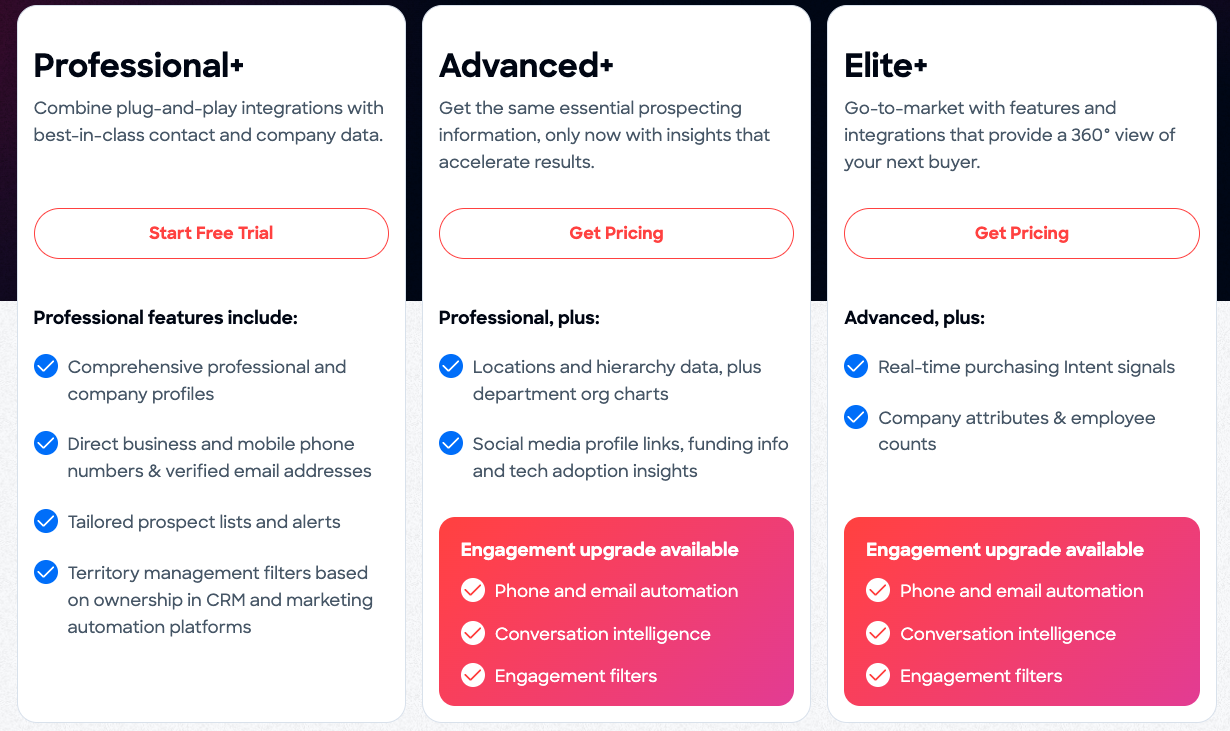
ZoomInfo pricing
Professional+: Custom pricing
Advanced+: Custom pricing
Elite+: Custom pricing
Free trial available
Main differences between ZoomInfo and Apollo.io
ZoomInfo is a B2B data provider, while Apollo.io is a sales acceleration platform that leverages AI and includes data as one of its core components.
Lusha
Lusha is a sales intelligence platform that provides sales teams with accurate and up-to-date B2B contact information such as phone numbers and email addresses for their target prospects.
Key features
- Data enrichment: Ensures that its database of contact information is up-to-date and accurate in real time.
- Mobile app: Allows sales teams to access their contact information on the go, so they can be more productive and efficient while away from their desks.
- Lead generation: Allows sales teams to automatically identify and engage with high-quality prospects.
- Reporting and analytics: Sales teams can gain insights into their outreach results and make informed decisions to improve their results over time.
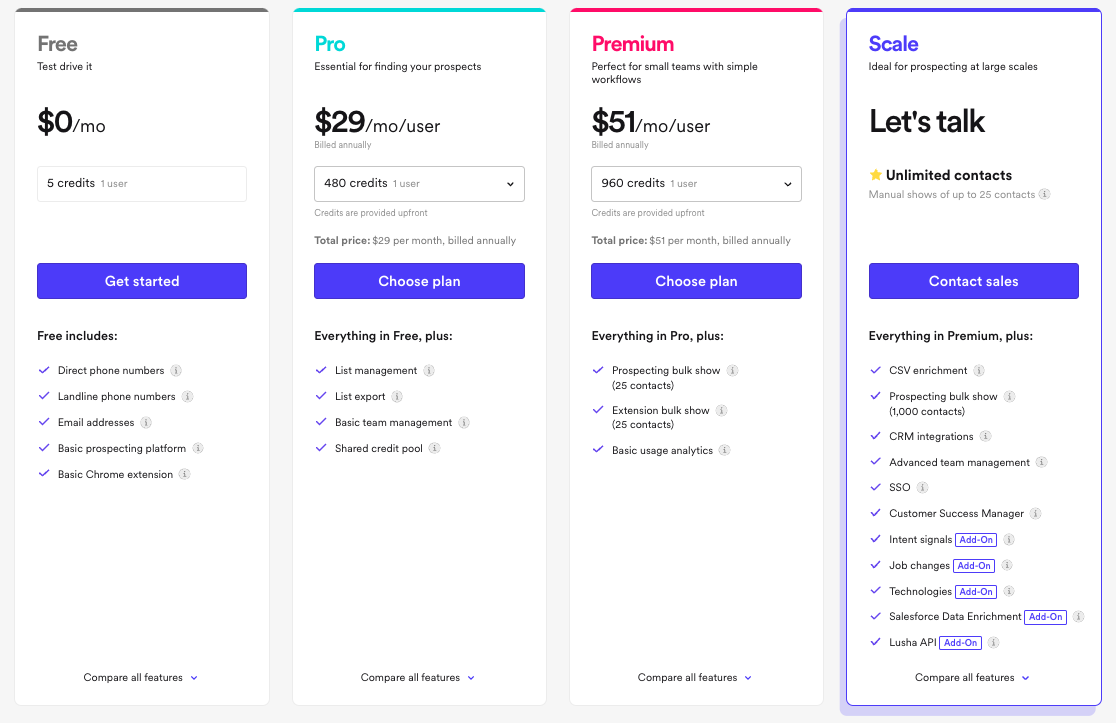
Lusha pricing
Pro: $29 per user/month (billed annually)
Premium: $51 per user/month (billed annually)
Scale: Custom pricing
Free trial available
Main differences between Lusha and Apollo.io
Apollo.io offers a wider range of features, including lead scoring, buying intent data, and sequencing capabilities, as well as a comprehensive B2B database. Lusha, on the other hand, focuses primarily on verifying and enriching contact data.
Rocketreach
Rocketreach is a sales intelligence and lead generation platform that provides B2B data and contact information to help sales teams find and reach out to the right prospects. Rocketreach's platform offers a range of data and information, including company information, professional email addresses, phone numbers, and social media profiles.
Key features
- B2B database: Includes information on millions of companies and professionals, including contact details, social media profiles, and other relevant information.
- Lead generation: Includes the ability to search for prospects by company, location, industry, job title, and other criteria.
- Data accuracy: Rocketreach places a high emphasis on data accuracy and uses a combination of human verification and proprietary algorithms to ensure that its data is up-to-date and reliable.
- Email verification: Helps sales teams improve the accuracy and deliverability of their emails by verifying the email addresses of prospects before they send emails.
- Chrome extension: Lets salespeople discover leads on Google, Angelist, Crunchbase, and LinkedIn.
Rocketreach pricing
Individual plans:
Essentials (Email Only): $39/month (billed annually)
Pro (Email+Phone): $99/month (billed annually)
Ultimate (Email+Phone): $249/month (billed annually)

Team plans:
Custom pricing
Enterprise plans:
Custom pricing
RocketReach vs. Apollo.io: Key Differences
Overall, the main difference between Apollo.io and Rocketreach is the scope and focus of their respective platforms. While both platforms are designed to help sales teams find and reach out to the right prospects, Apollo.io offers a more comprehensive suite of sales intelligence and prospecting tools, while Rocketreach primarily focuses on lead generation.
Cognism
If your team operates heavily in Europe or places a premium on compliance, Cognism is a fantastic choice. It’s a sales intelligence platform known for its high-quality, GDPR-compliant B2B data. What really sets it apart is its commitment to data accuracy and privacy. Cognism actively scrubs its data against "Do Not Call" lists in multiple countries, giving your sales team peace of mind. They also offer phone-verified mobile numbers, which they call Diamond Data®, ensuring you’re connecting with the right person. This makes it an ideal solution for teams that need reliable, compliant contact information to fuel their outreach without worrying about legal headaches.
SalesIntel
SalesIntel stands out by emphasizing human verification to achieve its impressive 95% data accuracy rate. This means you're getting contact information that real people have checked, reducing bounce rates and wasted time. Beyond just providing contacts, SalesIntel gives you deeper insights into a company's buying intent and the technology they currently use, helping you tailor your pitch perfectly. Their pricing is typically credit-based, so you only pay for the data you actually need. It’s a solid option for teams that want to be confident in their data's quality and gain a strategic edge with technographic and intent signals.
UpLead
For small to medium-sized businesses looking for a straightforward and affordable data provider, UpLead is a strong contender. Its main draw is the real-time email verification process. When you export a contact list, UpLead checks the data on the spot to ensure it's accurate and deliverable. This simple but powerful feature helps maintain your sender reputation and improves campaign performance. UpLead offers a clean interface and flexible pricing plans that make it accessible for growing teams who need reliable contact data without the enterprise-level price tag, making it a practical tool for building your sales pipeline.
Hunter.io
Hunter.io is a specialist tool with one primary focus: finding and verifying professional email addresses. If your outreach strategy is heavily reliant on email, this is a tool you’ll want to look at. It’s incredibly simple to use—you can search for emails by domain, find the email of a specific professional, or verify a list of existing emails to clean your data. While it doesn't offer the broad range of data points that platforms like Apollo.io do, its specialization makes it highly effective at what it does. It's perfect for marketing and sales teams who prioritize email list accuracy above all else.
Snov.io
Snov.io goes a step beyond simple email verification by combining data prospecting with cold outreach tools. It’s a great fit for small businesses and startups that need an all-in-one solution for their top-of-funnel activities. With Snov.io, you can find and verify emails, but you can also build and launch automated cold email campaigns directly within the platform. This integration of features simplifies the outreach process, allowing you to manage prospecting and initial engagement from a single dashboard. It’s a cost-effective way to handle multiple parts of the sales cycle without juggling several different tools.
Seamless.AI
As its name suggests, Seamless.AI leans heavily on artificial intelligence to deliver contact and company data in real-time. It’s built for speed, allowing sales teams to quickly find verified phone numbers, emails, and direct dials while they browse company websites or LinkedIn profiles. The platform’s AI engine constantly scours the web to find and validate information, ensuring the data is fresh. This makes it a powerful tool for sales reps who need to build targeted lists quickly and efficiently. If your team’s motto is "always be prospecting," Seamless.AI provides the velocity you need to keep the pipeline full.
Lead411
Lead411 offers accurate B2B data with a unique twist: trigger event alerts. These notifications inform you when a target company experiences a significant change, like securing new funding, launching a new product, or hiring a new executive. These events often signal a perfect time to reach out, giving you a compelling reason to start a conversation. This feature turns a static contact list into a dynamic source of timely opportunities. Combined with its affordability, Lead411 is an excellent choice for small and medium-sized businesses that want to make their outreach more relevant and timely without breaking the bank.
Clearbit
Clearbit operates a bit differently from the others on this list. Instead of just being a database you search, it excels at enriching the data you already have. It integrates directly with your CRM and other tools to automatically update and add detailed information to your existing contact and company records in real-time. This ensures your entire team is working with the most accurate and complete picture of your customers. When your CRM data is enriched, you can create highly targeted segments and trigger personalized outreach. For instance, you can use that fresh data to power AI-powered workflows that move deals forward automatically.
Top Apollo.io Alternatives for Sales Engagement
Mixmax
Mixmax is the BEST. All hail Mixmax.
Kidding. We're not that obnoxious.
Here are some facts about Mixmax and how it differs from Apollo.io.
Mixmax is a sales engagement solution through and through and it’s built for the entire revenue team. That’s what its primary function is. It helps sales and CS teams focus on relevance, personalization, and conducting in-depth prospect research instead of performing manual tasks like updating Salesforce, setting up individual follow-up reminders, and so on.
Plus it sits on top of Gmail so sales reps can perform essential tasks without leaving their inbox.
Key features
- Multi-channel sequencing: Allows users to create a series of custom email, SMS, or LinkedIn messages that will be sent automatically to a recipient at specific intervals. This can help sellers reach prospects and customers on their preferred channel, increasing the chances of engagement.
- Email enhancements: Sales and CS can boost reply rates with Mixmax’s built-in email enhancements, including one-click meetings, embedded polls and surveys, GIFs, link previews, Gmail shortcut commands, and a ton of other nifty features.
- Workflow rules: Helps salespeople automate tasks and processes within their email workflow by creating rules that trigger actions based on specific conditions (e.g., when an email is viewed 3x, when a link is clicked, when a meeting is scheduled, etc.).
- Salesforce & app integrations: Mixmax integrates with Salesforce, Slack, Gong, Google Calendar, LinkedIn, and a ton of other apps. Revenue teams can automate CRM data entry, set up Slack notifications based on certain actions, analyze their sales calls, book meetings with one click, and access LinkedIn InMail through their inbox. View all integrations here.
- Email tracking: Lets users track email open rates, reply rates, link clicks, and downloads all through a detailed and easy-to-navigate dashboard. This helps revenue teams make data-driven decisions on future outreach efforts.
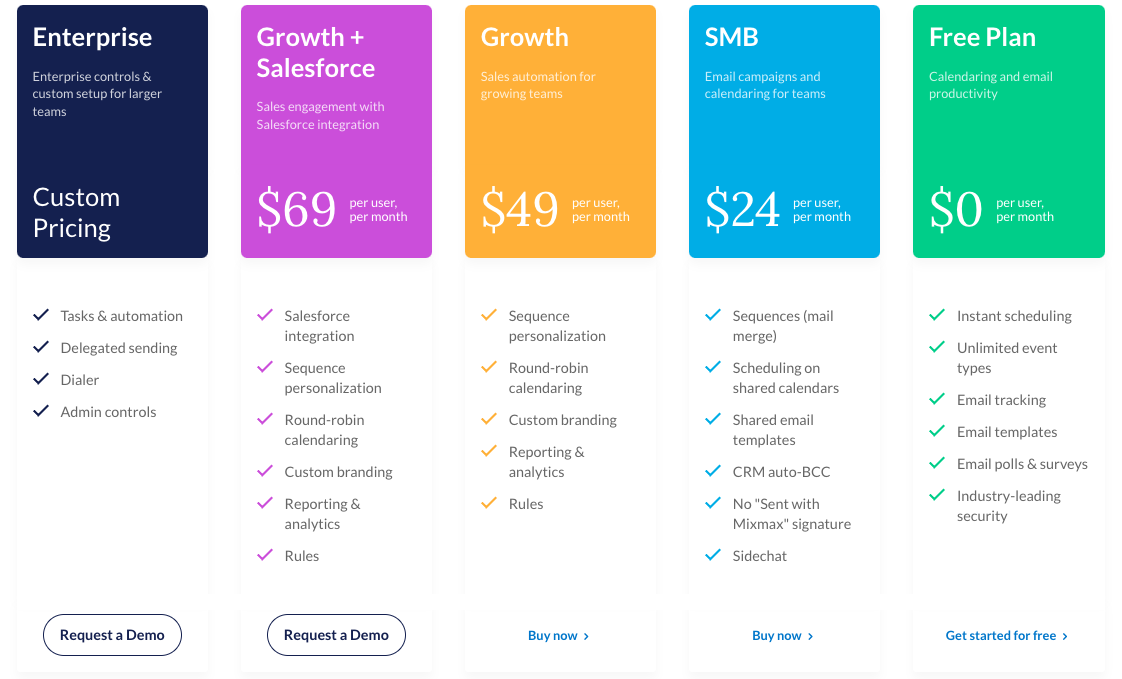
Mixmax pricing
Growth + Salesforce: $69 per user/month (billed annually)
Growth: $49 per user/month (billed annually)
SMB: $24 per user/month (billed annually)
Enterprise: Custom pricing
14-day free trial available
Main differences between Mixmax and Apollo.io
The main difference between Mixmax and Apollo.io is that Mixmax is primarily a sales engagement solution, whereas Apollo.io is a lead generation and data intelligence tool. Although Apollo.io has some sales engagement functionality like sequencing and email tracking, it is not as refined as Mixmax’s features. Note that Mixmax and Apollo.io can be used in parallel as two distinct platforms in a sales tech stack.
Outreach
Outreach is a powerful sales engagement tool built for mid-market to enterprise organizations with segmented territories and junior SDR teams. Its got all the bells and whistles in terms of features and functionality and is accessible through its own separate platform, outside of the inbox.
Key features
- Email templates: Allows users to create customizable email templates that sales teams can use to streamline their outreach process and save time.
- Email tracking: Helps track and report on key metrics, such as email opens and clicks, allowing sales teams to gauge recipient engagement and make informed follow-up decisions.
- Cadences: Enables sales teams to create and automate their outreach processes, or "cadences," through a series of pre-defined email and task templates that are triggered based on specific events or conditions.
- Meeting scheduling: Integrates with calendar tools like Google Calendar and Outlook, allowing sales teams to schedule and manage their meetings directly from the platform.
- CRM integration: Outreach syncs to Salesforce to automatically update contact information and records.
Outreach pricing
Custom pricing upon request. We’ll let you in on a little secret–it don’t come cheap.
No free trial available.
Main differences between Outreach and Apollo.io
Outreach is a sales engagement solution that is made for larger organizations with big SDR teams, whereas Apollo.io’s sales engagement features are lacking and wouldn’t be able to handle day-to-day outreach activities. However, Apollo.io has an Outreach integration that can make up for its own shortcomings. It’s worth noting that if you’re looking for a solution that your AEs and CSMs can also use, neither Outreach nor Apollo.io will be a great fit.
Salesloft
Salesloft is a popular sales engagement solution that is ideal for high-volume prospecting by SDR teams. It’s jam-packed with features that are meant to help sales teams communicate more effectively and drive better results.
Key features
- Cadences: Lets sales reps create and define sales cadences and set up triggers based on specific events or conditions.
- Sales playbooks: Gives new reps instant access to successful sales plays, cadence examples, and best practices so they can quickly start producing revenue.
- Analytics and reporting: Offers real-time analytics and reporting on outreach activities, performance, and results.
- Personalization tokens: Provides a range of personalization tokens that sales reps can use to add dynamic and personalized content to their emails and other messages, such as the recipient's name or company name.
- Integrations: Integrates with a range of tools and services, such as Google Calendar, Salesforce, and Slack, allowing sales reps to access and manage their data and activities from a central location.
Salesloft pricing
Custom pricing upon request.
No free trial available :(
Main differences between Salesloft and Apollo.io
Apollo.io is a complete data intelligence solution while Salesloft offers a wide range of sales engagement features and functionality. The latter is the ideal choice between the two if your team needs to boost engagement with prospects and accelerate pipeline. But if you’re looking for a sales engagement solution that’s for smaller companies and ideal for the whole revenue team, Salesloft might still not fit the bill.
Klenty
If your team is focused on reaching prospects through various channels, Klenty is a solid option. It’s designed for multi-channel outreach, allowing you to create automated campaigns that incorporate emails, calls, and LinkedIn messages. With a database of over 220 million contacts, it provides a substantial pool for your prospecting efforts. Klenty helps you connect with potential customers wherever they are most active, making it a versatile tool for sales teams that don't want to limit their outreach to just one platform. It’s particularly useful for creating a structured, multi-touch sales cadence that keeps your engagement consistent and effective across different communication methods.
Reply.io
Reply.io is another strong contender in the multi-channel sales engagement space. Its primary focus is helping sales teams automate their outreach across email, LinkedIn, calls, and even WhatsApp. This platform is built to streamline the process of contacting prospects through a series of coordinated steps, ensuring you maintain a consistent presence without getting bogged down in manual tasks. By automating these interactions, your team can focus more on building relationships and closing deals rather than just sending messages. If you're looking for a tool to manage a high volume of sales outreach across several platforms simultaneously, Reply.io is definitely worth a look.
Top Apollo.io Alternatives for LinkedIn Prospecting
While many platforms offer broad prospecting capabilities, some tools specialize in pulling data directly from LinkedIn. This is a huge advantage for teams that rely heavily on the professional network to identify and research leads. If your sales strategy is centered around LinkedIn, using a dedicated tool can save you a ton of time and give you more accurate contact information than a general-purpose database might. These alternatives are designed to integrate seamlessly with your LinkedIn workflow, making it easier to turn profiles into actionable leads in your CRM without the hassle of constant tab-switching or manual data entry.
The real value of these specialized tools lies in their efficiency. They operate right where your reps are already working, often as a browser extension that overlays information on LinkedIn profiles. This eliminates the friction between finding a promising lead and taking the next step to engage them. Instead of a multi-step process involving copying names, searching for contact info elsewhere, and then manually adding them to a sequence, your team can capture and verify data in just a few clicks. This speed allows reps to build highly targeted prospect lists faster, so they can spend more time personalizing their outreach and starting meaningful conversations.
LeadIQ
LeadIQ is a fantastic choice if your team lives on LinkedIn. It excels at capturing lead data directly from LinkedIn profiles and Sales Navigator searches. Instead of manually copying and pasting information, you can use LeadIQ to find and verify email addresses and other contact details with just a few clicks. This streamlines the top-of-funnel process, allowing your reps to build targeted prospect lists quickly and efficiently. The platform is designed to reduce the friction between finding a promising lead on LinkedIn and actually reaching out to them, making it a powerful tool for any team focused on social selling and prospecting.
Kaspr
Similar to LeadIQ, Kaspr is another excellent tool for sourcing contact information directly from LinkedIn. It operates as a simple Chrome extension that allows you to extract verified email addresses and phone numbers from individual LinkedIn profiles. The convenience of having this functionality right in your browser while you're prospecting makes it incredibly efficient. Kaspr is known for its ease of use and the accuracy of the data it provides, helping you bypass gatekeepers and connect directly with decision-makers. For sales reps who need to quickly find contact information without leaving their LinkedIn workflow, Kaspr is a top-tier solution.
Alternative Strategies for Prospecting
Sometimes, the best solution isn't a single, all-in-one platform. Depending on your team's specific needs and budget, you might find that a combination of specialized tools gives you a more powerful and flexible workflow. This approach allows you to pick the best-in-class tool for each part of your process—from data intelligence to outreach execution. By building a custom tech stack, you can cover all your bases without compromising on the quality of any single function. This ensures your team has exactly what it needs to succeed, rather than settling for a jack-of-all-trades platform that might be a master of none.
Adopting a modular strategy also future-proofs your sales process. As your team grows or your strategy evolves, you can swap individual tools in and out without having to overhaul your entire system. For example, if you decide to focus more heavily on a new channel, you can simply add a tool that specializes in it. This flexibility is key to staying agile and responsive. When the tools in your stack integrate well with each other, you can create a seamless flow of information that empowers your reps to work efficiently and effectively, no matter what their specific task is.
Combine Tools for a Stronger Workflow
A highly effective strategy is to combine different tools to create a more robust prospecting and engagement process. For instance, you can use LinkedIn Sales Navigator for its powerful search and filtering capabilities to identify ideal prospects, and then pair it with a data intelligence tool like ZoomInfo or Lusha to get verified email addresses and phone numbers. Once you have that accurate contact data, you can use a sales engagement platform to execute your outreach. This is where Mixmax shines, allowing you to use AI-powered workflows to automate personalized, multi-channel sequences without ever leaving your inbox. This layered approach ensures you have the best tool for each job: finding, verifying, and engaging your prospects.
Frequently asked questions about Apollo.io alternatives
How much does Apollo.io cost?
Apollo.io has a range of plans available, including its Basic plan at $39 per user/month, its Professional plan at $79 per user/month, and its Organization plan at $79 per user/month (min 5 users).
What type of tool is Apollo.io?
Apollo.io is a sales intelligence tool that provides real-time data and insights on prospects. It uses AI and machine learning to gather data from various sources. It provides access to a large database of contacts that is ideal for lead discovery.
Key Takeaways
- Identify Apollo.io's core limitations: Recognize that Apollo.io is primarily a data intelligence platform, not a complete sales engagement solution. Common reasons for seeking an alternative include unreliable data accuracy, a confusing credit-based pricing model, and potential compliance gaps.
- Prioritize data quality and integration: When evaluating alternatives, focus on how a platform verifies its contact information and whether it offers advanced insights like intent data. Ensure any new tool integrates smoothly with your CRM to prevent manual data entry and workflow disruptions.
- Combine specialized tools for better results: The most effective solution is often a custom tech stack. Pair a dedicated data intelligence tool for prospecting with a powerful sales engagement platform to create personalized, AI-powered workflows directly from your inbox.