
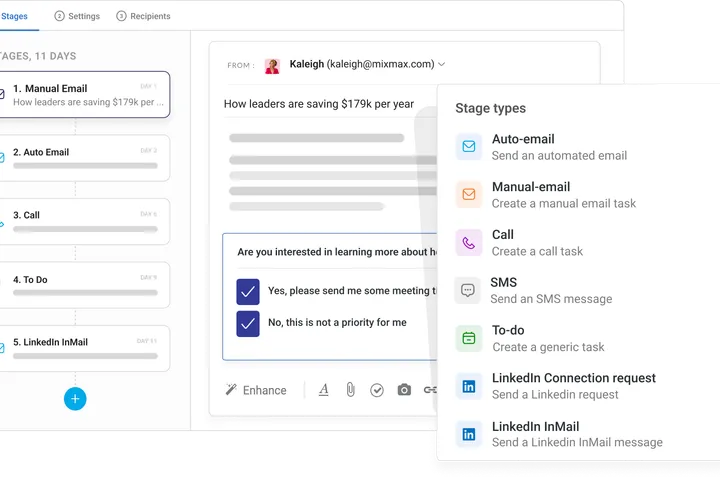
Here’s a scene that plays out on every sales floor, every single week.
A rep has been running the same five-step outbound sequence for months. Open rates look “fine.” Reply rates are… unclear. They couldn’t tell you which emails in the sequence are actually earning replies and which ones prospects scroll right past. They don’t change anything - not because the sequence is working, but because nothing looks obviously broken. And they have no way to pinpoint what is. This is the quiet cost of “good enough” outreach. And it’s eating your pipeline alive.
The “set it and forget it” trap
Most reps treat sequences like a slow cooker. Build it once, turn it on, walk away. And honestly? It’s hard to blame them. If a sequence booked a meeting three months ago, why wouldn’t it still work today?
Because the data that would tell them otherwise is practically invisible.
The metrics reps typically see - open rates, maybe aggregate reply rates - measure curiosity at best. They don’t tell you that Step 3 is where every prospect goes cold. They don’t reveal that your “breakup email” in Step 5 actually drives more replies than your carefully crafted opener. Open rates are vanity metrics dressed up as insight. The real signals - reply rates by step, drop-off points, conversion to actual meetings booked - are either buried in a dashboard nobody checks or simply don’t exist in any actionable form.
What Reps actually see vs. what they need to see
Picture the typical sequence analytics experience. You get a top-level view: X emails sent, Y opened, Z replied. Maybe a percentage. Maybe a chart that trends vaguely upward. That’s it. No per-step breakdown. No way to compare Step 2’s reply rate against Step 4’s. No signal that tells you where your sequence loses people and why.
Now picture what would actually help: a clear view showing that your second email gets a 12% reply rate but your fourth gets 1.3%. That your sequences targeting VP-level prospects convert to meetings at half the rate of director-level ones. That the Friday send in Step 3 consistently underperforms the Tuesday send in Step 1.
This isn’t a laziness problem. Reps aren’t ignoring their data - they’re flying blind. The visibility simply isn’t there, and most tools don’t surface it in a way that makes optimization feel possible, let alone easy.
The vicious cycle that kills pipeline
Here’s where it gets ugly.
Reps are under pressure to build pipeline. So they do the only thing that feels productive - crank up outbound volume. More contacts. More sequences. More sends.
But the added volume leaves zero time to stop and analyze what’s actually working. They can’t see which steps are falling flat, so nothing gets optimized. Underperforming sequences stay underperforming. Reply rates stay low. Pipeline doesn’t materialize.
Leadership’s response? “Add more contacts.”
So reps stuff even more prospects into the same broken sequences, burning through their total addressable market faster while results stay flat. It’s a vicious cycle: more volume to compensate for poor performance, which creates more overwhelm, which prevents optimization, which drives worse performance. Rinse and repeat.
Meanwhile, managers can’t coach what they can’t see. Without step-level data, there’s no coaching conversation to have beyond “send more emails” - which only accelerates the cycle.
What “good” actually looks like
Imagine a world where a rep can see, in seconds, exactly which sequences are converting to meetings and which are dead weight. Where they can identify the specific step that’s losing prospects and rewrite just that email instead of scrapping the whole sequence. Where a manager can pull up a rep’s outreach data and say, “Your opener is strong, but your follow-up is losing 80% of engaged prospects - let’s fix that one email.”
That’s not a fantasy. It’s what happens when sequence performance data becomes visible, specific, and actionable.
The outreach playbook is changing
The old playbook was simple: build a sequence, launch it, hope for the best. The new playbook demands something different — understanding your outreach at every step, for every audience, in real time.
AI-powered tools are starting to make this kind of visibility not just possible but effortless. MCP-powered workflows, for example, can analyze sequence performance at a depth that would take a human hours to replicate - surfacing the specific steps, messages, and patterns that separate pipeline-building sequences from ones that just burn through contacts.
The reps who figure this out first won’t just send better emails. They’ll build more pipeline with less volume, shorter ramp times, and outreach that actually earns replies.
The vicious cycle has an off-ramp. It starts with seeing what’s really going on.



.ePDMaJDs.webp)