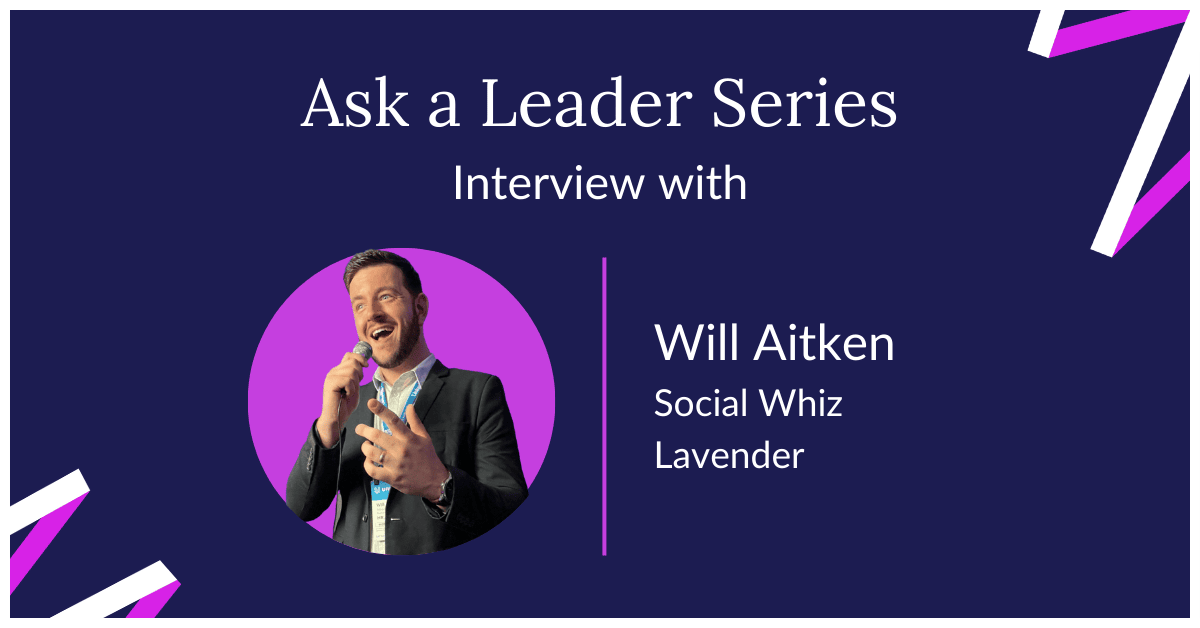
How do you sell ice to a Canadian in winter? According to Will Aitken from Lavender, you don’t. Instead, you ask questions to find out if they have a problem you can solve. This philosophy is the heart of modern selling. It’s about identifying a need, not pushing a product. Will is a true people whiz, and in our interview, he explains how to see buying signals and act on them. We also cover his biggest sales mistake and career advice he’d give his younger self.
1. How would you sell ice to a Canadian in winter?
My initial reaction is to not try to sell ice to a Canadian in winter as long as they have ice. I have an ethos, especially in B2B sales, that you shouldn’t sell to everyone. Not everyone is a fit. And really what you should be looking for is people who have a very specific set of problems that you could help solve.
Because if you try to sell to everyone, you go way too broad. Your messaging gets really wishy-washy. And ultimately, you won’t close sales. You’ll have more sales end in no decision because those people don’t have a compelling reason for change.
So for the most part, a lot of Canadians might not have a need for ice in the winter, because believe it or not, it’s really cold where I live and there’s a lot of ice around. Less now than there was a few years ago because of global warming, but let’s not get into that.
I would be specifically looking for a list of questions. I would be asking the questions to try and figure out if they really do have ice. Because I also don’t wanna just assume they’ve got it covered. Because let’s be honest, even if it is really cold in Canada, maybe they don’t wanna be eating ice from the street. Maybe their freezer is broken.
So I would be asking questions like, “Hey Canadian person,” let’s call you Zach, cause I know a Canadian called Zach. First of all, I try and get some context. “Do you even use ice at the moment? Do you use ice in your drinks? How are you currently using ice, if at all? Do you freeze your food? Do you include ice in your drinks?”
“Yes.”
“Okay, how are you currently doing that today?”
And you might go, “Well, I have a freezer.”
“Tell me more about that.”
“Well, typically with my freezer, I’ll put in some trays of water.”
And I’ll go, “Okay, interesting. So how often do you have to refill those trays?”
And what I’m starting to do by asking those questions is paint a picture of how they’re doing things today, and if they’re doing them well, and if I hear, “Oh, I’m using ice trays and I’m refilling them in the sink and putting them in my freezer every day,” well then that means I can say, “Okay, well what happens when you forget to fill the ice tray?”
“I don’t have any ice.”
“That must be frustrating. Tell me more about that.”
And I can start to create this gap, this problem that Zach wasn’t thinking about. And that’s that he forgets to sometimes refill the ice tray. His wife comes downstairs to make a nice glass of water. That creates tension in their relationship.
Cause she asked him to refill the ice tray. He didn’t. He forgot again. He said he would. And all of a sudden we’ve got this huge emotional gap that can be filled by my ice, my product, because of the questions I’m asking him. So I wouldn’t talk about the ice, basically. I would ask him about his use for ice, if he uses ice, and how he does that today. And then ideally find a problem.
If I didn’t find a problem, if I found that Zach has the best ice machine on the planet and his wife is so happy with how much ice is in their household and it’s never broken–great. That’s awesome. “I don’t suppose you would know anyone who maybe doesn’t have as good of an ice hookup as you, Zach?” and then I’d get a referral from them and actually find someone I could help.
2. What’s one of the worst responses you’ve gotten from a cold call?
The one that sticks with me was actually in America. I was calling sales leaders. So you’d imagine sales leaders typically would have a bit more empathy for a cold call, right? And I called this person, and sometimes when you’re calling you’re a little bit zoned out, maybe doing some notes in Salesforce or whatever it may be.
And I called someone, and they picked up the phone, and I was kinda like, “Oh, hey Jeff, how are you?” He was like, “Yeah, I’m good. Who’s this?” And I was like, “It’s Will Aitken here from Proposify (where I was working at the time). Just spotted that you’re currently hiring folks on LinkedIn. I’m curious, as your team grows, how are you avoiding this problem?”
And he went, “Sorry, is this a cold call?” I was like, “Yeah, it is. Yeah, sorry, my bad Jeff. Will Aitken from Proposify, it is a cold call.” He said, “Why are you pretending that you know me?” I’m like, “Excuse me?” He’s like, “Well, you said ‘how have you been,’ that suggests that we’ve spoken before.”
Even in my kind of surprised moment, I told myself that I’m pretty sure I didn’t say that. So I was like, “Oh, um, I’m not sure I did. I said, ‘How are you?’ Granted not the best opener, Jeff. I’m sure, you know, salesperson to salesperson–can we start again?” And he said, “No, no, no. You did pretend you knew me,” yada, yada yada. And he kind of gave me an education.
“So why don’t you lead with value?” He kind of gave me some coaching in a way, but it was from a very condescending, angry tone.
So anyway, we finished the call and I went back and listened to the call recording in Gong.
And sure enough, I had said, ‘How are you?’ I was right! And this is the problem when you let your ego get involved in sales. I kind of wanted to prove Jeff wrong because he had upset me. So then I sent Jeff the recording and said, “Hey, looks like we got misunderstood there, I went back and checked the call. I did actually say, ‘How are you?’ and I’m really hoping we could pick this back up, cause I’m certain we could help you in the x, y, and z areas.”
He replied and said, “You recorded my call without my permission. I’m in the state of California. It’s illegal here, and I’m gonna sue you and have you fired.” On LinkedIn, this whole message.
I was awake, I couldn’t sleep for a week. He reached out to my boss.
Ultimately he stopped caring. But, oh boy. That kept me up at night for a long while thinking I was gonna lose my job, be sued, all kinds of stuff. So yeah, that was the worst one.
3. What’s the biggest mistake you’ve made in sales?
The biggest mistakes I made in sales weren’t the sales that I lost, because there’s only one thing worse than losing a sale–it’s closing a sale and then losing it.
So I think the biggest mistake I’ve ever made in sales was selling someone who wasn’t a fit, who ended up canceling. And at that point, you’ve celebrated with your team, everyone Slacks you with congratulations and kudos and a little emoji saying, “You made a sale, good job!”
You’ve been paid the commission, or maybe you’re thinking about how you’re gonna spend that commission.
And then you hear from the customer success manager that things weren’t going as well as they’d hoped. And then they come back, they cancel because you can’t work it out, and your commission gets called back.
And then there’s a question mark over all the sales that you close in the future–Is this really a fit? Can we trust Will’s ability to put forward good-fit customers to the customer success team?
So I feel like those are the biggest mistakes that I’ve made in sales. And one does stick out cause it was the biggest sale in company history. And even though the customer was the one who initiated the sale, I should have just stopped, slowed down, and confirmed a few things, because it would’ve been better to disqualify the opportunity, figure out we weren’t a fit, and we couldn’t do what they thought we could do.
So my biggest mistake was that: closing a deal that shouldn’t have been closed, not asking enough questions, and really not confirming fit before I put them through.
4. What sales publications–other than Sales Feed–would you recommend?
I’ve gotten a lot of value just from following the right people on LinkedIn. Folks like Belal Batrawy, Jen Allen–Challenger–she has a great podcast as well. And a lot of that stems from these trainers who have this following around them.
But outside of that, Sales Hacker is a great resource. They do lots of webinars. They have a bit of community, they have a lot of written resources. JB Sales also, now rebranded as sellbetter.xyz. They do almost a webinar a day now, and those webinars have really good guests–sometimes myself, so, you know they’re good–and they’re on a wide variety of topics from sales development right through to negotiation and closing.
Outside of that, I’m always a big fan of self-learning. So looking for courses that catch my eye. But also reading books that are sales-focused and seeing how you apply it.
Consuming content is great, especially if you’re a creator, cause you need new ideas and perspectives to make sure you’re not becoming biased or out of touch. But also then actually taking it into a sales process and applying it, and then figuring out what works for you.
You don’t have to take everything you read or everything you hear from one person or one community as gospel. It’s really about finding what works best for your style of sales, because if you sell out or you start doing things that you don’t believe in, then you’re not really sold on the idea and you’re not really committed to it.
That’s where I think a lot of people get lost in sales, get burnt out, and ultimately become unhappy and fail in their careers.
5. If you had a time machine, what advice would you give yourself?
It’s kind of funny because most people who end up in sales end up there accidentally. I started in sales as soon as I finished university, cause I had no idea what I wanted to do, and that’s what led me here. And I’m really happy with where I’m at, so I wouldn’t really change that much about what I had done and the steps I’ve taken.
Now what I would tell myself to do differently is probably start creating or documenting my journey sooner. So being a content creator now on LinkedIn has opened up my entire life to the opportunity I work at now at Sales Feed, a lot of side income opportunities, and ultimately a hobby that I really enjoy, which is making and editing videos.
So I wish I had just told myself to do that sooner so I could actually be maybe even further ahead than where I am now. Because I could probably be three times as well known, and have done three times as many events and speaking opportunities and all that stuff. But at the same time, that’s probably a couple of years down the road for me now as well.
So I don’t have any regrets, but I would say start building that network, creating content, finding your voice, and connecting with people. Because I’ll tell you what, through creating content, I have met people who have given me way more value than if I had never spoken to them.
So I would say start reaching out to people, start having those conversations with people outside of your company. Cause your network is so powerful. If you were ever to be laid off or lose your job, then that security is massive. And you see this a lot, especially recently. There are a lot of tech layoffs, these folks losing their jobs, but because they know 10,000 people or have a following or are really good networkers, they’ve got stuff lined up already, and that gives you that security net.
So that’s what I probably recommend doing to myself sooner. Creating content, networking, and building a professional brand and network.
Check out VP of Sales Kyle Parrish’s interview for more expert tips and advice from our Ask a Leader series.
Frequently Asked Questions
What is a “sales feed”?
The term can be confusing because it has two common meanings. It can refer to a publication like a blog or online magazine that offers sales tips and news. It can also describe a technology platform that gives you a live “feed” of sales activity, such as identifying which companies are visiting your website. The first helps you learn, while the second helps you find active prospects.
How do website visitor identification tools work?
These tools place a small piece of code on your website. When someone visits, the code identifies their IP address and matches it to a database of companies. This turns anonymous website traffic into a list of potential leads. Instead of waiting for someone to fill out a form, your sales team gets an alert that a specific company is showing interest, allowing for timely and relevant outreach.
What’s the difference between Mixmax and tools like Salesloft?
The main difference is where the work happens. Salesloft is a separate web application that reps log into to manage their tasks. It has a plugin that adds features to your inbox, but the core platform is outside of it. Mixmax is built to work directly inside Gmail, meaning reps never have to switch applications to build sequences, schedule meetings, or track engagement. This inbox-native design leads to much higher adoption.
Why are integrations so important for sales tools?
Integrations are what make a sales tool truly useful. A tool that operates in a silo creates more manual work for your team. When a platform connects with your CRM (like Salesforce or HubSpot) and your inbox, data flows automatically. This keeps your records accurate without manual entry and allows reps to act on insights immediately, all from within their existing workflow.
How can AI actually help a sales team?
Instead of vague promises, practical AI helps reps focus on what matters. For example, AI-powered workflows can analyze engagement signals like email opens and clicks to surface the highest-priority accounts that need attention. This tells reps exactly what to do next, right in their inbox. It removes the guesswork and administrative work, freeing up more time for reps to sell.